

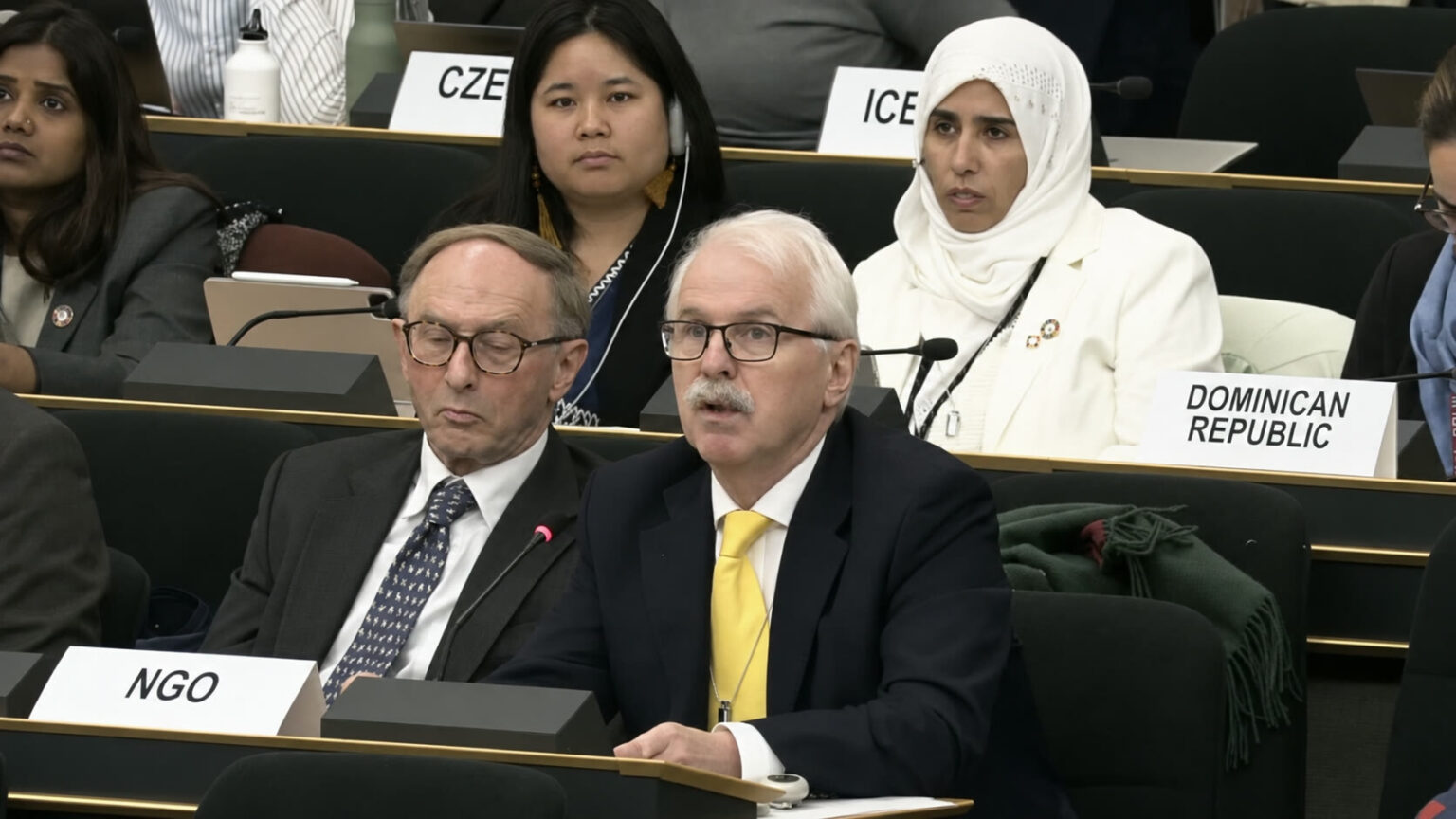
At the 19th UN Forum on Minority Issues, IARF President Robert Ince encouraged the North Macedonian authorities to open a dialogue with the Bektashi Community, an IARF member community, and to consult it before approving any restoration of its historic seat, the Harabati Baba Tekke in Tetovo. He also recommended that regional human rights systems keep monitoring how a minority community fares once its court case has been closed.
He spoke on 26 November at the Palais des Nations in Geneva, in the panel on regional frameworks, mechanisms and initiatives to advance minority rights.
The statement

Thank you, Chair.
In 2013 we told this Forum that our member, the Bektashi Community, a Sufi minority in North Macedonia, had been denied legal recognition.
In 2018 the European Court of Human Rights found that that refusal violated the community’s freedom of association. Going to a regional court worked. In 2024 the community regained its legal status, and the case was closed.
Legal status matters, because a community can then act and speak in its own name. The Bektashi Community needs that now for a question the Court was not asked to decide. Its historic seat, the Harabati Baba Tekke in Tetovo, is still in dispute.
But two other parts of the regional framework can help.
First, the OSCE commitment to promote dialogue between government and religious communities, including on the use of places of worship. We encourage the North Macedonian authorities to open that dialogue with the Bektashi Community, on equal footing with other religious communities, and to consult with it before approving any restoration of the tekke, a protected monument.
Second, the monitoring bodies. We recommend that regional systems follow up litigation with monitoring: when a case concerning a minority community is closed and supervision ends, the monitoring bodies are told what is left open, and continue to report on how the community fares.
Thank you.
Background
The Bektashi Community, based in Tetovo, has been an IARF member community since 2012. IARF raised its situation at the Forum in 2013, in a statement delivered by Arben Sulejmani, who leads the community. Read the 2013 statement (PDF, 2 pages) and IARF’s other statements at that session.
The European Court of Human Rights ruled in 2018 that the refusal to register the community violated its freedom of association, read in the light of freedom of religion. The community regained its legal status in 2024, and in December that year the Council of Europe’s Committee of Ministers closed its supervision of the judgment. Read the Court’s judgment and the Committee’s final resolution.
Robert Ince visited the tekke this autumn, during a trip to North Macedonia, Kosovo and Albania. The trip was also part of the preparations for the 2027 World Congress, which the Bektashi World Headquarters will host in Tirana. Read about his visit.
The first recommendation rests on a commitment that North Macedonia and the other OSCE participating States made in 2013: to promote dialogue between religious or belief communities and government bodies, “including, where necessary, on issues related to the use of places of worship and religious property” (OSCE Ministerial Council Decision No. 3/13). The second builds on an offer by the UN Special Rapporteur on minority issues, Nicolas Levrat, to work with regional mechanisms on “better collective tools” for protecting minorities (his 2026 report to the General Assembly, para. 71).