International Association
for Religious Freedom
Bringing together free and liberal religious communities and advocating for human rights since 1900
News and updates from the IARF, by the IARF and community members.
A curated selection of news from our Member Organisations and Chapters around the world.
This article explores the relevance of the 15th-century theologian Nicolaas Cusanus to modern liberal thinking. It focuses on his concept of ‘learned ignorance,’ which suggests that since God transcends human logic and contradictions, dialogue between different perspectives is essential for spiritual growth.
The author examines the ‘lonely funeral’ initiative, where poets honor those who die with no one to mourn them. Connecting this to the Lenten season, the piece encourages spiritual reflection and a ‘digital detox’ to foster compassion and solidarity.
A recent study day for ministers and spiritual caregivers from various liberal religious denominations demonstrated that liberal religion remains vibrant and energetic. Participants shared creative initiatives such as podcasts, magazines, and new community growth strategies. Despite the general decline in church attendance, the event highlighted a strong commitment to finding new ways to express faith and social engagement.
Unitarian Universalist Association President Rev. Dr. Sofia Betancourt was arrested by Capitol Police in Washington, D.C., during a protest against the Department of Homeland Security’s budget. The demonstration, which included several hundred faith leaders, targeted federal funding for ICE and Customs and Border Patrol, emphasizing a moral obligation to oppose the dehumanization of neighbors.
In this article, Pastor Klaas Douwes uses the belladonna plant as a metaphor for liberal theology (vrijzinnigheid). He explains that just as the plant can be both a medicine and a deadly poison depending on the dosage, liberal faith offers an antidote to dogmatic rigidity but risks becoming listless and ‘suffocating’ if it lacks conviction or becomes too diluted by tolerance. He concludes that while liberalism is inherently risky due to its embrace of doubt, it remains essential for the vitality of Christianity and society.
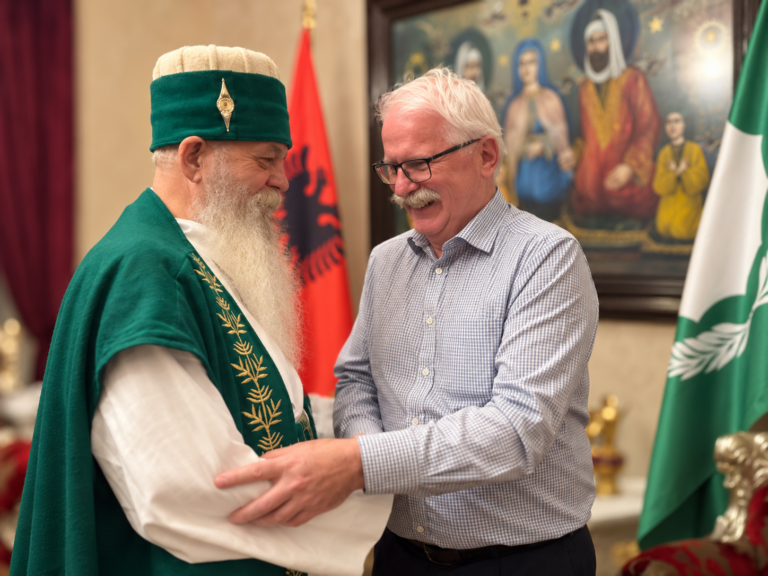
World Grand Father Edmond Brahimaj issued a message marking the 96th anniversary of the establishment of the Bektashi World Headquarters in Albania. The message honors the 1930 decision by Sali Njazi Dede to move the seat to Tirana following persecution in Turkey, highlighting the institution’s role in preserving Bektashi traditions and promoting values of love, tolerance, and national identity.
Pastor Karl van Klaveren reflects on the historical unity of philosophy and theology, suggesting that labels often obscure the universal nature of wisdom. He argues for an interconnected worldview that sees all humanity as the image of God, transcending traditional religious and social boundaries.
Reflecting on the new year, Antje van der Hoek discusses the importance of trust as the ‘invisible cement’ of society. She contrasts biblical perspectives on hope and repetition, ultimately suggesting that faith communities can help people draw from a spiritual source of trust during times of political and social instability.
Unitarian Universalists in Minneapolis are responding with protests and mutual aid following the fatal shooting of Renee Nicole Good, a mother of three, by an ICE agent. Local ministers emphasize the moral compulsion to protect neighbors and provide support amidst heavy federal police presence and community upheaval.
Professor Ulrich Schmiedel will deliver a lecture in Utrecht on how liberal theology and religion influence the discourse surrounding European borders and migration ethics. The event includes a study afternoon featuring theologians and activists to discuss the role of public theology in the current migration crisis.
The Hungarian Unitarian Church held celebrations in Torda and Kolozsvár to mark the 458th anniversary of the Edict of Torda, the first law to establish religious freedom. The events included ecumenical messages, the presentation of the János Zsigmond Award to Mihály Balázs, and the announcement of 2026 as a special memorial year.
Haxhi Dede Baba Edmond Brahimaj, the World Leader of the Bektashi, was elected as the Chairman of the Presidency Board of the Interreligious Council of Albania for 2026. During the council’s first meeting of the year, members approved a 2026-2028 strategic plan focused on strengthening interfaith dialogue, promoting peaceful coexistence, and increasing the social involvement of youth and women.
A curated collection of current stories about religious freedom and human rights.
The Freedom of Thought Report is a global survey published by Humanists International that monitors discrimination and persecution against humanists, atheists, and the non-religious. The website provides country-specific ratings, interactive maps, and a comprehensive database of legal and social conditions for the non-religious worldwide.
The Humanist Society Scotland (HSS) claims that mandatory religious observance in Scottish schools violates children’s human rights. An audit of 280 schools found that most sessions involve Christian worship led by clergy, despite the majority of pupils having no religious belief. HSS is urging the Scottish Government to allow pupils to opt out of these activities to avoid potential legal action.
New legislative initiatives in the Russian State Duma seek to ban religious services and ceremonies in residential buildings. While aimed at restricting Muslim migrants, the laws would significantly impact Protestant groups and other minority faiths that rely on home-based worship. Religious leaders and human rights organizations argue the bill is unconstitutional and would drive religious activities underground.
Antisemitism incidents in the UK reached record daily highs following a fatal terror attack on a Manchester synagogue in October 2025. The Community Security Trust (CST) reported 3,700 incidents throughout the year, marking a 4% increase from 2024. The data highlights a persistent rise in anti-Jewish hate, including a record number of incidents involving property damage and desecration.
The French Ministry of the Interior reported 2,489 anti-religious acts in 2025, a level stable compared to the previous year. Antisemitic acts remain disproportionately high, accounting for over half of all incidents, while anti-Muslim acts saw a 88% spike. The data reflects a context of heightened tensions following the October 7 attacks in Israel.
Rector Chems-Eddine Hafiz of the Grand Mosque of Paris has introduced a new guide and the “Paris Charter” to prove that Islamic values are fully compatible with French laws. The publication serves as a “roadmap” for both Muslims and non-Muslims to navigate religious practices in secular contexts. Hafiz expressed a commitment to open dialogue on sensitive topics like blasphemy and the veil to help repair the fractured social fabric and emphasize national belonging.
A coalition of multi-faith organizations has filed a lawsuit against the Trump-Vance administration’s Religious Liberty Commission, alleging violations of the Federal Advisory Committee Act. The lawsuit claims the commission lacks religious diversity, consists almost exclusively of Christian members, and promotes a narrow ‘Judeo-Christian’ agenda consistent with Christian Nationalism. The plaintiffs are seeking a court order to declare the commission’s formation unlawful and require public disclosure of its records.
The Cato Institute announced the release of a new book edited by Mustafa Akyol titled ‘No Compulsion in Religion—No Exceptions.’ The volume features essays from global Muslim scholars arguing that religious freedom is an authentic Islamic ideal rooted in the Qur’an rather than a Western import. The book challenges coercive legal traditions regarding apostasy, blasphemy, and ritual observance, arguing that such interpretations often serve authoritarian political power rather than faith.
Interfaith Alliance has denounced the ‘Greater Than’ campaign, an anti-LGBTQ+ initiative seeking to overturn marriage equality. Rev. Paul Brandeis Raushenbush characterized the campaign as an attack on religious freedom and human dignity, asserting that a majority of religious Americans support the right to marry.
India’s Supreme Court has agreed to review the constitutional validity of anti-religious conversion laws enacted by 12 states. The petitioner, the National Council of Churches in India (NCCI), argued these laws incentivize vigilante violence against minorities. The Solicitor General, representing the Centre, stated the government has responses and contested the petitioner’s claims. The court referenced past judgments concerning Article 25 of the Constitution, which guarantees freedom of conscience and the right to propagate religion, but not the right to convert others.
Russian police and military officers raided Council of Churches Baptists’ Sunday worship in Krasnodon on January 25th, threatening to stop all future services if the church does not register with Russian authorities. This is part of a pattern of raids on religious meetings (Baptist and Muslim) in Russian-occupied Donetsk and Luhansk Regions between July and December 2025, often resulting in fines for “missionary activity.” Council of Churches Baptists intentionally avoid official registration. The article details specific raids, interrogations, and legal proceedings against pastors, highlighting the Russian occupation authorities’ severe violations of freedom of religion or belief, despite calls from the UN to respect these freedoms.
Armenia’s Prime Minister Nikol Pashinyan initiated a reform of the Armenian Apostolic Church, seeking to remove Catholicos Garegin II and establish a state-led Coordinating Council. The government justifies this by accusing the Church leadership of involvement in politics, referencing the Church’s criticism of the government following the Nagorno-Karabakh defeat. The article argues this justification is legally untenable, as Armenian and international law permit religious institutions to engage in political discourse without violating the separation of Church and State principles. A secondary government narrative links some clergy to Russian intelligence (‘KGB agents’), which the author disputes given the Armenian Church’s unique, largely Western-educated, and historically independent ecclesiastical structure. Finally, the PM has publicly accused clergy of moral failings (adultery, violating celibacy), which the author contends fall under the Church’s internal, canonical jurisdiction, not the State’s purview, noting the suspicious timing of leaked private footage.
Displaying times in .... You can view events in their local time or choose any timezone.
Share this event via the following platforms or copy the link.
You must be signed in to the IARF Network to join this session.
If you do not have an account, please sign up.
Registration to the IARF Network is free for members of our Member Organisations and Chapters.
If your religious community or organisation is not a member, you can support our work by becoming an individual member.