
When Wealth Fences in the Sacred
On 5 March, the International Association for Religious Freedom (IARF) addressed the UN Human Rights Council to highlight a structural failure in many jurisdictions where private property and quiet enjoyment rights are not balanced against the rights of indigenous communities to practice their faith and honor their deceased.
The situation is starkly illustrated by the Kāneʻākī Heiau in Hawaiʻi—a 600-year-old Native Hawaiian temple currently enclosed within a private residential development. Among those affected is Prof. George Williams, a past President of the IARF who was adopted into the Kanenuiakea faith. We share his complete submission below.
When Wealth Fences in the Sacred
On a steep hillside on Oʻahu, overlooking the Waianae coast, a small but growing controversy is drawing international attention from advocates of religious freedom.
Within a gated luxury development lies an ancient Native Hawaiian healing Heiau—a temple site traditionally associated with medicine and spiritual restoration—along with ancestral burial grounds protected under state preservation laws.


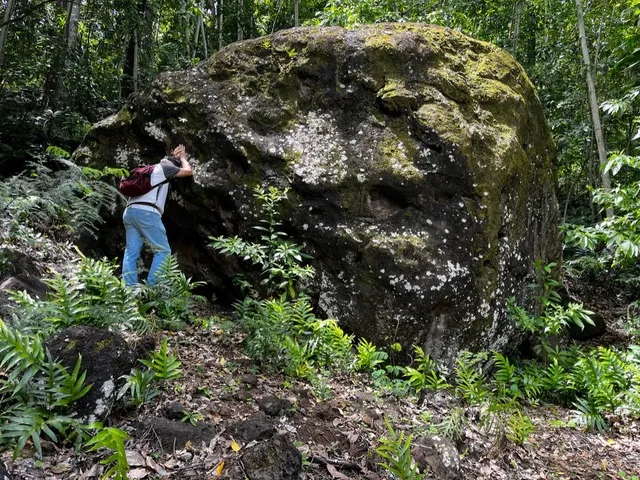


Community members and religious freedom advocates say access to the sacred site has been effectively restricted by the homeowners’ association (HOA) that now controls the surrounding land.
The dispute began years ago when the rocky hillside was developed into a high-end residential enclave. Legal agreements transferring community land to HOA control included provisions requiring maintenance of the Heiau and continued public access.
But as property values rose, the HOA tightened security. While Wai’anae is cited as having one of the lowest median household incomes in all of Hawai’i — and the highest Native Hawaiian population in the world, the gated neighborhood of 46 households enclosing Kaneʻaki Heiau, has the highest income in Hawai’i according to census data.
And after its gate was installed, visitors could be turned away. Some Native “practitioners” (a term used to avoid ridicule) say they were warned they could face arrest for trespassing if they attempted to reach the Heiau for prayer or ceremony.
For many Indigenous Hawaiians, sacred space is inseparable from the land itself. Unlike traditions centered inside religious buildings, Native Hawaiian spirituality takes place in natural settings—mountains, shorelines, burial grounds, and temple platforms built of stone.
“When access is blocked, worship is blocked,” said one advocate involved in the dispute. And at Kaneʻaki Heiau, even if access were to be allowed, it had to be supervised by the HOA!
The conflict has now drawn the attention of the International Association for Religious Freedom (IARF), one of the world’s oldest interfaith organizations. Leaders within the association have approved filing an Amicus Curiae brief stressing U.S. Constitutional and International guarantees of freedom to worship.
IARF has historically defended minority faith communities around the world. Supporters say this case reflects a pattern in American history in which Indigenous religions have been marginalized or dismissed.
Native spiritual practices were criminalized in parts of the United States until the late 19th and early 20th centuries. Although federal laws now recognize Indigenous religious rights, enforcement often depends on local conditions and legal interpretation.
“This isn’t only about one Hawaiian hillside,” said an interfaith leader familiar with the matter. “It’s about whether religious freedom includes traditions rooted in land and nature rather than inside of churches, mosques, or synagogues.”
Interestingly, the legal challenge has been propelled in part by a successful couple who purchased a home with the right of access through the HOA’s gate. But soon they faced harassment on what seems racial and social grounds. They refused to leave. Instead, they pressed for enforcement of the original access obligations. They were joined by Indigenous Hawaiians and those who were denied access to worship or visit their healing shrine or ancestors’ graves.
Observers say the case could set an important precedent for how homeowners’ associations interact with sacred and archaeological sites nationwide. At its heart, the dispute raises profound legal questions: Does ownership of surrounding land allow a private association or corporation to restrict access to a sacred site protected by law? Can communal burial grounds be effectively privatized by encirclement? Do property rights supersede the cultural and religious rights of Indigenous peoples whose sacred spaces do not resemble conventional religious buildings?
For interfaith groups, the answer carries broader implications. Religious freedom, they argue, must apply not only to majority traditions with visible institutions, but also to Indigenous communities whose sanctuaries are woven from the earth itself.
In Hawaiʻi, where land is more than property and history more than a footnote, this small hillside may become a symbol of something much larger—the effort to reconcile property and religious rights, ownership with reverence.
Please consider signing a petition in support of religious freedom.
Protecting Ancestral Heritage: IARF Addresses the UN on Indigenous Burial Rights on Private Land
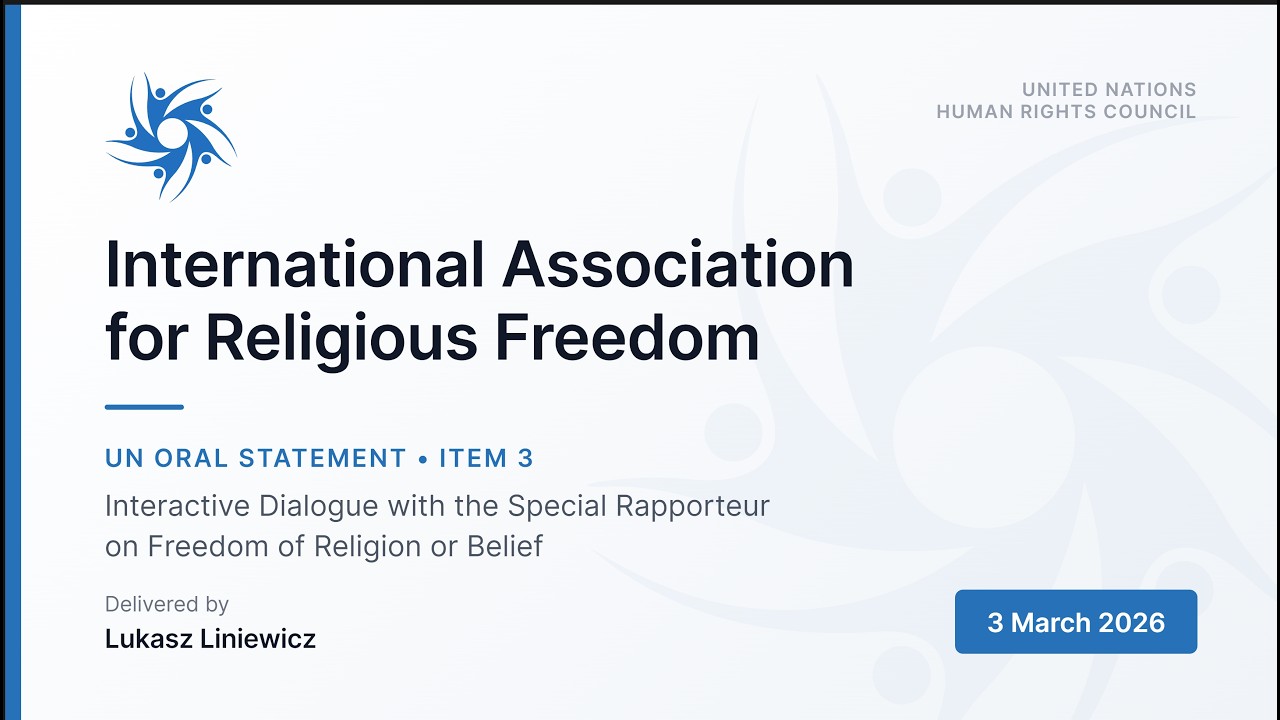
March 5, 2026 — During the ongoing session of the UN Human Rights Council, the International Association for Religious Freedom (IARF) took the floor to address a critical but often overlooked intersection of human rights: the right of Indigenous Peoples to access and care for their ancestral burial sites when those sites are located on privately owned land.
The statement was delivered during the Interactive Dialogue with Dr. Nazila Ghanea, the UN Special Rapporteur on Freedom of Religion or Belief, responding to her latest report on how freedom of religion or belief relates to death and honouring the deceased.
Watch the Oral Statement
The Regulatory Gap: Private Property vs. Sacred Duties
While many States have established protections for sacred and burial sites, these frameworks frequently suffer from a significant blind spot. Protections are often conditioned on government action or apply strictly to publicly managed lands.
When ancestral lands and burial sites fall into private hands or under private residential governance, Indigenous communities are frequently severed from their heritage. Without national frameworks extending to private property, communities are left without legal recourse to fulfill their religious and cultural duties to their ancestors.
Grounding the Issue: Kāneʻākī Heiau in Hawaiʻi
To illustrate the profound impact of this regulatory gap, IARF highlighted the situation at the Kāneʻākī Heiau site in Mākaha, Hawaiʻi. Here, Native Hawaiian practitioners face immense barriers—enforced by private residential governance—when seeking to access and care for their iwi kūpuna (ancestral remains).
This is not an isolated incident. The full scale of this problem remains largely undocumented globally, leaving many Indigenous communities silently cut off from their most sacred sites.
IARF’s Call to Action
In our statement to the Human Rights Council, the IARF urged States to take the following crucial steps:
- Conduct Systematic Assessments: States must actively document sacred and burial sites affected by private land governance.
- Develop Effective Frameworks: We need concrete legislative and policy solutions that balance private property rights with the fundamental human right to manifest religion and care for the deceased.
We look forward to continuing this vital conversation with the Special Rapporteur and UN Member States to ensure that honoring the deceased is a right guaranteed to all, regardless of modern property lines.
Full Transcript of the Oral Statement
Interactive Dialogue with the Special Rapporteur on Freedom of Religion or Belief 3 March 2026
“Mr. President,
The International Association for Religious Freedom welcomes Special Rapporteur Ghanea’s report on freedom of religion and honouring the deceased. We particularly appreciate paragraph four, which highlights the barriers Indigenous Peoples face in accessing burial lands to honour their ancestors.
In many States, protections for burial sites are conditioned on government action or apply only to publicly managed lands. This leaves a significant regulatory gap when such sites fall within privately owned or governed land. Without national frameworks extending to these contexts, private property mechanisms can effectively sever Indigenous communities from their ancestral heritage.
As an illustrative example, at the Kāneʻākī Heiau site in Hawaiʻi, Native Hawaiian practitioners face profound barriers—enforced by private residential governance—when seeking to access and care for their iwi kūpuna, their ancestral remains.
We note that the full scale of this problem remains largely undocumented, and we encourage States to undertake systematic assessments of sacred and burial sites affected by private land governance, as a necessary first step toward effective frameworks that balance property rights with the fundamental right to manifest religion and care for the deceased.
Special Rapporteur, what concrete legislative or policy best practices have proven effective in enabling States to reconcile private land governance with the protection of Indigenous Peoples’ rights to access and care for sacred and burial sites?
Thank you.”
Further Reading:
- Read the Special Rapporteur’s full report (A/HRC/61/50)
Update from the US Chapter: Concerns Raised Over New “Religious Liberty Commission”
Our colleagues in the United States have shared a significant update regarding the current climate of religious freedom in their region. In a recent communication to members, the US Chapter raised serious concerns regarding the Administration’s establishment of a “Religious Liberty Commission” within the Department of Justice.
US Chapter President George Garland has alerted members to what the Board views as a troubling development, noting that the new commission appears to prioritize specific conservative religious interests in a way that conflicts with federal law. The Chapter stresses the importance of maintaining a clear separation of church and state to protect the rights of all faith communities.
In response, the IARF-US President and Board have formally endorsed a lawsuit filed by the Interfaith Alliance and a diverse coalition of partners, including Muslims For Progressive Values and Hindus For Human Rights. The legal challenge asserts that the commission was unlawfully constituted and seeks to ensure transparency regarding its recommendations.
The US Chapter is currently encouraging its members to contact their representatives in Congress to address the matter.
For the full statement from President Garland and further details on the coalition’s legal action, please visit the US Chapter website.
Read the full update at iarfus.org
From the ICCGC-CoNGO Confernece
The CoNGO-ICCGC Global Futures Conference, held on August 26 and 27, 2024, at the Church Center for the United Nations in New York, marked a significant assembly at the nexus of religion and civil society, dedicated to charting pathways toward a globally harmonious, just, peaceable, and sustainable future for people and their communities, the planet, and the entire ecological system.
The New York Conference partnered with the Interfaith Coalition Conference for Global Citizens (ICCGC) and the Conference of NGOs in Consultative Relationship with the United Nations (CoNGO) to collectively pursue peace, human security, dignity, and planetary sustainability. This collaboration emphasized local and global cooperation and solidarity across cultures and religions, while remaining mindful of diverse and uneven economic, social, and political conditions.
This conference aimed at igniting transformative dialogues and initiatives on a range of issues that are pressing both locally and globally. (Excerpt from Concept Note prepared by ICCGC)
This conference was hosted by Interfaith Coalition Conference for Global Citizens (ICCGC), Conference of NGOs in Consultative Relationship with the United Nations (CoNGO), and Won Buddhism. There were five sessions: Session 1. Global Ethics & Global Citizens, Session 2. Towards a Global Peace, Session 3. Dialogue between Religions and Civil Society, Session 4. Youth for Climate Action, and Session 5. Global Citizenship Education for Future Generation.
The moderator of Session 5. Global Citizenship Education for Future Generation was Kathy R. Matsui, one of the New York UN representatives of IARF. Global Citizenship education encourages global citizens to be independent, to develop global perspectives, to build harmony among people from other countries and ethnic groups, to understand diversity through cross-cultural education, to respect the Earth and all living beings, and to promote global well-being while enriching their lives. The four panelists discussed the following: how global citizenship is practiced in real life, what GCED is to the individual panelists, how GCED is implemented in their specific role and environment, and what message each panelist has for the youth and our future leaders. Furthermore, session 5 focused on the principles, values and criteria needed to practice global citizenship education. Having learned from the past, with the advancement of science and technology, the panelists further discussed what is our mission to appreciate and put to practice an education that would enhance the creativity and innovative values of the future generation, a generation that can think in terms of what can be done for the benefit of all, what can be done to protect and respect the life and dignity of all living beings.
The first speaker of the four panelists of this session was Dr. Robert Catalano, presently a professor at Sophia University close to Florence, Italy. He has also served as Director of center for interreligious dialogue of the Focalare for 13 years. The second speaker was Dr. Janet Gerson, Education Director of the International Institute on Peace Education. She is also Co-Director Emeritus, Peace Education Center, Teachers College, Columbia University, NYC.
The 3rd speaker was Professor Russell Pearce, the Edward & Marilyn Bellet Chair in Legal Ethics, Morality and Religion at Fordham University School of Law. Our final speaker was Rev. James A. Lynch, Jr., a Reverend authorized by the lay Buddhist Organization Rissho Kosei Kai. He is also an official representative for Rissho Kosei Kai to the United Nations.
The session ended as the panelists and the participants danced along with the song the final speaker, Rev. Lynch played in his presentation, a song by Cat Stevens.
Session 5 has fulfilled our collaborative pursuit of an education that prepares global citizens to practice collective peace and human security, human dignity, and planetary sustainability, and local and global cooperation and solidarity, across cultures and religions, and mindful of uneven and diverse economic, social and political conditions.
Global Citizens Pursuing a Just, Peaceable, Inclusive and Sustainable Future: An ICCGC-CoNGO Collaborative Conference
The CoNGO-ICCGC Global Futures Conference, scheduled for August 26 and 27, 2024, at the Church Center for the United Nations in New York, marks a significant assembly at the nexus of religion and civil society, dedicated to charting pathways toward a globally harmonious, just, peaceable, and sustainable future for people and their communities, the planet, and the entire ecological system.
The New York Conference partners with the Interfaith Coalition Conference for Global Citizens (ICCGC) and the Conference of NGOs in Consultative Relationship with the United Nations (CoNGO) to collectively pursue peace, human security, dignity, and planetary sustainability. This collaboration emphasizes local and global cooperation and solidarity across cultures and religions, while remaining mindful of diverse and uneven economic, social, and political conditions.
This conference aims to ignite transformative dialogues and initiatives on a range of issues that are pressing both locally and globally. (Excerpt from Concept Note prepared by ICCGC)
This conference is hosted by Interfaith Coalition Conference for Global Citizens (ICCGC), Conference of NGOs in Consultative Relationship with the United Nations (CoNGO), and Won Buddhism. There are five sessions:
- Session 1. Global Ethics & Global Citizens
- Session 2. Towards a Global Peace
- Session 3. Dialogue between Religions and Civil Society
- Session 4. Youth for Climate Action
- Session 5. Global Citizenship Education for Future Generation
The moderator of Session 5. Global Citizenship Education for Future Generation is Kathy R. Matsui, one of the New York UN representatives of IARF. Global citizenship education (GCED) is needed to face the challenges of the 21st Century and the challenges of the VUCA world, which is volatile, uncertain, complex, and ambiguous. Global Citizenship education encourages global citizens to be independent, to develop global perspectives, to build harmony among people from other countries and ethnic groups, to understand diversity through cross-cultural education, to respect the Earth and all living beings, and to promote global well-being while enriching their lives.
Global citizenship education offers opportunities for youth and adults to learn to create imaginative solutions to world problems, to help solve diverse global issues, and to become active citizens to make changes in society for the good of everyone. In this session, panelists will discuss the following: how global citizenship is practiced in real life, what GCED is to the individual panelists, how GCED is implemented in their specific role and environment, and what message each panelist has for the youth and our future leaders.
The speakers of this session are:
- Panelist 1: Dr. Roberto Catalano (Professor, Sophia University Institute, Italy)
- Panelist 2: Dr. Janet Gerson (Education Director, International Institute on Peace Education)
- Panelist 3: Dr. Russell Pearce (Professor, Fordham University)
- Panelist 4: Rev. James Lynch (Representative for Rissho Kosei Kai to United Nations)
Access to Worship at Native Hawaiian Shrine Denied
Upon returning to Hawai’i, I intended to worship at the Kanenuiakea healing shrine, Kane’aki Heiau, as per my custom according to my multiple faiths. However, access was denied, as it is now restricted to members of Mauna ‘Olu Estates. It is reported that no Hawaiian owners reside there.
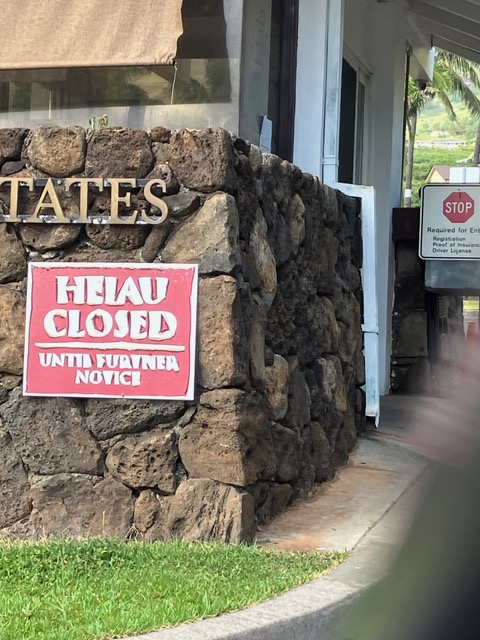
Access to Worship at Kahe’aki Heiau Denied
–Until Further Notice!
While the United States protects property rights, it does not recognize indigenous communal property, particularly places of worship that lack legal status under U.S. law. Kane’aki Heiau, a sacred temple and shrine, was first surrounded by a homeowners’ association and then claimed by it. The association now benefits from a tax deduction for preserving historic cultural property. Despite this, Hawaiians’ right to access is denied and enforced by State of Hawaii property rights law.
While the United States protects property rights, it does not recognize indigenous communal property, particularly places of worship that lack legal status under U.S. law. Kane’aki Heiau, a sacred temple and shrine, was first surrounded by a homeowners’ association and then claimed by it. The association now benefits from a tax deduction for preserving historic cultural property. Despite this, Hawaiians’ right to access is denied and enforced by State of Hawaii property rights law.
The International Association for Religious Freedom (IARF) and Religions for Peace are investigating how to effectively protest this apparent violation of U.S. and State of Hawaii constitutional rights regarding freedom of religion. Historically, the U.S. Supreme Court has interpreted freedom of religion as belief but not worship. Will colonial attitudes against indigenous worship change to support the religious freedom to pray at an acknowledged ancient temple?
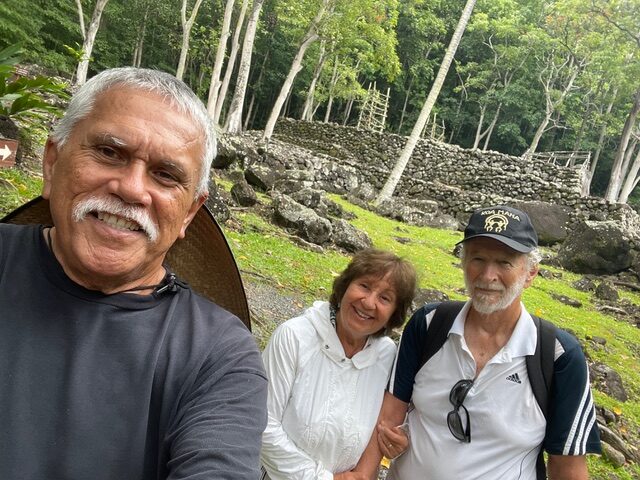
Kumu Glen Kila, George and Zizi at Kane’aki Heiau 2 years ago after climbing over locked gates. Kumu Glen is the Kahuna-nui, High Priest of Kanenuiakea, a faith with a thousand year history just on the Waianae Wahipana (west coast of Oahu).
IARF-US Launches Monthly Discussion Series
The US Chapter of the International Association for Religious Freedom is excited to announce a new monthly discussion series. On the third Wednesday of each month between April and December 2024, presenters will share their personal global spiritualities or alternately provide suggestions for how to support the United Nations’ Sustainable Development Goals (SDG)—an essential element for maintaining humanity’s spiritual freedom.
The one-hour sessions will begin at 4pm (PDT) on the designated dates, and attendees are welcome to listen or participate in the discussions following each presentation.
April 17
4:00 PM PDT (UTC-7)
John Young describes his daily and weekly spirituality practices drawn from many of the world’s major religions.
May 15
4:00 PM PDT (UTC-7)
George Garland talks about the role of the US Commission on Religious Freedom.
June 19
4:00 PM PDT (UTC-7)
Professor Kunihito Terasawa discusses his combined practices of Rissho Kosei Kai Buddhism and Evangelical Lutheranism.
July 19
4:00 PM PDT (UTC-7)
George Garland addresses the Sustainable Development Goals (SDG) and Planetary Boundaries – A Safe Space for Spirituality.
August 21
4:00 PM PDT (UTC-7)
Rahul Young discusses SDG #7: Affordable and Clean Energy – Electrifying America.
September 18
4:00 PM PDT (UTC-7)
Stephen Schwichow describes how he combines his Buddhist practices with his UU membership.
October 16
4:00 PM PDT (UTC-7)
Leela Stake addresses SDG #5: Gender Equality.
November 20
4:00 PM PDT (UTC-7)
Betsy Darr shares her experience of being a UU Pagan.
December 18
4:00 PM PDT (UTC-7)
John Young discusses how indigenous spiritual traditions can participate in inter-religious dialogue.
Attendees will have the opportunity to learn from speakers with varied backgrounds and experiences, fostering a rich dialogue on the intersection of spirituality and global sustainability.
To participate in this engaging series, individuals can request the Zoom link by emailing Rev. John Young at [email protected]. You can also contact Rev. Young on our Community Platform.
Recent Supreme Court Cases in the U.S. Interpreting Religious Freedom
This will be the first IARF Congress that my congregation and I participate in. I’m the current president of the board of directors for the Free Congregation of Sauk County, Wisconsin, which is the last surviving Freie Gemeinde of a hundred or so established by German immigrants to the U.S. between 1850 and 1950.
My goal in attending the Congress is to broaden my understanding — beyond my parochial and limited view of the world – of religious issues faced by other countries and institutions and people.
Preparing for the Congress has caused me to reflect on an aspect of “religious freedom” in the U.S. which may interest other attendees. The topic is how the concept of religious freedom is being used in the U.S. to permit persons to discriminate against others, especially in providing services.
Religious freedom is an issue of great current importance in the U.S. It has reached the point where two opposing sides interpret the phrase itself to have very different meanings.
On one side are those who ground religious freedom in the language of the First Amendment to our Constitution, that religion shall be free from direct state interference. The exact language is “Congress shall make no law respecting an establishment of religion, or prohibiting the free exercise thereof ….” On that same side are those who also point to the language of Thomas Jefferson in a letter to a congregation, when he wrote “I contemplate with sovereign reverence that act of the whole Amerian people which declared that their legislature should ‘make no law respecting an establishment of religion, or prohibiting the free exercise thereof’, thus building a wall of separation between Church and State.”
This widely-quoted view of the separation of church and state is not included in any law or official document, and it is challenged by those who stress the predominantly Protestant Christian background of the early American leaders. To this group, “religious freedom” primarily means the freedom to practice one’s (Christian) religion even when it conflicts with other societal values, and a vocal minority seeks to make the U.S. a Christian nation.
This short article attempts neither to give an exhaustive history of the struggles in the U.S. over more than two centuries, nor to detail the complexities and subtleties of the three relatively recent court decisions that currently define the outlines of the conflict, but only to introduce them to the attendees at this Congress, so they might become part of our discussion.
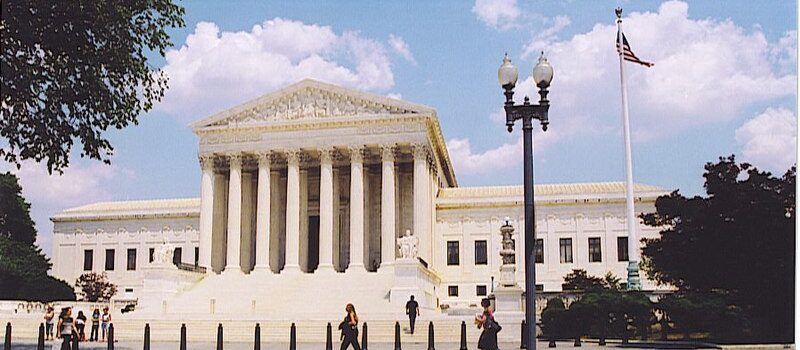
The U.S. operates with three branches of government: legislative, executive, and judiciary. Our national legislature is the Congress consisting of the Senate and the House of Representatives. Our national executive is the President and all the associated departments and agencies. Our national judiciary is the federal court system headed by the Supreme Court. All three branches can take actions (such as legislation, regulations, and decisions) that have the effect of law. Not infrequently, one law will be seen as conflicting with another law, or one right, such as freedom of religion, will be seen as conflicting with another right, such as freedom of speech. Over the past decade, the Supreme Court has issued decisions in three prominent cases interpreting religious freedom in ways that permit certain forms of discrimination:
- The Wedding Cake Case
In this case, a baker in the state of Colorado refused to create a wedding cake for a same-sex couple based on his religious objection to same-sex marriage. The Supreme Court ruled that requiring the baker to provide services to a same-sex couple would violate his right the the free exercise of his religion. Masterpiece Cakeshop v. Colorado Civil Rights Commission (2018). - The Hobby Store Case
The Supreme Court ruled that the employer (a “closely-held corporation” in which the corporation’s stock is held by a small number of investors, often family members) could refuse to provide its employees with a normally-required health care benefit (contraceptive coverage) if it conflicted with the religious views of its owners. Burwell v. Hobby Lobby (2014). - The Foster Care Case
The Supreme Court decided that a Catholic foster-care agency could refuse to work with same-sex couples, despite the city’s non-discrimination policy, because doing so would violate the free exercise of the agency’s religion. Fulton v. City of Philadelphia (2021).
I look forward to meeting and talking about many topics with other delegates to the Congress, and I hope that this article will lead me to learn of the situation in other countries, and of any parallels to the conflicting views of religious freedom I’ve touched on here.
The 35th Congress: Reimagine Interfaith
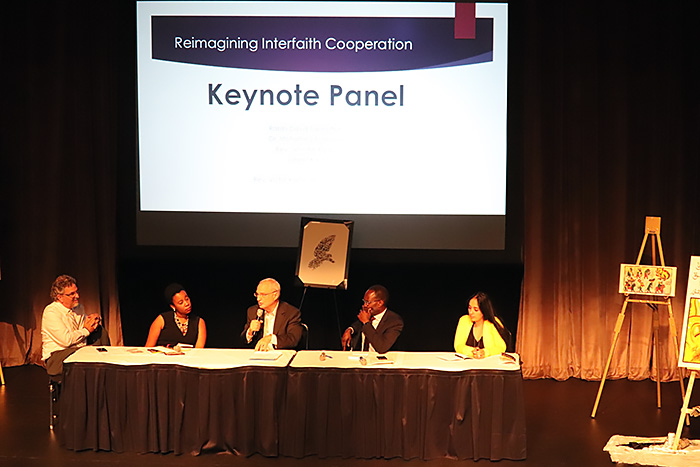
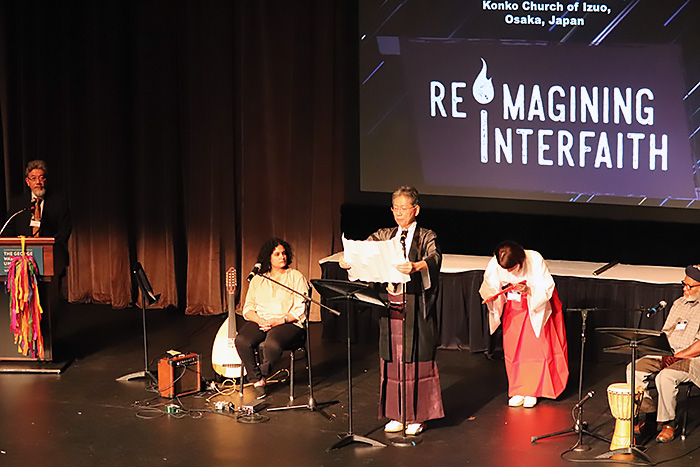
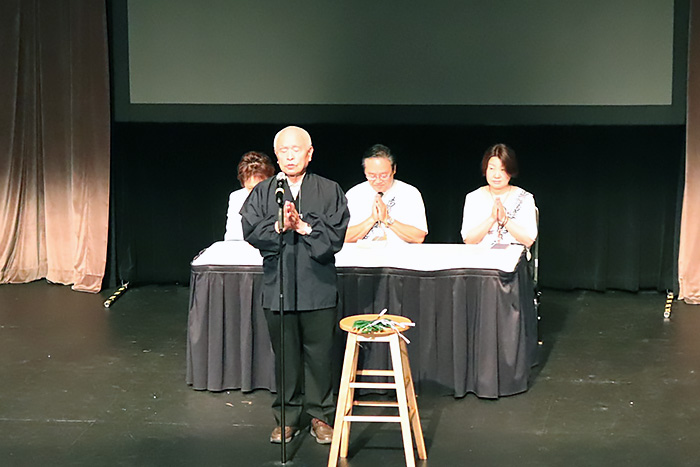
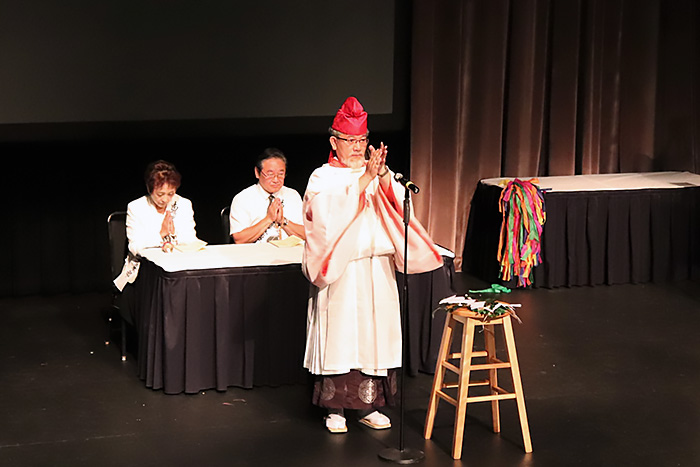
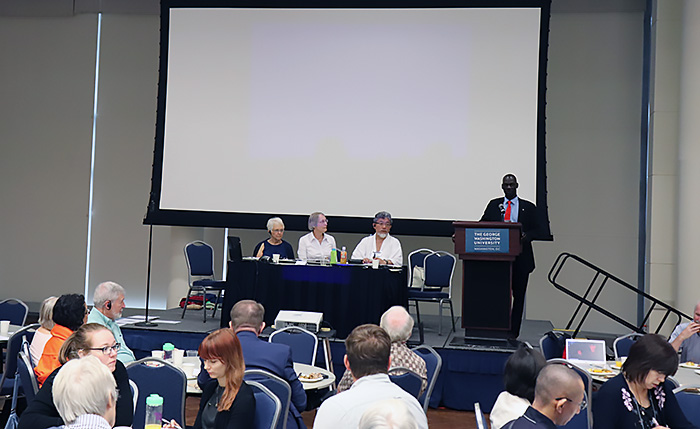
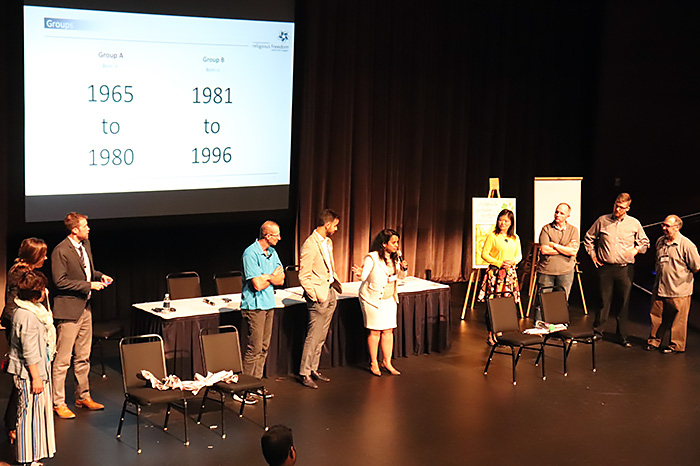
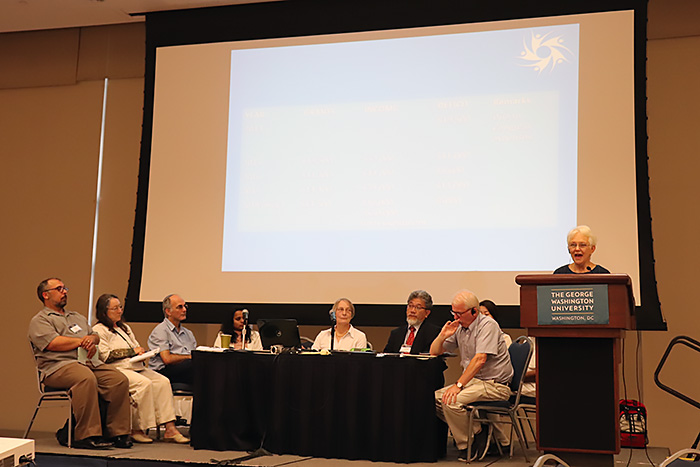
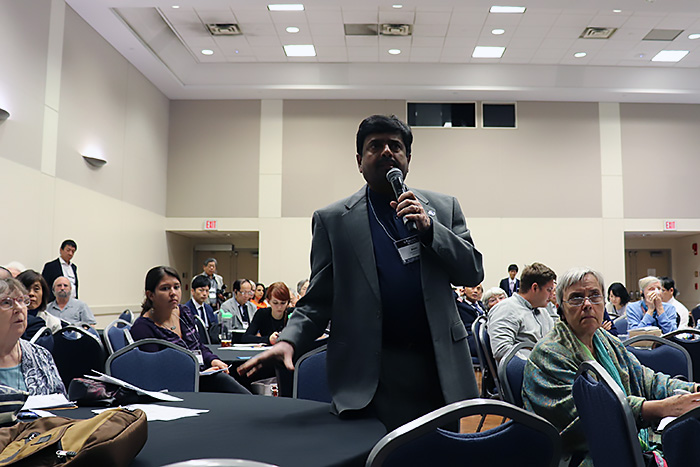
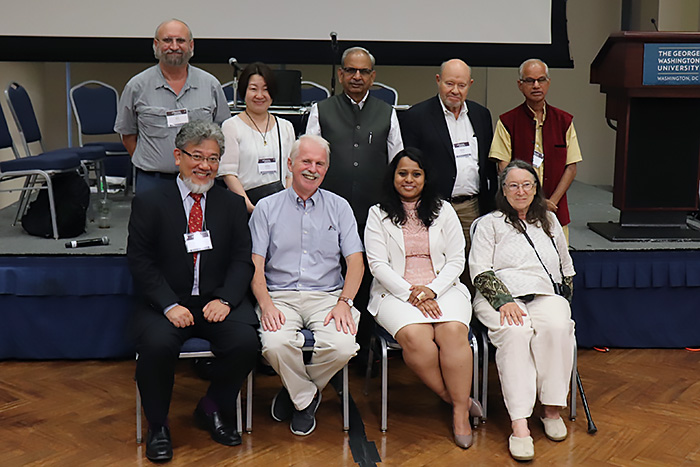
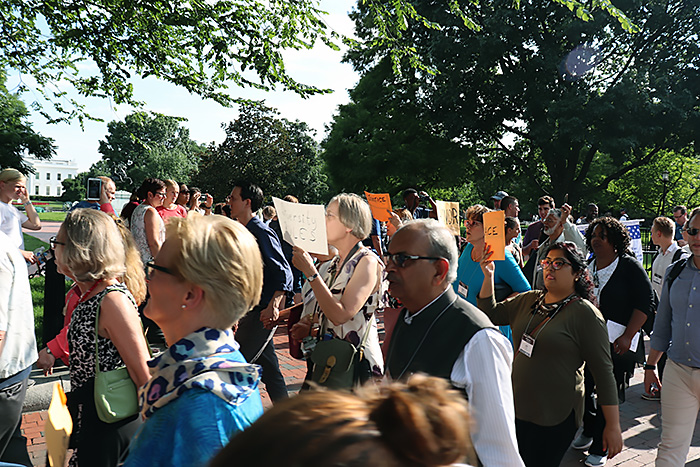
Our 35th Congress, held on 29 July – 1 August at George Washington University in Washington DC (USA), was something we hadn’t tried before. Namely, we chose the format of a collaboration project and were able to gather many wonderful, diverse partners with the support of the host, our member group, the Unitarian Universalist Association.
The Reimagine Interfaith Conference, like every Congress before, incorporated fellowship, learning, sharing, the General Meeting, Chapter and regional meetings, worship and many other wonderful experiences. This time we were honoured to share them with various friends from our partner organizations, which enriched the event in many different ways and allowed everyone to benefit from the enormous networking and skill-building opportunities.
Reimagine Interfaith was organized at our initiative and co-sponsored by such renowned organizations as Religions for Peace USA, United Religions Initiatives USA, United Church of Christ, the Hindu Temple Society of North America, GW Interfaith, Interfaith Youth Core, Fezana and Shoulder to Shoulder, as well as multiple religious communities.
Moving forward
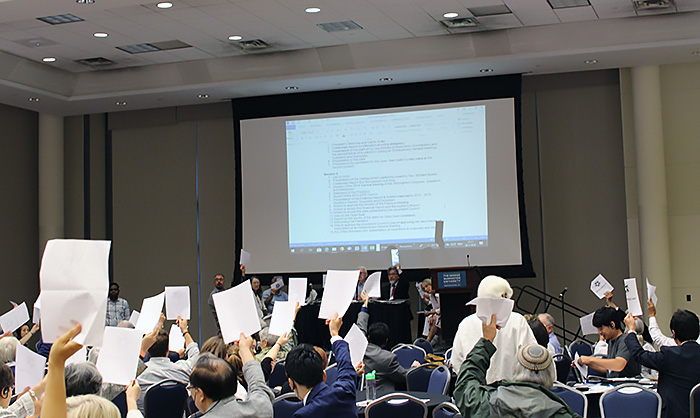
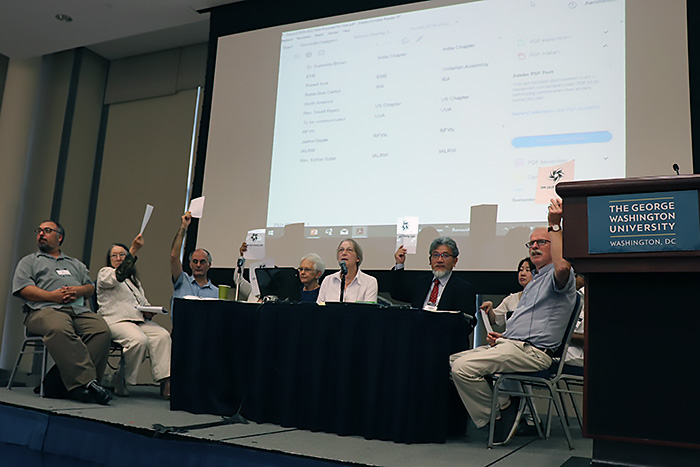
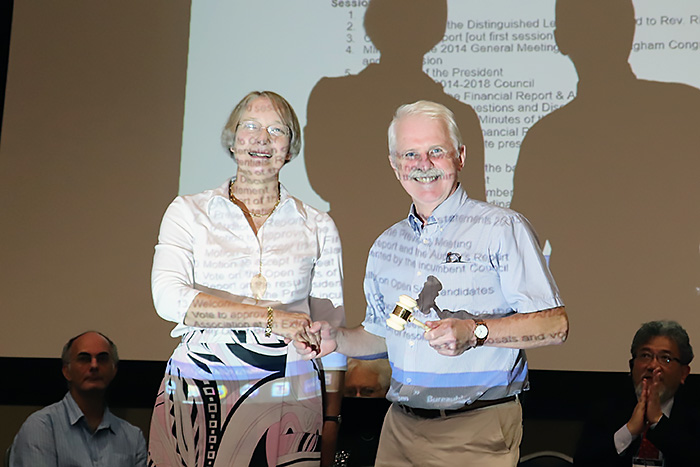
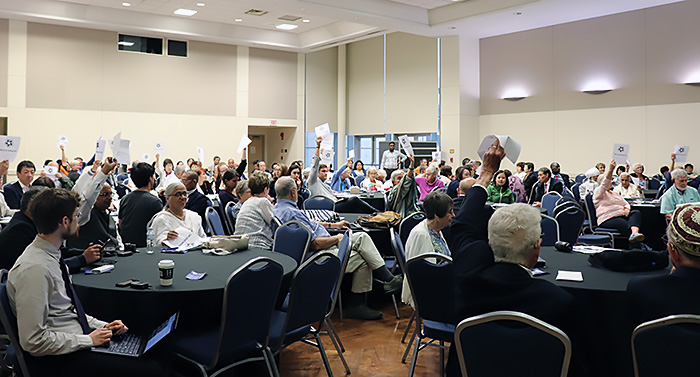
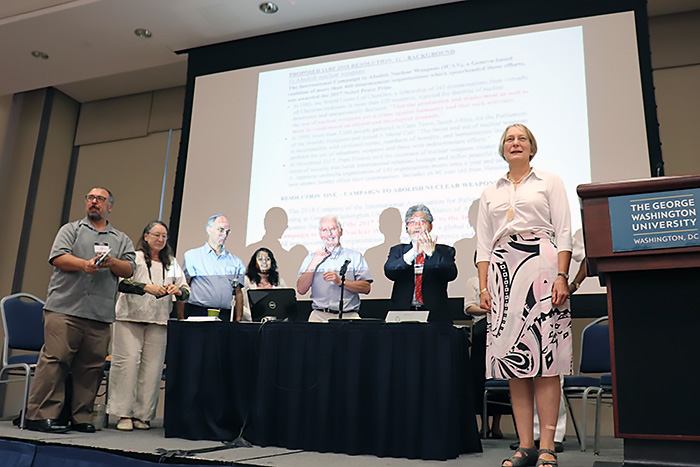
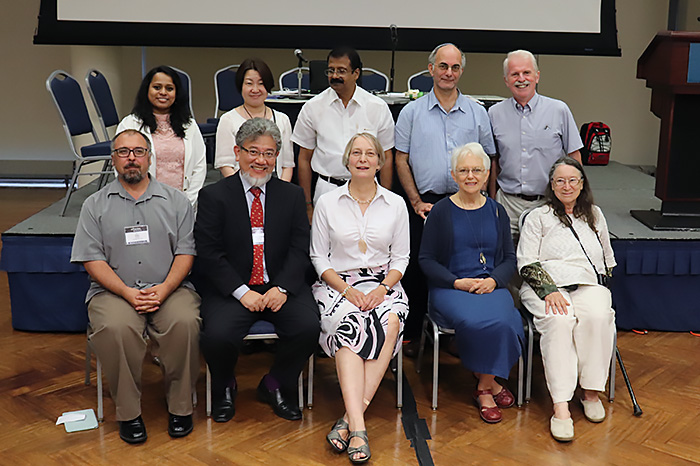
The General Meeting, attended by over a hundred delegates from all over the world, reviewed the performance of the organization and took a number of important decisions that will guide our work in the upcoming four years. Pursuing efficiency and even greater transparency, the association, currently incorporated as a Charitable Company under UK law, will transform into an Incorporated Charity Organisation, a new form of legal personality designed to simplify the way charities operate and help them focus more on their statutory goals by eliminating a number of cumbersome administrative obligations. This will provide an opportunity to redraft our constitution guided by the experience we have gained since the current document was adopted. The process has already began, launched by the outgoing Council, and will lead to calling an extraordinary General Meeting to approve the new constitution as soon as possible. The delegates approved of the work of the outgoing Council, presided by the Rev. Wytske Dijkstra, and elected a new International Council for a four-year term. The following persons were elected:
[table id=11 /]
The Chapters and Regions, as well as our sister organisation, the International Association of Liberal Religious Women, had a their meetings too. It was felt that enthusiasm has not diminished; indeed, it has grown and many new plans were made. The Congress, with its networking, fellowship and brainstorming opportunities with fellow IARF members and our partners, made it apparent that interfaith work is not less needed than a century ago, when IARF was being formed, strengthened our resolve to pursue the cause of liberty, tolerance, peace and justice. A number of interesting initiatives were born, among them a project to create a discussion paper taking out the most pressing issues we are currently confronted with, that will stimulate internal conversation as well as dialogue and cooperation with our partners: to find greater understanding of what is needed and of what new means we can employ to move forward. We will be reporting about the developments as these initiatives bear fruit.
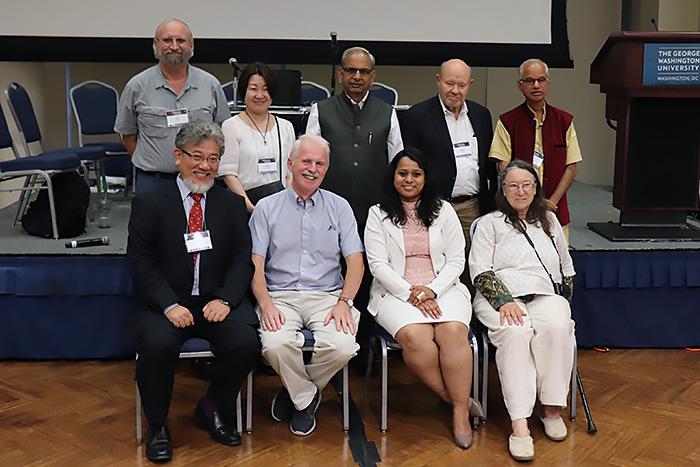

We are happy to have been able to celebrate the achievements of two prominent interfaith activists and support the work of an accomplished and unique interfaith project run by young adults.
The Schweitzer Award
The Franco-German theologian, organist, philosopher, physician, and Nobel Peace Prize winner Albert Schweitzer was a member of our organisation – perhaps the best-known of all. Schweitzer’s passionate quest was to discover a universal ethical philosophy, anchored in a universal reality, and make it directly available to all of humanity. The keynote of Schweitzer’s personal philosophy was the idea of Reverence for Life. Since 1975, we have honoured his contribution by creating the “IARF Albert Schweitzer Award for Distinguished Service to the Cause of Liberal Religion“. The Award is presented at each IARF Congress, currently held at 4-year intervals. Recent recipients include the Dalai Lama and Karen Armstrong.
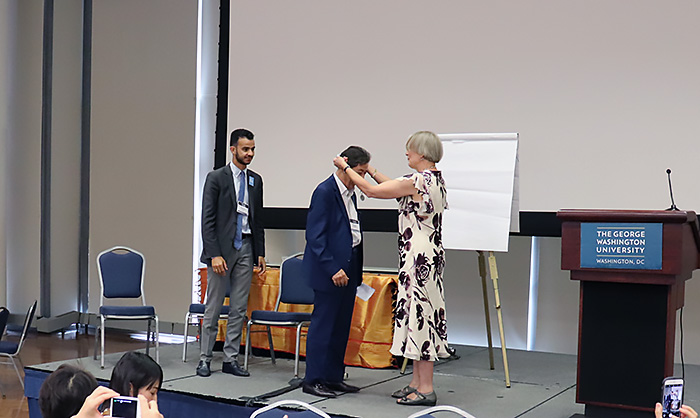
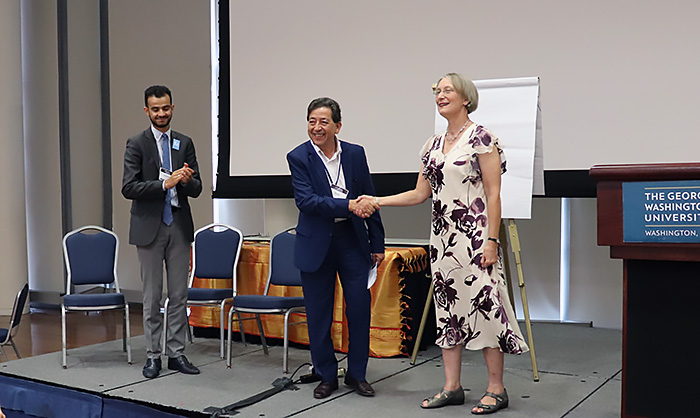
This year the award went to Sheikh Khaled Bentounès, the Sufi master of the Shadhiliyah-Darquawiya-Alawiya Sufi Tariqat based in France. The Sheikh is the founder and president of AISA (International Sufi Association Alawiyya), a UN-accredited organisation promoting peace efforts, interfaith dialogue and reconciliation, as well as women’s rights. In 2014 AISA launched a global campaign for the UN to establish the “International Day of Living Together in Peace” on 16 May. A petition to the UN was Created by Sheikh Bentounès “to demonstrate to the political authorities our desire for peace”, to which IARF has committed itself in 2015.
The Sheikh is an outspoken and charismatic advocate of freedom, human rights and border-defying relationships based on spirituality and humanism. A remarkable character and a highly charismatic religious leader in his own right, he is a key figure in an international network for promoting interreligious harmony and peace. His views on religion are inclusive and universal. He is equally apt to be at the centre of mystic gatherings as to lead large interfaith manifestations.
By: Mazaré, the Sanctuaries
For Reimagining Interfaith
extraordinary.
you’re here
you’re finally here.
i’ve heard so much about you
the glowing ones
i’ve seen snapshots of your eyes
not just open,
sho ‘nuf awake
like history books
written by the underdogs
eyes not just enlightened,
ablaze.
like a candle turned blow torch
you now see the jewels you have
that others lack
and you see the jewels
being ripped from others’ chests,
feet stepping on necks
backbones yanked out of place
so that upstanding citizens
can’t stand up straight
this enrages you
they say you shouted
at a pack of lions once.
they were circling this gazelle
who was wearing a hijab
wearing a cross
wearing a red dot
they were clawing at her
sneering, poking, prodding
prepping
to pounce
The Greeley Award
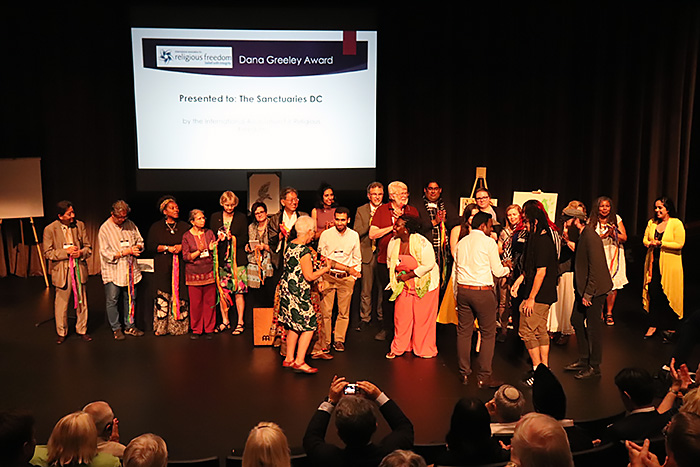
In the early seventies, Rev. Dana McLean Greeley served IARF as its president. A prominent Universalist leader throughout his career, he introduced a number of innovations to IARF and widened its scope by introducing several Japanese groups from Shinto and Buddhist traditions as members. The primary goals of the award are to support organizations of young adults, and the communities within which they are engaged, to conduct programs of leadership development, human rights education, and engagement in understanding one another’s beliefs within the context of commitment to religious freedom.
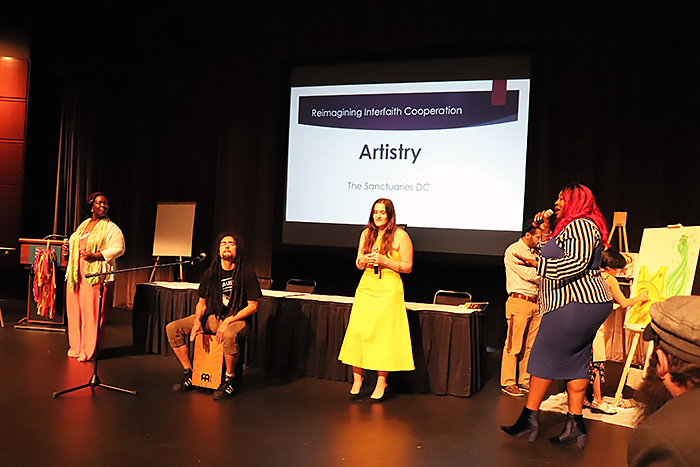
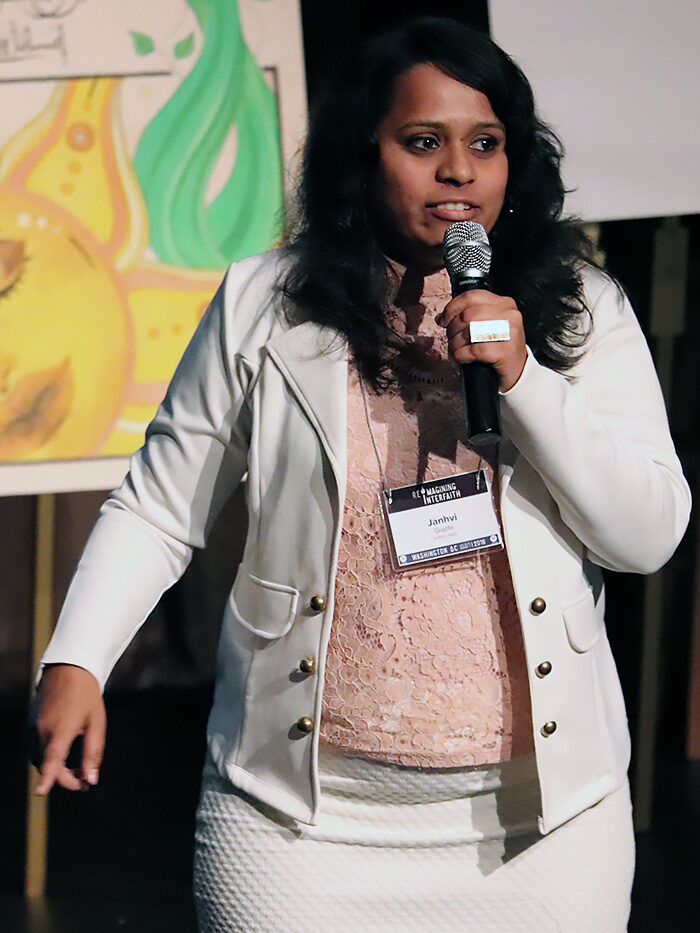
The Award, in the form of a monetary grant, is presented at each IARF Congress to a group of young adults in recognition of their contribution to interfaith work. This year the award went to The Sanctuaries: Interfaith Arts Education. This is how The Sanctuaries explains its mission.
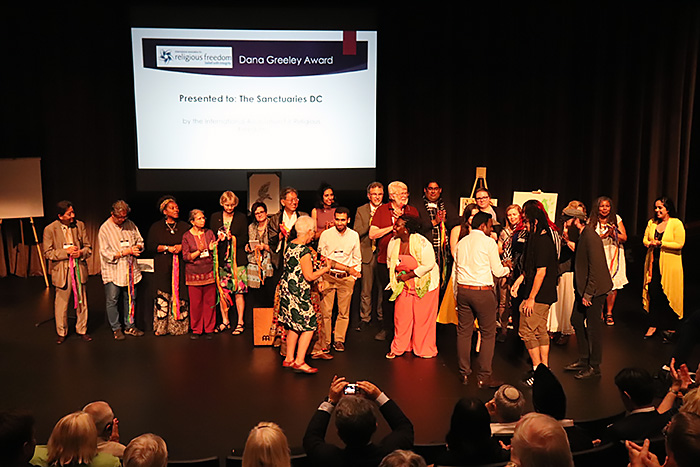 The Sanctuaries is the first interfaith arts community in the United States. We use the arts to transform two of the most divisive global issues of our time – race and religion – into forces for personal growth and social change. We fulfil this mission in two ways. First, through our multicultural community of over 150 artists, we deepen interfaith understanding by hosting regular events, retreats, and multimedia arts showcases. Second, through our Art for Social Impact training program, we educate interfaith artists how to be leaders in their local communities. Participants in this highly selective program gain first-hand experience working on the front lines of grass-roots justice campaigns to address the systems that keep us divided in the first place.
The Distinguished Leadership Award
 The IARF award for Distinguished Leadership in International Liberal Religion, established in 1980, is presented to prominent IARF activists who contributed most to the shape of the organisation and the pursuit of its goals. Former recipients include Shinichiro Imaoka (1981), Dana McLean Greeley (1984) and Diether Gehrmann (1990).
The commemorative plaque and certificate will be presented to Rev. Richard Boeke. Throughout several decades of his involvement in IARF Rev. Boeke has been active on both the international and national (Chapter) level, in England and the United States, working to promote peace and understanding between religions and cultures. His work and writings speak of the urgency of religious and cultural dialogue, especially among groups that appear radically disparate. He is unceasingly working to facilitate dialogue with well-regarded leaders, activists, and scholars of many faiths, as well as at the grassroots level.
Accounts from the Congress
It was pleasant time to interfaith meeting which I learnt and shared a lot across the world. The receptions were welcoming, both of the conference and dormitory. Accommodation, food and refreshments all were exquisite. Programs, presenters, spiritual focus and group meetings we fanatic. Speeches were charming across the board, from the president to all the council who spoken. The elections were conducted fairly and new council were welcoming and ready to work.
A selection of the most important things I have gained and experienced:
– I celebrated other faith belief without losing mine.
– Partner with others who do not look like me.
– Plant the seed of my faith to other faith groups
– My faith was not compromised directly
In conclusion, the Reimagining Interfaith Conference brought interfaith communities into better alignment with social equity and social justice that are concern without any community faith being converted. Internationally, we got to know people and learnt to break barriers internally and externally from all the interfaith fraternity. Generally, Reimaging Interfaith Conference was international condition building across the identity.
This Reimagining Interfaith/IARF 35th World Congress was a new experience for me. Therefore, I was very nervous if they would accept me, as I do not have a religion. Although I have participated in many meetings and conferences before, they were never ones focused on religion, so negative things crossed through my mind. However, I was told that Japan has customs that make religion feel familiar even if someone does not have experience with a particular religion. I thought I understood that but I realized I actually didn’t. That is probably because I hadn’t faced religion and also hadn’t felt how important having a religion is, but I experienced the importance of having a religion and the inner warmth of human through this RI/IARF conference.
In this program, there were several opportunities to discuss in a group named “circle group”. Most of them were meeting for the first time and English, which is not my first language because I’m from Japan, made me concerned with how I should behave and if they would accept me. Especially since I am not a native English speaker, my fears of being misunderstood when speaking English always cross my mind. Although it is a linguistic problem, it is internalized and appear as features of ourselves. The linguistic issue weakens myself and it comes to the forefront. Those things made me even more nervous in the circle group.
Furthermore, speaking with a lot of strangers made me even more concerned with how I should behave and if I really could explain the way I feel ; hence, I decided to not expose myself much. Also, because the theme was religion, I found it hard to be open-minded as I do not belong to any religion and do not have knowledge about it.
In the circle group, I was just listening to the others and didn’t give any opinion. Because of this, the others in the group probably thought I was a cranky person even though I thought I was being cheerful as I ordinarily am, which I believed to relieve myself. However, I gradually realized that was wrong. I alienated myself by keeping my emotions in check. Because of this, when they said to me “Eri, would you like to talk about yourself?” , I kept refusing it but gradually, I realized how I was alienating myself. Eventually I cried as I realized my true nature, but the members of circle group listened to me carefully and accepted me the way I am. They told me about their views of religion and told me “ It’s okay, no worries” when I talked to them about why I was anxious. I think that warmth and kindness connect people beyond any religion. It is certainly an important part of religion to build their personality. I experienced the view of religions and learned to help and support each other.
Until now, I have not belonged to a religion and had an inferiority complex when I was among people with religion. Even though I do not have a religion, I believe in a god or buddha somewhere in my mind, and now I know everyone accepted who I am, which made me more confident. Furthermore, I thought I perhaps have a hybrid view of religion. Because I do not have religion, I strongly wanted to change my views of religion so that I could build
various teachings of my own.
I do not belong to a religion, but it reflects on myself or my views of religion by
learning various religions. I hope that I would like to continue learning to express myself with confidence in the future.
Impressions from the Congress









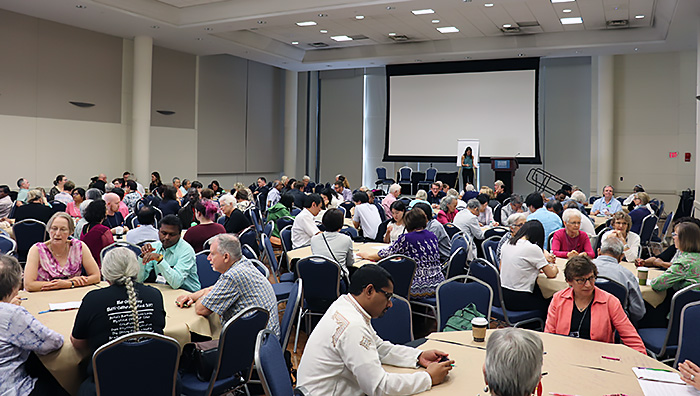
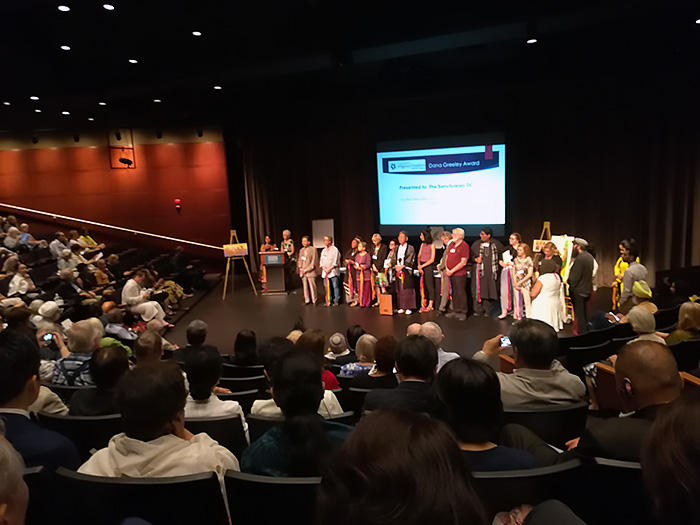
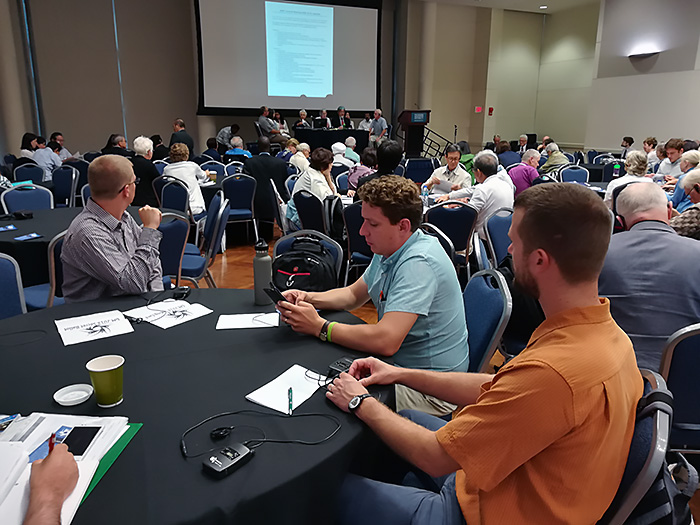
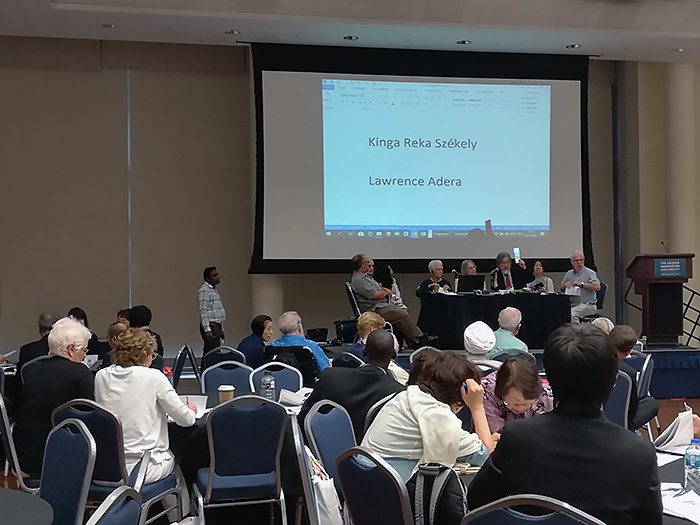

Winner of the Dana McLean Greeley Award for young adult interfaith work
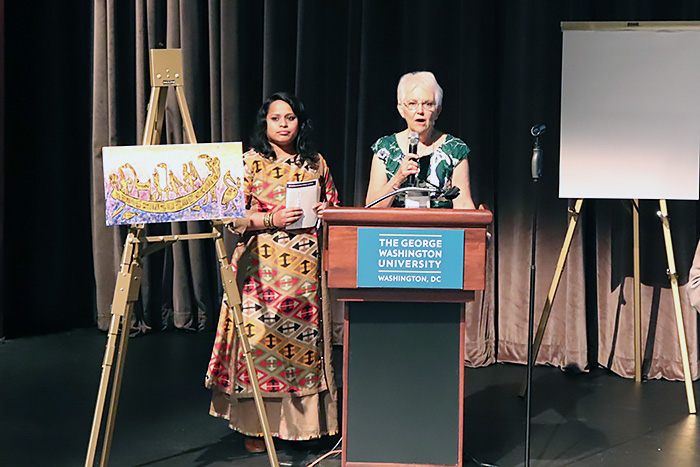
After carefully considering the 12 applications we received this year, each well-prepared and outlining a valuable project we would love to support, the Greeley Award Committee, tasked with this difficult duty, decided to award the project submitted by The Sanctuaries: Interfaith Arts Education.
This is how The Sanctuaries elaborate on their mission to ignite the sacred power of the arts for social change:
The Sanctuaries is the first interfaith arts community in the United States. Founded in Washington, DC, by a group of twenty young adults in 2013, we use the arts to transform two of the most divisive global issues of our time – race and religion – into forces for personal growth and social change. We fulfil this mission in two ways. First, through our multicultural community of over 150 artists, we deepen interfaith understanding by hosting regular events, retreats, and multimedia arts showcases. These programs are often the only structured opportunities in the city for young adults of different religious backgrounds to build lasting relationships of mutual care and support. Second, through our Art for Social Impact training program, we educate interfaith artists how to be leaders in their local communities. Participants in this highly selective program gain first-hand experience working on the front lines of grass-roots justice campaigns to address the systems that keep us divided in the first place.
What distinguishes our approach:
– It centers young adults. Too often, programs are created for young people, not by them. This project positions young adults as valuable teachers of this work for audiences of all ages. In the process, it builds trust and understanding across lines of social and generational division.
– It builds collective capacity. Too often, programs perpetuate dependency on an outside expert. This project equips teachers to share frameworks and skills that enable communities to move this work forward on their own. In the process, it builds long-term capacity, not clients.
– It scales by invitation. Too often, programs grow for numbers rather than for needs. This project relies on individuals and communities inviting teachers into their context to advance this work. In the process, it builds a replicable and respectful model of collaboration. As Dana McLean Greeley once exhorted: “Let us find something worthwhile to love, and something worthwhile to do, and give ourselves away, and we shall find ourselves again.” At the heart of our approach is this spirit of embodiment. This work is something that’s not just done, but lived.
You can learn more about the project and the organization on its website, thesanctuaries.org, and its Facebook page, www.facebook.com/SanctuariesDC/
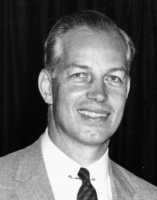
The Background of the Dana McLean Greeley Award
In 1969, Rev. Greeley [was] a pivotal force in giving the International Association for Religious Freedom (IARF) the name it still carries, and new, committed leadership from both Shinto and Buddhist traditions in Japan. He loved IARF’s heritage, and boldly moved it into its future. The Award was created by the IARF to respond to the intention of the Dana McLean Greeley Foundation for Peace and Justice to honor Rev. Greeley’s memory and life achievements for peace through the gift of a $50,000 endowment to the IARF, announced at a service and celebration held in Concord, MA, on November 5, 2006.
The Founding Purpose: The historical Mission of the Award has been to celebrate the achievements of young adults within a religious and/or interfaith community with a strong commitment to human rights, justice, and peace. The award supports an ongoing or new project of a group, featuring the collaborative engagement of young adults with their community, providing the group with material support. In turn, the group is committed to work with young adults, to develop leaders within the next generation, and to expand understanding of human rights, justice, and interfaith dialog within the context of religious freedom.
Goals of the Award: The primary goals of the award are to support organizations of young adults, and the communities within which they are engaged, to conduct programs of leadership development, human rights education, and engagement in understanding one another’s beliefs within the context of commitment to religious freedom.
The Award (or awards) will be presented at each IARF Congress, currently held at 4-year intervals. They will be celebrated and promoted at a special ceremony, and through publicity within and beyond the IARF.