
SACC role in Kochi first
11 March 2013
The campaigning body of one of the world’s leading peace organizations, Mayors for Peace, known as the “2020 Vision Campaign“, has chosen the city of Kochi as its first Associate Member in South Asia.
SACC chairman Thomas Mathew was instrumental in this choice being made, in reciprocation of the generous help given toward the successful organisation of IARF’s 33rd World Congress held in Kochi in 2010, by Kochi Corporation and the then Mayor.
Please see the report here.
Bangladesh Chapter president honoured
Dhaka, Bangladesh
7 December 2012
The Gurudwara of Dhaka celebrated the 500th year of Guru Nanak’s visit to Dhaka and his stay on the present Gurudwara campus, then known as Nanak’s Chapra.
About 300 Sikhs from India attended the program.
President of IARF’s Bangladesh Chapter, Prof. Kazi Nurul Islam, received special recognition at a reception, in the form of a Crest brought from Punjab, in recognition of h is contribution to the promotion of Sikh Studies, at home and abroad.

“Dhaka Gurdwara gets Sikh History Research Centre: There is virtually no Sikh population in Dhaka, Bangladesh, yet a Sikh History Research Centre has been established in the complex of Gurdwara Nanak Shahi by Sampradaya Karsewa, Sarhali (Punjab) for the research and propagation of Sikhism. Kazi Nurul Islam, Founder Chairman of the Department of World Religions, has been appointed as its honorary director”. ( Source )
In addition, on 26th December the University of Dhaka formally awarded him a Gold Medal, certificate and Crest for his lifelong contribution in promoting inter-religious harmony both in Bangladesh and abroad.
Sanctions, Embargos and Human Rights: British Chapter resolution
18 December 2012
Preamble
“Sanctions and embargos directly affect Religious Freedom and other human rights. In December we learned that the United States’ economic blockade against Cuba has forced the postponement of the 6th General Assembly of the Latin American Council of Churches (CLAI), scheduled for 19 to 24 February 2013 in Havana, Cuba. (as reported 14 Dec 2012 <http://www.ekklesia.co.uk/node/17614>).
The American branch of the Ecuadorian bank Pichincha in Miami froze a deposit of 101,000 US dollars made by the CLAI headquarters in Quito, Ecuador. The transfer to Cuba was to cover costs of food and lodging for the 400 delegates and other participants expected to attend the meeting in that nation.
“This is greatly disappointing to the member churches of CLAI and to the entire constituency of the World Council of Churches (WCC),” the Rev Dr Olav Fykse Tveit said on Thursday 13 December 2012, after learning of the decision by CLAI to postpone the assembly.
“This shows that the decades old economic blockade of Cuba is out of touch with the realities in the world today, particularly in the faith-based communities, and should be ended for the sake of justice and peace,” Dr Tveit added.
The social effect of sanctions upon civilian populations historically may be seen in the shift of Cuban policy from left-wing nationalism to austere communism, the birth of the Russian Mafia in the black markets of the former Soviet Union and the growth of terrorist organizations in Palestine, Iraq and Syria. The current situation in Iran for people with long- term illnesses has recently been highlighted. International banks refuse to process payments for medicines because they fear incurring penalties for sanction-breaking.
Resolution
The British Chapter of the IARF questions the morality and long-term effectiveness of the indiscriminate use of sanctions, embargoes and blockades as ‘peaceful’ proxies for direct military action in pursuance of political, territorial or commercial aims or for collective punishment. Such actions inflict real and unjust harms upon the most vulnerable members of targeted nations. They often become an obstacle to the peaceful resolution of disputes. Sanctions and embargoes may in times of peace appear to be a less reprehensible response to ‘provocations’ than overt military action. However, this is only true if their consequences upon the human rights of the powerless are fully considered. They may directly and indirectly cause widespread personal injury and loss of life. This entrenches divided opinion, encourages violent response, and presents an obstacle to genuine meaningful negotiations.
We therefore urge states and nations enforcing or responding to sanctions, to act humanely, proportionately and moderately, to accept the responsibility to avoid or limit the harms caused by their actions, and to respect the Human Rights of vulnerable civilian populations.”
Rev. Dr. Richard Boeke, Chair, British Chapter IARF
Rev Chris Hudson MBE, Vice-Chair
Rev Feargus O’Connor, Secretary
With contributions by Shaykh Muhammad Amin Evans, Charanjit Singh, and Derek McAuley
2012 International Human Rights Day in India
10 December 2012
- Visakhapatnam – Integral Institute Of Advanced Management
- Bangalore – Sri Krishna International Group of Institutions
HRET at Sri Venkateshwara
@Sri Venkateshwara College of Engineering & Technology (SVCET), Tiruvallur, Chennai:
Human Rights Education training
22-23 November 2012
Facilitator: Bro. Albert Xaviour
This training event is among the first in a new initiative in the IARF HRE program, by the young adult network RFYN, to match IARF central funding with self-funding / local contributions.
Its report below is among the first in the overall IARF HRE program to feature all event costings & expenditure (Please see the table on the final report page for figures that show how these events have achieved this self-funding initiative’s goal).
Sri Venkateshwara College HRET – slides from IARF on Vimeo.
Report (PDF 3 pages, illustrated)
International Human Rights Day
10 December 2012
IARF Council member Adv. V. Rengapashyam and college Placement Officer James Manoharan spoke to an audience consisting of the participants in the above HRE training plus other interested students. The founder and Chairman of Sri Venkateshwara College, Dr. K.C. Vasudevan, attended together with other staff.
British Chapter meets Canterbury archbishop
Derek McAuley, Chief Officer of IARF member group the British Unitarian General Assembly, met the Archbishop of Canterbury at an Interfaith Reception at Lambeth Palace on Thursday 22 November 2012.
The event was held to celebrate InterFaith Week, mark the 25th Anniversary of the UK’s InterFaith Network, and to recognise the Archbishop’s contribution to inter faith relations over the last ten years.
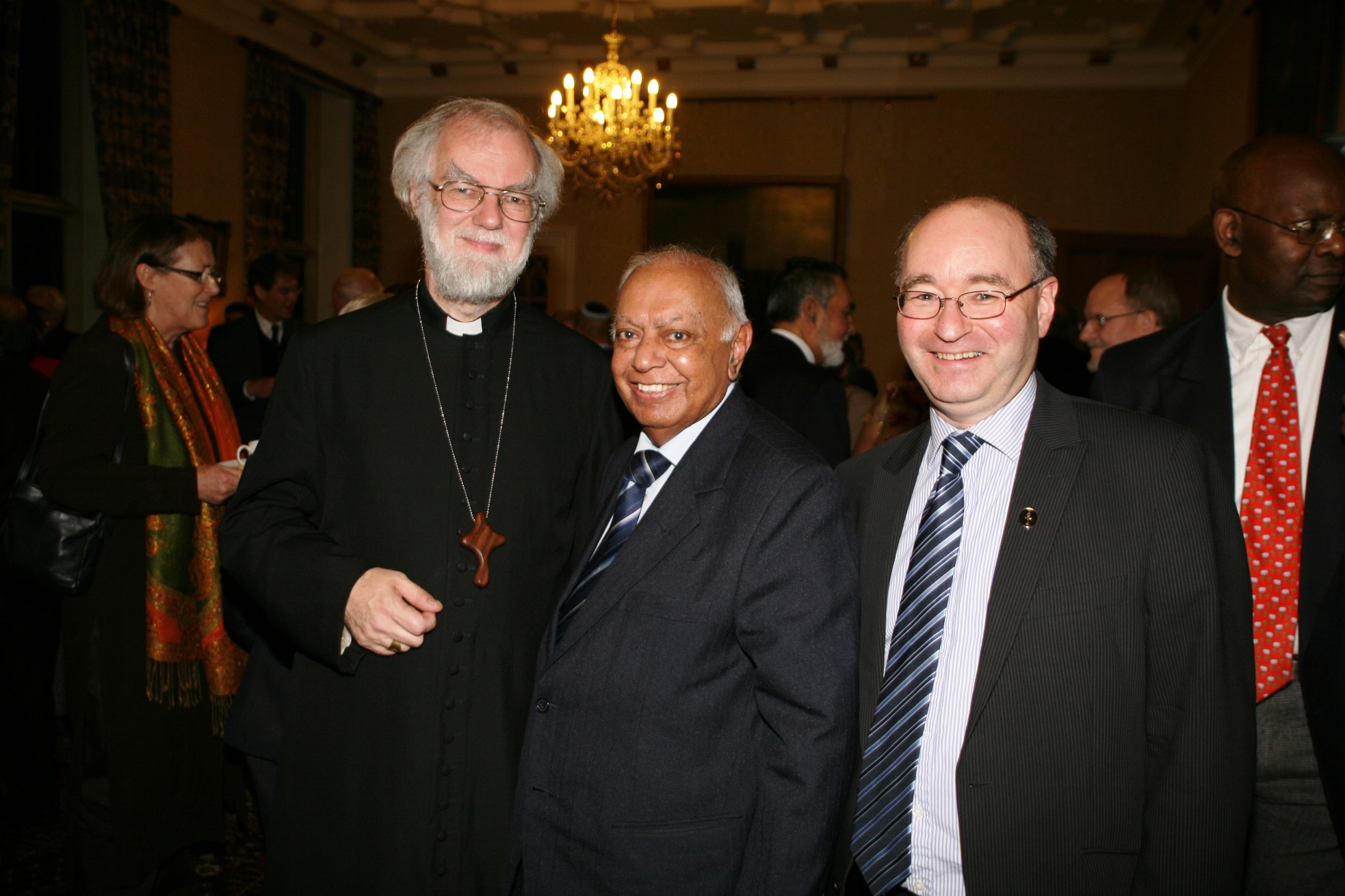
Derek is pictured with Dr Rowan Williams and Harry Shukla MBE, an interfaith activist from Newcastle Gateshead who was one of the speakers at the event.
Picture: Paresh Solanki, InterFaith Network.
Interfaith dialogue in Nepal Chapter
24 November 2012
Kathmandu, Nepal
Report: Interfaith dialogue on Religious Tolerance & Citizen’s Responsibility (PDF, 10 pages illustrated)
Report on 14th India Chapter Conference
30-31 October 2012
Sri Adichunchanagiri Mahasamsthana Mutt, Mandya District, Karnataka, India
Report on 14th India Chapter Conference
(PDF illustrated, 22 pages – 13mb)
British Unitarians raise concerns about growing threats to religious freedom with UK Government
07 September 2012
IARF British Chapter board member Derek McAuley, Chief Office of our member group in Great Britain the GAUFCC (General Assembly of Unitarian & Free Christian Churches), has raised his concerns about the growing threats to religious freedom in many parts of the world with new government International Development junior minister, Lynne Featherstone MP.
RFYN International Youth Conference 2012
24 to 28 September 2012
@Nobili Pastoral Centre, Madurai, TamilNadu, India
- Organized in association with the Angelo Province of the Institute of the Brothers of the Sacred Heart, India.
- A historic gathering for IARF in being a first attempt to be self-funded (that is, funded entirely from local member group contributions).
- 21 different Sacred Heart bodies around South India contributed generously. The 85 young adult participants themselves raised $900.
RFYN Madurai 2012 Report (PDF 22 pages, illustrated inc YouTube links)
[portfolio_slideshow]