
IALRW’s Congress to Follow the IARF Congress on 7-9 September 2023
The International Association for Religious Freedom (IARF) is delighted to announce that our member organisation, the International Association of Liberal Religious Women (IALRW), will be hosting their World Congress in Cluj-Napoca (Kolozsvár) from the 7th to the 8th of September, 2023. This congress comes directly after the IARF World Congress, presenting a unique opportunity to attend both events in succession.
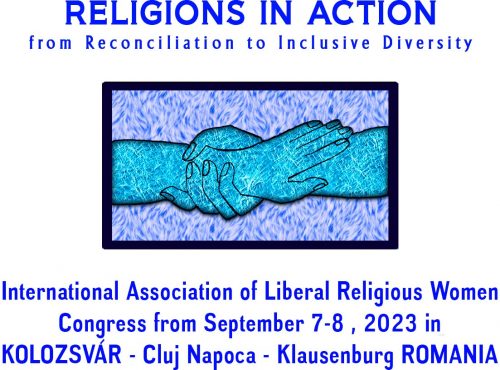
The congress will be held under the theme “Religion in Action: From Reconciliation to Inclusive Diversity”, reflecting the IALRW’s ongoing dedication to fostering dialogue and understanding among women of diverse faith traditions. Although the speakers for the event have not yet been confirmed, we assure you that the lineup will consist of some of the most insightful voices in the field. We will be publishing the program shortly, so please keep an eye on our website for updates.
The World Congress will be graciously hosted by the Hungarian Unitarian Church at the House of Religious Freedom, a historic 15th-century townhouse located in Cluj-Napoca. Known as one of the oldest and most significant townhouses in the city, the House of Religious Freedom has been lovingly restored by the Hungarian Unitarian Church and is dedicated to promoting the ideals of religious freedom and tolerance.
IALRW’s history is rooted in the IARF, and its focus on women’s issues in religious communities and interfaith cooperation remains a cornerstone of its mission. The organisation welcomes women from liberal faith communities around the world, fostering an environment of mutual support in the search for spiritual enrichment and identity. We are confident that this upcoming World Congress will be a testament to this mission, offering attendees the chance to engage in enriching dialogue and meaningful action.
For further information about the World Congress, please contact Dr. Esther Suter at [email protected]. You can also visit the IALRW website at https://www.ialrw.org/ to learn more about their ongoing projects, recent research, and member organisations.
The IARF and IALRW look forward to welcoming you in Cluj-Napoca (Kolozsvár) for these back-to-back congresses. Please mark your calendars and join us in fostering interfaith dialogue and inclusive diversity.
Persecution of Unitarians in Burundi
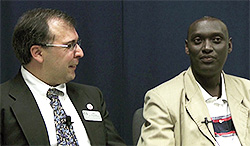
The International Council of Unitarians and Universalists, many of whose member churches are also members of the IARF – has reported on November 19 that Rev. Fulgence Ndagijimana, pastor of the Unitarian Church of Burundi,
The ICUU has issued an emergency statement on the situation, which you can read on its website, calling upon the government of Burundi
Joshua Eaton’s article on UU World provides interesting background information on the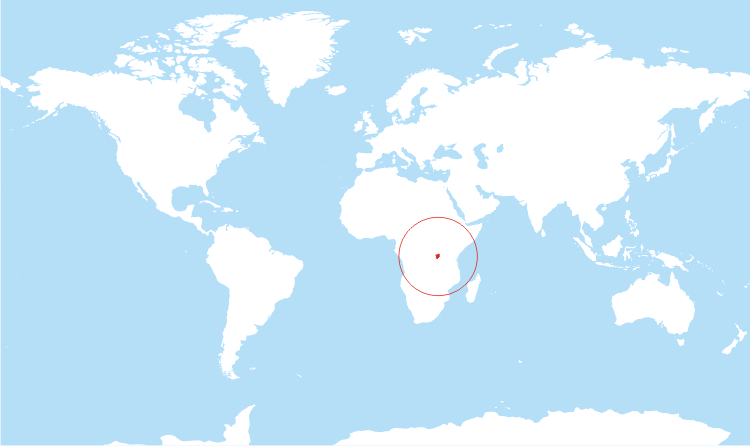 situation in the country and the Burundi Unitarian community, as well as a more detailed account of Rev. Fulgence’s present ordeal and the efforts of the international Unitarian community and its allies to aid him.
The IARF stands in solidarity with Burundi Unitarians and the world Unitarian community in these troublesome and uncertain time, and joins in the appeal to the Burundi government to respect religious freedom and cease all unlawful actions. We are hopeful that the crisis will soon be resolved and the congregation will be allowed to continue its work and worship untroubled. To show your support you may consider joining the Standing With UU-Burundi initiative on Facebook.
Below you can watch a short video about Burundi Unitarians.
Interreligious Harmony Week 2014 – Dhaka rally
Interreligious Harmony Rally
Campus of the University of Dhaka
2 February 2014
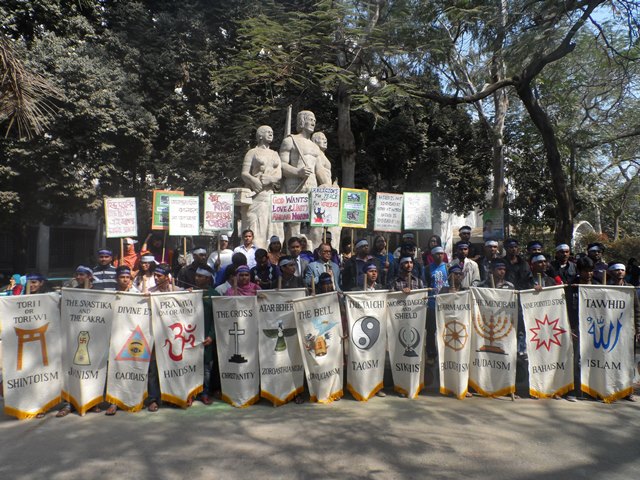
Dear Peace-loving brothers and sisters of the world,
Please accept my greetings of peace.
On the occasion of Interreligious Harmony Week declared by the United Nations,
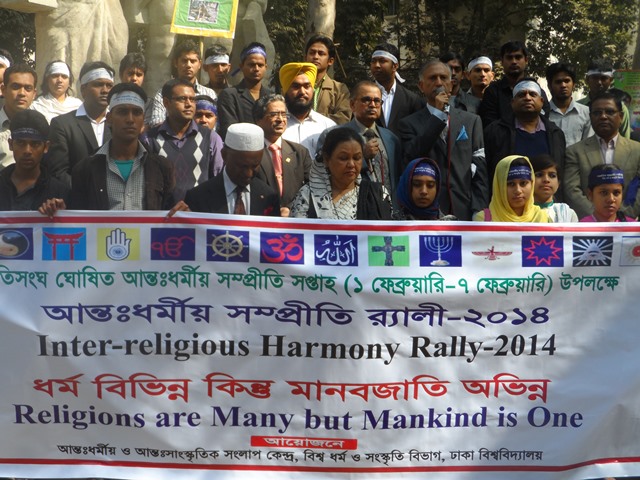
The Centre for Interreligious and Intercultural Dialogue (CIID) of the Department of World Religions and Culture of the University of Dhaka, in collaboration with International Association for Religious Freedom (IARF), United Religions Initiative (URI), Religions for Peace(RfP) and Warm Heart Association Bangladesh (WHAB), held an INTERRELIGIOUS HARMONY RALLY on February 2, in the campus of the University of Dhaka.
The Rally was inaugurated by Professor AAMS Arefin Siddique,the Vice Chancellor of the University.Speaking on the occasion were:
Professor Hirendra Nath Biswas,President of National Hindu Reformation Society; Professor Sumonkati Barua, a reputed Buddhist scholar; Bhai Manjit Singh of Gurudwara Nanakshahi, Dhaka; Professor Father Tapan De Rozario of the Departmet of World Religions; Professor Muhammad Elius of the same Department; and Professor KAM Saaduddin, a renowned sociologist of Bangladesh.Many distinguished professors including Professor Azizun Nahar Islam, Professor Nusrat Sultana and Professor Mahbubur Rahman, and hundreds of students joined this Rally.
Professor Kazi Nurul Islam conducted the whole programme.
Different electronic and printed media gave massive coverage of this Rally.Please pray to God so that we can continue our endeavour to promote world peace and harmony.
With regards to all of you.
Yours in peace
Kazi Nurul Islam
[Chair of IARF Bangladesh Chapter]
Bangladesh attacks on Hindus condemned
“Dear Peace Loving People of the World,
The Executive Communities of International Association for Religious Freedom (IARF), United Religions Initiative (URI) and Religions for Peace (RfP) Bangladesh in an emergency joint meeting condemned with the strongest possible language against the atrocities done towards the Hindu communities in the recent past particularly, on the 2nd November, 2013 in Pabna (Northern Part of Bangladesh).
The members present urged upon the Govt. of Bangladesh and the people of conscience to come forward so that such kinds of atrocities towards the Hindu communities cannot take place in future. They condemned the Islamic political party namely, Jamat-e-Islam of Bangladesh and its students wing SHIBIR for creating all these heinous acts which are against Human Rights, Religious Freedom and especially against the teachings of Islam, which is, in truest sense of the term, a Religion of Peace.
The meeting was presided over by [Chair of IARF Bangladesh Chapter] Dr. Kazi Nurul Islam, Professor and Founding Chair, Department of World Religions and Culture; and Director, Centre for Interreligious and Intercultural Dialogue, University of Dhaka.
Yours in Peace: Md. Abu Taher, a Human Rights Activist of Bangladesh”.
British Chapter committee member elected to IFN-UK Executive
1 July 2013
The British Chapter of IARF has congratulated committee member Derek McAuley on his election to the Executive Committee of the Inter Faith Network for the United Kingdom.
The Inter Faith Network plays a key role in promoting good relations between people of different faiths in this country and advancing public knowledge and mutual understanding of the teachings, traditions and practices of the different faith communities in Britain.
The Executive Committee are the trustees and directors of the organization which is a registered charity and company.
Derek was nominated in the category of ‘Other Inter Faith Organisations’ at the Annual General Meeting held in Birmingham on 1 July 2013 and acts in an individual capacity.
Derek said:
“I am pleased to have the support of the IARF in my new role. IFN plays a significant role in promoting inter faith dialogue which as recent events have shown is key to good community relations. I am proud of the long-standing commitment of IARF, from its establishment in 1900, to developing good inter faith relations among the religions of the world and was a founder member of the Inter Faith Network”.
British parliamentary RF group launch report
The newly formed All Party Parliamentary Group on International Religious Freedom launched a report at the House of Lords on Wednesday, 26 June 2013, revealing that millions of people in 184 countries have experienced aggression or intimidation because their beliefs.
Article 18: An Orphaned Right
Launch of Human Rights Resource Centre (HRRC)
Hindupur, Andhra Pradesh, India
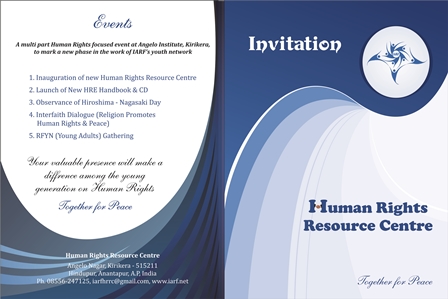
On Thursday 8 August 2013, a multi-part event marked a new phase in the Human Rights work of RFYN (IARF’s youth network) in India.
Council member Br. Albert Xaviour, young adult representative on IARF’s international governing board, organized the event, with the indispensable help of his team of co-workers Janhvi Gupte, Immanuel Manish, Kausrajan, Clinton Moses, Vijaysinh N. Dhandhukiya, Yashika Kim, Sathya Narayanan, G. Vishnupriya & Ruzbeh Vistasp Hodiwala.
The event comprised:
1. Inauguration of new Human Rights Resource Centre
Office space at Angelo Institute outside Hindupur, Andhra P., has been donated by Brothers of the Sacred Heart of Jesus, India (SHJ-India), and will provide a base for trainings of young adults across several states.
2. Launch of new Human Rights Education handbook & CD for trainees
The handbook will be used as a training manual for all programs to be offered by RFYN through its network.
3. Hiroshima-Nagasaki Day
Observance of the Day (August 6th), with ceremony of remembrance.
4. Interfaith Dialogue
Involving local religious leaders answering questions from RFYN young adults, this ‘multi-logue’ will mark the inception of a new branch of IARF-India Chapter, for the town of Hindupur (Angelo Institute is located just outside Hindupur).
5. RFYN gathering
Members of our young adult network from around the country will hold planning and training sessions over two days.
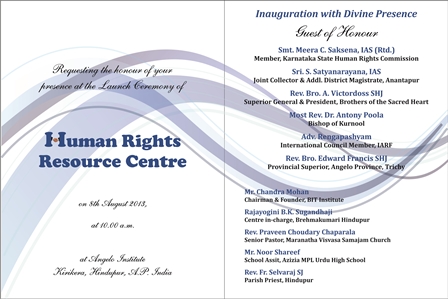
Dignitaries attending:
- Smt. Meera C. Saksena, Hon. Member, Karnataka State Human Rights Commission (SHRC);
- Most Rev. Dr. Antony Poola, Bishop of Kurnool;
- Sri S. Satyanarayana, Joint Collector & Addl. District Magistrate, Anantapur;
- Rev. Bro. A. Victordoss, Superior-General & President, SHJ-India;
- Adv. V. Rengapashyam, IARF Council member;
- Rev. Bro. Edward Francis SHJ, Provincial Superior, Angelo Province, SHJ-India;, Trichy;
- Mr. Chandra Mohan, Chairman & Founder, BIT Institute;
- Rajayogini B.K. Sugandhaji, Centre In-charge, Brahma Kumaris, Hindupur;
- Rev. Praveen Choudary Chaparala, Senior Pastor, Maranatha Visvasa Samajam Church;
- Mr. Noor Shareef, School Asst., Azizia MPL Urdu High School;
- Rev. Fr. Selvaraj SJ, Parish Priest, Hindupur;
- Rev. Br. Michael Raj SHJ, Secretary, Caussanel Province.
A message of congratulations was received from Dr. Rahul Rai, Director of the Indian Institute of Human Rights:
“On the occasion of the establishment of The Human Rights Resource Centre
(HRRC) under the aegis of the International Association For Religious Freedom (IARF),
I take this opportunity to extend my best wishes to HRRC and its functionaries.
Human Rights Education lies at the heart of our efforts to build a society based on
the twin principles of Justice and Equity. The endeavour of HRRC in partnership
with Brothers of Sacred Heart of Jesus to promote Human Rights Education will go a
long way in creating a culture of respect for Fundamental Human Rights”.
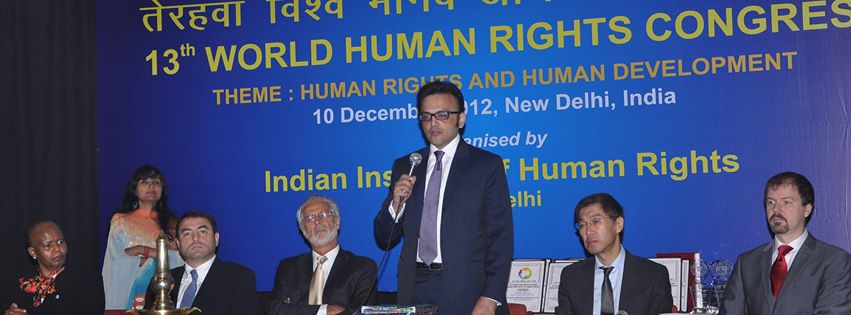
IARF welcomes warmly the practical as well as moral support extended by Rev. Bro. Victordass, Superior-General of BSHJI, in the form of office space for the centre, and anticipates a fruitful collaboration toward the mutual goals of our respective organisations.
And RFYN-India youth network acknowledges with much gratitude the gift of INR 276,000 (GBP3,000) from the UK-based International Interfaith Centre, an old colleague of IARF in Oxford days, toward the outfitting of the centre.
Tehmina Kazi on Religion, Religious Freedom and Secularism
Religion, Religious Freedom and Secularism
– by Tehmina Kazi
This article appeared in the March 2013 edition of the IARF British Chapter’s Newsletter and IARF Peacemaking Commission News
For the last three and a half years, I have been the Director of a registered charity named British Muslims for Secular Democracy. When I tell other people what I do at networking events and dinner parties, most are delighted, a small proportion give me funny looks, and the rest remain abjectly confused about what secularism actually means (as well as its attendant implications for religious minorities living in the UK).
Hence, I was pleased to find out about the publication of Jacques Berlinerblau’s book, How to Be Secular: A Call to Arms for Religious Freedom last year. While it was written from an American perspective, it also provided a rigorously-researched blueprint for addressing some of these issues in the UK. As Berlinerblau summarises, “So everyone uses the term (secularism), but its definition remains vague. One of my conclusions is, if there’s ever going to be a coherent secular movement in the United States, there will have to be clear articulation of its core values and principles.”
The associate professor says his definition of secularism does not in any way denigrate religion, but rather stresses a core secular goal of “enabling citizens to live peaceably with other citizens whose creed is different than their own.” While many political scientists have articulated pluralistic visions of a secular society, Berlinerblau goes several notches further by embracing the symbiotic relationship between religious communities and secularists. He describes how their respective success as civic actors is often dependent on each other, and outlines a 12-step programme to revive secularism, which actively includes and empowers people of faith. For example, he states, “Either secularism and Catholicism, whose relations have often been strained, must have this peace pipe moment or secularism in America isn’t going to go very far.”
How does all of this apply to a British context, particularly to Muslims? Very well, as it happens. In Contextualising Islam in Britain, a ground-breaking research project conducted by Cambridge University, a diverse group of Muslim participants were asked “What does it mean to live faithfully as a Muslim in Britain today?” An overwhelming majority of them affirmed their support for the British model of procedural secularism (which means that it is theoretically possible for all voices, whether religious or not, to access the public sphere equally). The participants observed that procedural secularism provides many benefits for British Muslims, including religious freedom. As British Muslims we are able, for the most part, to practice our faith in an atmosphere of respect and security, with recourse to established anti-discrimination provisions if this is not the case. Many public sector workplaces now have multi-faith prayer rooms, and halal food options (notwithstanding occasional pork DNA scares!) are available in school canteens and prisons.
Secularism in the UK can only thrive on the basis of specific pacts that different communities make with each other. Non-religious groups and individuals must accept the fact that some people view their faith as the most important part of their identities, even if this may seem perplexing. The onus is also on religious groups and individuals to forge common ground on contentious issues such as women’s rights, LGBT rights, freedom of expression and the establishment of good inter-faith – and, crucially, intra-faith – relations. While certain commentators have argued that these issues have become a stick with which to beat religious minorities, I don’t think we should be encouraging the victim mentality and “Get out of jail” card that this analysis engenders.
First, we should be putting our “equalities hats” on – and keeping them there. This means acknowledging the six protected equality grounds – gender, age, disability, race, religion and sexual orientation – and respecting their rights, but also insisting that each group upholds their responsibilities. For example, this means that a religious group who believes gay marriage to be sinful is entitled to hold such a view, but never entitled to prevent other religious organisations from holding such ceremonies if they so wish.
They should also expect to be robustly challenged on those views. By the same token, an employer who finds Islam repugnant should never be empowered – either by tacit acceptance or active collusion – to bully their Muslim employees. Thankfully, there are many wonderful initiatives like the Measuring Anti-Muslim Attacks project (Tell MAMA) which provide support to people who have been treated badly due to their “Muslimness,” or even perceived “Muslimness”.
Second, we should revisit religious texts that speak of civic engagement in positive terms. Within a procedural secular state such as Britain, Muslims have rights and responsibilities that are in keeping with Islamic teachings. Far from advocating withdrawal from society, mainstream Islamic scholarship regards civic engagement as highly desirable for Muslim citizens. Understanding that being a religious Muslim in Britain today also means living a full life as a citizen – with all the rights and responsibilities that entails – is a crucial step towards becoming well-integrated citizens in today’s Britain.
For example, Imam Abu Ishaq al-Shatibi, a 14th-century Andalusian scholar, articulated this principle in his work on the Maqasid al Sharia (goals of the sharia, or Islamic principles). He drew parallels between citizens’ rights and responsibilities in a state – such as freedom of conscience and the obligation to speak out against tyranny – and the objectives of Islam.
More needs to be done to highlight this area of thought, and how it can be used as inspiration in the lives of British Muslims, and followers of any faith, today.
______________
Tehmina Kazi is a Law Graduate of the LSE, and the Director of British Muslims for Secular Democracy.
Guidelines for arranging group visits to Houses of Worship
From Scarboro Missions, comprehensive guidelines for visiting houses of worship of various faiths, authored by renowned Canadian multifaith educator, JW Windland.
TEDx ViadellaConciliazione