
Faith Must Be a Liberating Force: IARF Statement on the Berlin CSD Attack
Berliners gathered in mourning on Sunday, 26 July, following the previous evening’s attack near the city’s Christopher Street Day celebrations. One woman was killed and many others were injured. Germany’s federal prosecutor has taken over the investigation on suspicion of an Islamist motive; the full circumstances remain under investigation.
On Sunday, an interfaith memorial service was held at St Mary’s Church on Alexanderplatz, followed by a silent march to the Brandenburg Gate. Seyran Ateş and Tugay Saraç led the Islamic contribution on behalf of the Ibn Rushd-Goethe Mosque. In the mosque’s invitation, Ateş wrote:
As the Ibn Rushd-Goethe Mosque, we do not merely stand alongside the queer community — we are part of that community.
Seyran Ateş
Reflecting on Qur’an 5:32 — “Whoever kills a person, it is as though they had killed all humanity” — Ateş added:
God does not make a person’s worth dependent on their religion, origin, or sexual orientation. Every person is a creation of God. Every person possesses equal dignity. And every human life is sacred.
Seyran Ateş
IARF is deeply saddened by this tragedy, which took a human life, brought injury and suffering to many more, and deepened fear among people already vulnerable to hostility. We condemn this act of violence without reservation. We mourn the woman who was killed and stand with those who were injured, their loved ones, our members and friends in Berlin and across Germany, and all those who now feel threatened.
Difference should never be treated as a threat or become a cause of fear and hatred. Religious extremism must be named and confronted. But this attack must not be cynically used as a pretext to demonise an entire group, whether ethnic or religious. Collective guilt is both false and dangerous.
For more than 125 years, IARF has brought together people who affirm the intrinsic value of every human being and each person’s right to self-determination and unconstrained intellectual and spiritual growth, within a culture of mutual respect. Together with our members, partners and countless people of goodwill, we strive for a world in which individuals can live out their truth while according that same right to others.
Such a world can be achieved only through honest dialogue, real and effective measures to protect vulnerable groups, and actions that give expression to our experience of faith as a liberating and reconciling force — in our communities, across regions and countries, and globally, in every sphere of social life.
The mosque’s invitation concluded with words that also express the spirit in which IARF offers this statement:
Love is halal. Hatred is never permitted.
Ibn Rushd-Goethe Mosque
Protecting Ancestral Heritage: IARF Addresses the UN on Indigenous Burial Rights on Private Land
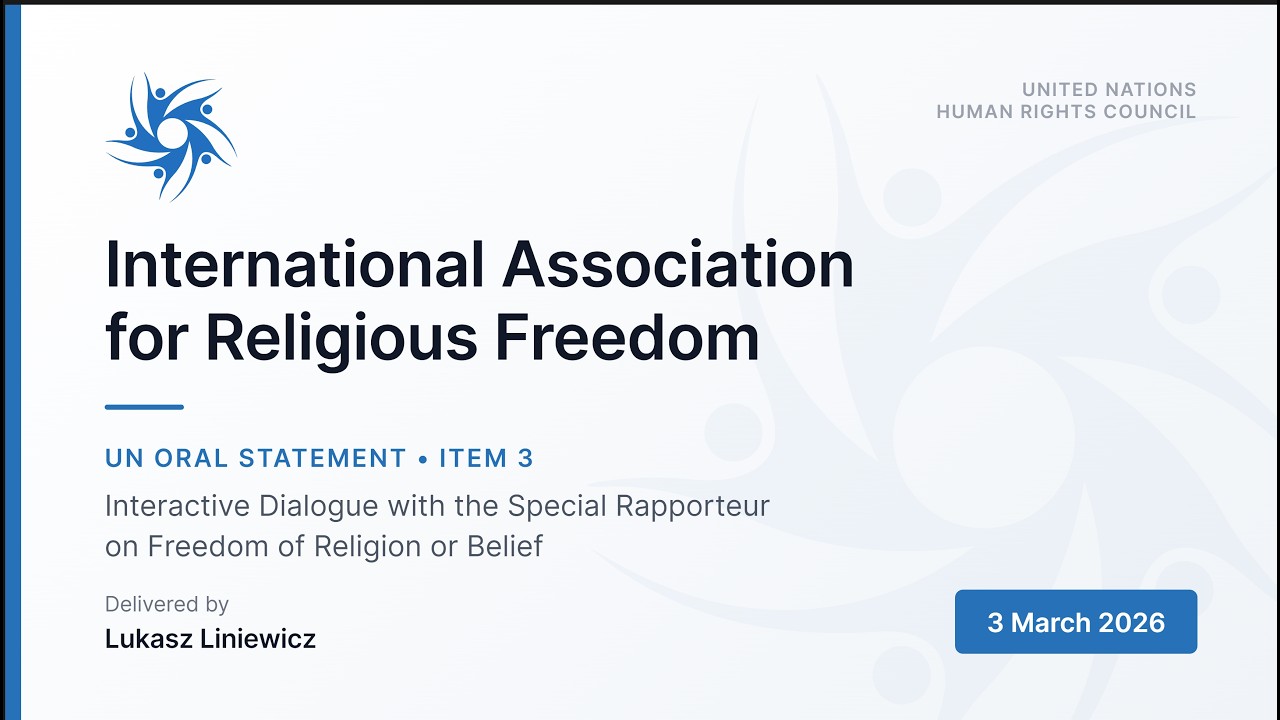
March 5, 2026 — During the ongoing session of the UN Human Rights Council, the International Association for Religious Freedom (IARF) took the floor to address a critical but often overlooked intersection of human rights: the right of Indigenous Peoples to access and care for their ancestral burial sites when those sites are located on privately owned land.
The statement was delivered during the Interactive Dialogue with Dr. Nazila Ghanea, the UN Special Rapporteur on Freedom of Religion or Belief, responding to her latest report on how freedom of religion or belief relates to death and honouring the deceased.
Watch the Oral Statement
The Regulatory Gap: Private Property vs. Sacred Duties
While many States have established protections for sacred and burial sites, these frameworks frequently suffer from a significant blind spot. Protections are often conditioned on government action or apply strictly to publicly managed lands.
When ancestral lands and burial sites fall into private hands or under private residential governance, Indigenous communities are frequently severed from their heritage. Without national frameworks extending to private property, communities are left without legal recourse to fulfill their religious and cultural duties to their ancestors.
Grounding the Issue: Kāneʻākī Heiau in Hawaiʻi
To illustrate the profound impact of this regulatory gap, IARF highlighted the situation at the Kāneʻākī Heiau site in Mākaha, Hawaiʻi. Here, Native Hawaiian practitioners face immense barriers—enforced by private residential governance—when seeking to access and care for their iwi kūpuna (ancestral remains).
This is not an isolated incident. The full scale of this problem remains largely undocumented globally, leaving many Indigenous communities silently cut off from their most sacred sites.
IARF’s Call to Action
In our statement to the Human Rights Council, the IARF urged States to take the following crucial steps:
- Conduct Systematic Assessments: States must actively document sacred and burial sites affected by private land governance.
- Develop Effective Frameworks: We need concrete legislative and policy solutions that balance private property rights with the fundamental human right to manifest religion and care for the deceased.
We look forward to continuing this vital conversation with the Special Rapporteur and UN Member States to ensure that honoring the deceased is a right guaranteed to all, regardless of modern property lines.
Full Transcript of the Oral Statement
Interactive Dialogue with the Special Rapporteur on Freedom of Religion or Belief 3 March 2026
“Mr. President,
The International Association for Religious Freedom welcomes Special Rapporteur Ghanea’s report on freedom of religion and honouring the deceased. We particularly appreciate paragraph four, which highlights the barriers Indigenous Peoples face in accessing burial lands to honour their ancestors.
In many States, protections for burial sites are conditioned on government action or apply only to publicly managed lands. This leaves a significant regulatory gap when such sites fall within privately owned or governed land. Without national frameworks extending to these contexts, private property mechanisms can effectively sever Indigenous communities from their ancestral heritage.
As an illustrative example, at the Kāneʻākī Heiau site in Hawaiʻi, Native Hawaiian practitioners face profound barriers—enforced by private residential governance—when seeking to access and care for their iwi kūpuna, their ancestral remains.
We note that the full scale of this problem remains largely undocumented, and we encourage States to undertake systematic assessments of sacred and burial sites affected by private land governance, as a necessary first step toward effective frameworks that balance property rights with the fundamental right to manifest religion and care for the deceased.
Special Rapporteur, what concrete legislative or policy best practices have proven effective in enabling States to reconcile private land governance with the protection of Indigenous Peoples’ rights to access and care for sacred and burial sites?
Thank you.”
Further Reading:
- Read the Special Rapporteur’s full report (A/HRC/61/50)