Introduction 1: Does Religious Freedom Matter? 2: Does Equality Trump Freedom? 3: Religious Beliefs and Institutions. 4: Equal Beliefs? 5: Is Religious Toleration Enough? 6: Freedom from the Law? 7: Belief and Practice 8: Necessary Limits to Religious Freedom 9: The Challenge of Equality 10: The Foundations of Equality and Freedom Conclusion
Scientists turn to natural selection, genes or adaptation to explain the living world, but much of the imagery used to present evolution threatens to distort our understanding of the incredible history of our planet. There is no science without mythology, and the only way to reveal the facts is to understand the fictions.
This book is the fruit of 15 years of face-to-face interfaith dialogue [in Britain] between practitioners of the three Abrahamic faith communities, Judaism, Christianity and Islam.
Martha Nussbaum and the new religious intolerance
Her latest book, The New Religious Intolerance, is a vigorous defence of the religious freedom of minorities in the face of post-9/11 Islamophobia.
This is an important and pioneering book, which seeks to find common ground between the teachings of Islam and of Buddhism. It is my hope that on the basis of this common ground, followers of each tradition may come to appreciate the spiritual truths their different paths entail, and from this develop a basis for respect for each others’ practice and beliefs. This may not have occurred very often before, because there has been so little opportunity for real understanding between these two great traditions.This book attempts to set that right …
From a Buddhist point of view, the practice of Islam is evidently a spiritual path of salvation.
— His Holiness the Fourteenth Dalai Lama
New Servetus title from IARF
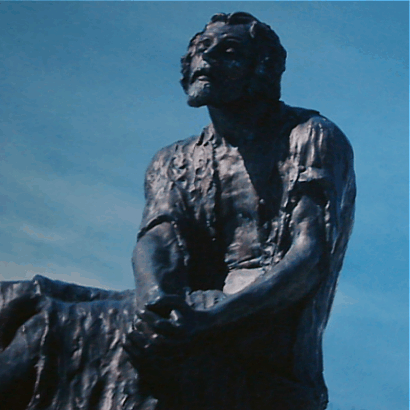
Publication: On the martyr Servetus
State of the martyr Servetus at Annemasse, France
2011 was the 500th Anniversary of the birth of Miguel Servetus (1511-1553), a Unitarian martyr for religious freedom, burned at the stake with his books in Geneva, 27 October, 1553…
Our British Chapter has collaborated to produce a festschrift titled “Servetus – Our 16th Century Contemporary” (PDF download), edited by Richard Boeke & Patrick Wynne-Jones, with contributions from Sandor Kovacs, Peter Morales, Richard Boeke, Peter Hughes, Jaume de Marcos.
Peter Morales with Servet festschrift
A flyer with details for obtaining the printed version is here.
Review: The Great Transformation – The Beginning of Our Religious Traditions
From the Axial Age
Karen Armstrong, The Great Transformation: The Beginning of Our Religious Traditions (New York: Alfred A. Knopf, 2006), 469 pp.
Karen Armstrong has written her most important book to date, tracing the origins of our religious inheritance in four centers of the Axial Age: China, India, Greece, and Palestine. The Axial Age gave rise to the origins of religious traditions as we know them between circa. 900 and 200 B.C. She skillfully weaves the histories of perhaps the most violent times in the human story with our religious origins as reactions to violence. In profound ways the founders sublimated violence into higher spiritual potentials of human nature. The sacrifice of bulls and sheep, and the willing sacrifice of the warrior hero became the self-sacrifice of the compassionate servant as in II Isaiah or for the renouncer in Upanishadic times, or even Socrates in his last days. Empathy for all, even the enemy, becomes a virtue even for the warrior or the king, as for Arjuna in the Bhagavad Gita or the emperor Ashoka, or Xunziâ’s advice for the compassionate king. In the Axial Age civilization became too complex for violence to govern beneficially. Religion, Armstrong believes, has not yet surpassed its most sublime Axial Age discoveries. To counter today’s distortions of religious traditions we must relearn step one, self-criticism in the face of enemies, and two, appropriate practical action to calm aggressions in our local traditions.
That she has surveyed these four centers of Axial origins with depth, appreciation and fairness is a remarkable achievement in our partisan age! I wished she had explored the interrelationships and mutual influences among the four centers. She does compare and contrast ideas among them but does not show causal connections, for example the great influence of Persian religion both in the west and in India or Chinese Confucian influences on the Enlightenment in Europe, or Greek art on the rise of Buddhist and later Hindu sculpture. In addition Armstrong bows somewhat with a loyalty to the so-called “perennial philosophy”, though she tends to relegate it to pre-Axial influences. And she gives a theistic meaning to T’ien and Taoist inner spirituality generally agreed among scholars to be misplaced for Chinese Humanism.
Taken as a whole, Karen Armstrong has given us a much needed world centered view for our religious inheritance, a critical grounding if we are ever to make this planet work for all its inhabitants. Ahimsa, jian ai, love thy neighbor as thyself, still in our time over two millennia later, forms our highest and widest embrace.
This easy-to-use fourth edition is updated and revised with the latest membership statistics on the various faith traditions, an expanded glossary of religious terms and an all-new section on popular religious symbols. It also includes the “Everything You Need to Know Before You Go” checklist.
This book helps turn the “strange” into the less confusing (but not the ordinary). Most of all, it enables the invited “stranger” to truly appreciate the experience, and enrich their own spiritual understanding.
We use cookies and local browser storage to keep you securely logged in and maintain your preferences. No third-party trackers or ad networks are used. Read our Privacy Policy.
Strictly NecessaryAlways Active
Keeps you logged in and protects forms from submission forgery. Necessary for account operation.
Usability & UI PreferencesOptional
Remembers details like chat widget coordinates and records if you have voted in a poll to prevent repeated popups.
JavaScript Core PlatformAlways Active
JavaScript is required to render the interactive app, direct messaging, offline caching, and calendars. No tracking libraries are loaded.
Why do we use JavaScript?
Our platform runs as a modern, interactive single-page application for logged-in members. We connect securely to socket.iarf.net via WebSockets for instant message delivery and online status indicators.
Where does my data go?
All data belongs exclusively to IARF and is stored on our secure VPS located in the EU. We do NOT run Google Analytics, Facebook Pixels, or other tracking code. External requests are only made to fetch FontAwesome icons and Google Fonts from public CDNs to display symbols and typography.
What happens offline?
We install a Service Worker to cache layout elements locally. No personal information is stored inside the local cache; it only speeds up navigation and enables basic offline views.



 by Stuart M. Matlins