Please Sign the Petition for Yezidis in the Netherlands
In recent months, IARF has supported young Yezidis in the Netherlands in their efforts to oppose a recent change in Dutch asylum policy, under which it is now deemed safe for Yezidis and followers of some other minority religions to return to Iraq and resume their previous lives, whereas international organisations and experts say the opposite.
For members and readers resident in the Netherlands
Please read, sign and share the petition below, and show your moral support for the young Yezidis.
This May, eleven IARF members from the US, UK, Netherlands, Switzerland and Germany undertook a spiritual and religious journey of two weeks to Japan. Kathy Matsui, member of IARF’s Japan Chapter and one of our UN representatives, accompanied us on the trip, supported for parts of it by Yayoi Kimura of Ittoen and Ritsuko Ushio of the Konko Church.
In Tokyo we were received on the first day by the Buddhist organisation Rissho Kosei-kai, in whose pilgrimage resort we stayed in Tokyo, the Japan Chapter and the Japanese section of the International Association of Liberal Religious Women (IALRW), with a tour of the premises, a tea ceremony, traditional garments, and several presentations.
In Hiroshima, local Chapter members had lunch with us following an impressive visit to the Peace memorial and memorial museum. We spent considerable time in Kyoto and Osaka, visiting amongst others our member organisations Ittoen and the Konko Church, the Aoi Matsuri procession, and having lunch with IARF’s Japan Liaison Committee, alongside visits to several Buddhist temples and shrines. Our thanks also go to our member organisations Mutsumi-kai and Shitenno-ji for their warm welcome and their kind hospitality.
The Ittoen community, due to its location in the hills and its philosophy of humility and servitude, made a lasting impression. Our day at Tsubaki Grand Shrine, in the mountains east of Osaka, taught us about the nature of Shintoism, explained to us in a prayer as adapting to the natural order of things and seeking harmony, and in a way complementary to Buddhism. Koyasan offered two days of meditation and contemplation, with many Buddhist temples, in a beautiful mountainous setting south of Kyoto, where women, until far in the twentieth century, were not supposed to disturb the monks. We stayed in a Buddhist monastery, with vegetarian meals, sober, but delicious.
All participants were united by their sincere interest in classic and modern Japan and their openness to its spiritual traditions, which showed not only during the various encounters with our hosts but also in the talks amongst ourselves. We extend our thanks to all in Japan who made this visit possible. It has shown that enabling personal growth through exchange and common celebration is one of the most valuable aspects of IARF, and that we should undertake more such exchanges.
Use arrows or swipe to navigate. Pinch, double-tap, scroll, or use the controls to zoom.
Protecting Ancestral Heritage: IARF Addresses the UN on Indigenous Burial Rights on Private Land
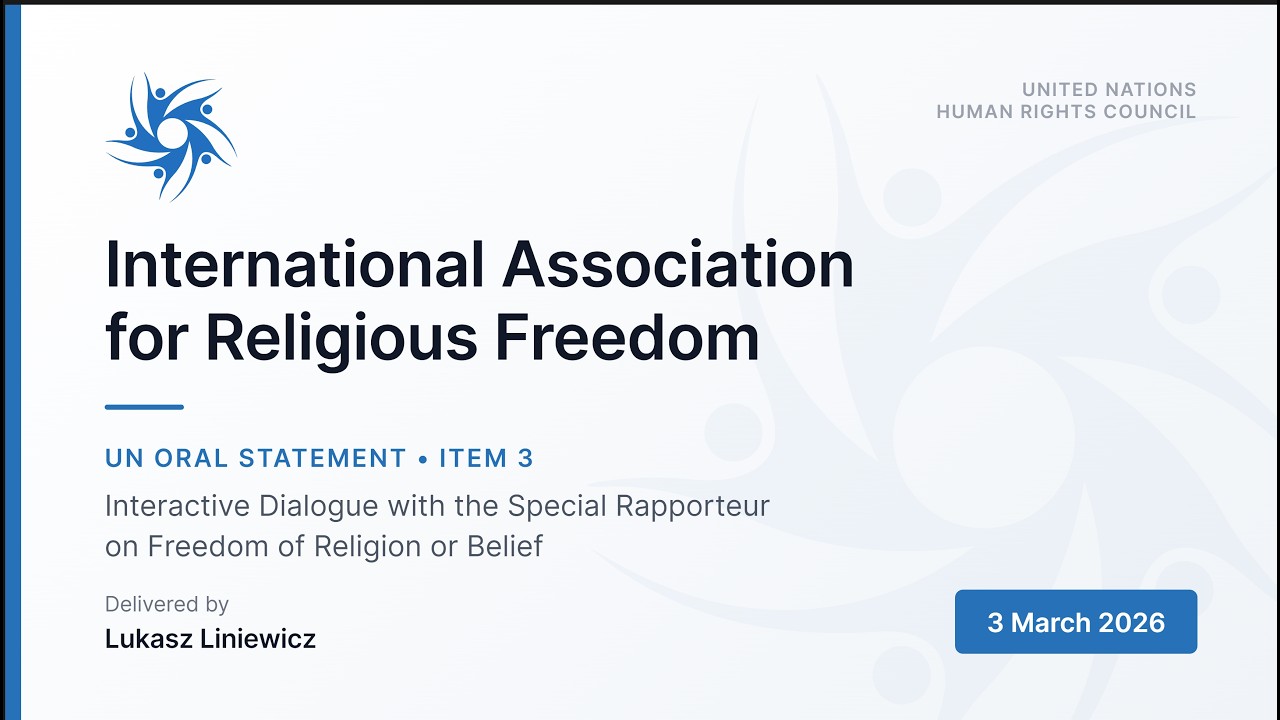
March 5, 2026 — During the ongoing session of the UN Human Rights Council, the International Association for Religious Freedom (IARF) took the floor to address a critical but often overlooked intersection of human rights: the right of Indigenous Peoples to access and care for their ancestral burial sites when those sites are located on privately owned land.
The statement was delivered during the Interactive Dialogue with Dr. Nazila Ghanea, the UN Special Rapporteur on Freedom of Religion or Belief, responding to her latest report on how freedom of religion or belief relates to death and honouring the deceased.
Watch the Oral Statement
The Regulatory Gap: Private Property vs. Sacred Duties
While many States have established protections for sacred and burial sites, these frameworks frequently suffer from a significant blind spot. Protections are often conditioned on government action or apply strictly to publicly managed lands.
When ancestral lands and burial sites fall into private hands or under private residential governance, Indigenous communities are frequently severed from their heritage. Without national frameworks extending to private property, communities are left without legal recourse to fulfill their religious and cultural duties to their ancestors.
Grounding the Issue: Kāneʻākī Heiau in Hawaiʻi
To illustrate the profound impact of this regulatory gap, IARF highlighted the situation at the Kāneʻākī Heiau site in Mākaha, Hawaiʻi. Here, Native Hawaiian practitioners face immense barriers—enforced by private residential governance—when seeking to access and care for their iwi kūpuna (ancestral remains).
This is not an isolated incident. The full scale of this problem remains largely undocumented globally, leaving many Indigenous communities silently cut off from their most sacred sites.
IARF’s Call to Action
In our statement to the Human Rights Council, the IARF urged States to take the following crucial steps:
Conduct Systematic Assessments: States must actively document sacred and burial sites affected by private land governance.
Develop Effective Frameworks: We need concrete legislative and policy solutions that balance private property rights with the fundamental human right to manifest religion and care for the deceased.
We look forward to continuing this vital conversation with the Special Rapporteur and UN Member States to ensure that honoring the deceased is a right guaranteed to all, regardless of modern property lines.
Full Transcript of the Oral Statement
Interactive Dialogue with the Special Rapporteur on Freedom of Religion or Belief3 March 2026
“Mr. President,
The International Association for Religious Freedom welcomes Special Rapporteur Ghanea’s report on freedom of religion and honouring the deceased. We particularly appreciate paragraph four, which highlights the barriers Indigenous Peoples face in accessing burial lands to honour their ancestors.
In many States, protections for burial sites are conditioned on government action or apply only to publicly managed lands. This leaves a significant regulatory gap when such sites fall within privately owned or governed land. Without national frameworks extending to these contexts, private property mechanisms can effectively sever Indigenous communities from their ancestral heritage.
As an illustrative example, at the Kāneʻākī Heiau site in Hawaiʻi, Native Hawaiian practitioners face profound barriers—enforced by private residential governance—when seeking to access and care for their iwi kūpuna, their ancestral remains.
We note that the full scale of this problem remains largely undocumented, and we encourage States to undertake systematic assessments of sacred and burial sites affected by private land governance, as a necessary first step toward effective frameworks that balance property rights with the fundamental right to manifest religion and care for the deceased.
Special Rapporteur, what concrete legislative or policy best practices have proven effective in enabling States to reconcile private land governance with the protection of Indigenous Peoples’ rights to access and care for sacred and burial sites?
Update from the US Chapter: Concerns Raised Over New “Religious Liberty Commission”
Our colleagues in the United States have shared a significant update regarding the current climate of religious freedom in their region. In a recent communication to members, the US Chapter raised serious concerns regarding the Administration’s establishment of a “Religious Liberty Commission” within the Department of Justice.
US Chapter President George Garland has alerted members to what the Board views as a troubling development, noting that the new commission appears to prioritize specific conservative religious interests in a way that conflicts with federal law. The Chapter stresses the importance of maintaining a clear separation of church and state to protect the rights of all faith communities.
In response, the IARF-US President and Board have formally endorsed a lawsuit filed by the Interfaith Alliance and a diverse coalition of partners, including Muslims For Progressive Values and Hindus For Human Rights. The legal challenge asserts that the commission was unlawfully constituted and seeks to ensure transparency regarding its recommendations.
The US Chapter is currently encouraging its members to contact their representatives in Congress to address the matter.
For the full statement from President Garland and further details on the coalition’s legal action, please visit the US Chapter website.
Unitarian Beginnings and Heritage in Poland: A Historical Pilgrimage
Dates: May 20–26, 2026 |
Location: Poland |
Organizer: Polish Unitarian Society & Partners
We are pleased to share a unique opportunity for IARF members—particularly those in Europe—to explore the deep roots of liberal religion. This historical study tour is hosted by leaders from the Polish Unitarian Society, a member group of the IARF, in collaboration with Unitarian Universalist ministers from the United States.
Discover the “Heartland” of Religious Dissent
Join a journey back to the 16th century, visiting the Unitarian “heartland” where the Polish Brethren (also known as Socinians) established congregations that openly challenged dogma, rejected infant baptism, and championed pacifism. These events occurred eight years before similar movements in Transylvania, making this a crucial site for the history of religious freedom.
The influence of the Polish Brethren was monumental for the development of liberal religious and political thought in Holland, England, and America. The tour will focus on Raków, the intellectual center where the famous Racovian Catechism was printed in 1605.
Itinerary Overview
This pilgrimage moves from the modern capital to the historic countryside, ending in the royal city of Kraków.
WarsawDay 1: May 20
Afternoon arrival in the capital. Orientation and welcome dinner with the group.
Warsaw → The CountrysideDays 2-3: May 21-22
Meeting with local Unitarians and historian Prof. Stanisław Obirek. Departure by chartered bus to the historic heartland.
Raków & SurroundingsDays 4-5: May 23-24
Based near Raków, we visit worship sites of the Polish Brethren—some restored, others in evocative ruins.
KrakówDays 6-7: May 25-26
Tour concludes in the royal city. Visit Wawel Castle, the Old Town, and WWII history sites. Closing dinner.
Departure is scheduled for the morning of May 27.
Cost & Logistics
The tour is led by Rev. Jay Atkinson, Rev. Roger Jones, and Rev. Kevin Tarsa, alongside local Polish lay leaders Justyna Borusińska and Jarosław Wajchert.
Cost: Approx. $1000 USD (double occupancy) / $1200 USD (single). Includes lodging, local transport, breakfasts, and some meals. (Airfare not included).
Financial Aid: Scholarship aid is being explored for seminarians and early-career ministers.
Registration & Contact
For questions, specific payment details, or to register for the tour, please contact the lead organizer, Jay Atkinson.
The International Association for Religious Freedom (IARF) is deeply saddened to share the news of the death of the Rev. John Clifford.
John was a dedicated internationalist, a passionate advocate for peace, and a universally respected leader within the Unitarian movement. His commitment to interfaith understanding and his service to our organization spanned decades, leaving a lasting mark on colleagues across Europe and the United Kingdom.
A Devoted IARF Activist
John’s connection to the IARF was profound and hands-on. Born in the USA, he eventually settled in the UK, but his vision was always global. From 1983 to 1986, John served directly on the IARF staff at our former headquarters in Frankfurt, Germany.
Long-time IARF colleagues Lucie Meijer (Dutch Chapter) and Dorothee Gehrmann (German Chapter) shared this reflection on his time with the secretariat:
John Clifford, a Unitarian minister from the UK, joined the IARF Staff at headquarters in Frankfurt, Germany, from 1983–1986. He moved with his family to live in Offenbach and cycled each day to the IARF office in Frankfurt, where he took care of publicity.
He was involved in organizing the IARF Peace Vigil in Utrecht, Netherlands, in 1985, during the IARF Peace Conference Europe. He edited the Conference Declaration on ‘Peace – our commitment to the future’. It could be said that he was a faithful and devoted IARF activist and competent helper at IARF conferences and congresses, before as well as after his years on the staff of the IARF international secretariat.
A Life of Ministry and Service
Born in the United States, John discovered Universalism while in secondary school. After training for the ministry, he moved to Britain, where he was naturalised in Scotland in 1975. He served as the minister of Glasgow Unitarian Church from 1975 to 1983, immediately prior to his service with the IARF in Frankfurt.
Upon returning to the UK, his dedication to the movement continued to grow. He served the British General Assembly (GA) of Unitarian and Free Christian Churches with distinction, holding the roles of Deputy General Secretary, Executive Committee member, President of the Ministerial Fellowship, and President of the General Assembly.
His commitment to internationalism remained a core part of his work; from 2005 to 2009, he served as the Executive Secretary of the International Council of Unitarians and Universalists (ICUU).
In his later years, he remained a beloved figure in Scotland as an associated minister at St Mark’s Unitarian Church in Edinburgh. Friends there remember him for his “thoughtful presence, gentle friendship, and deep care for the life of the congregation.”
Philosophy, Personality, and “The Web of Life”
John was a man of deep intellect and broad interests. He described his personal philosophy as centered in “empirical process philosophy,” blending liberal Christianity, Buddhism, and a deep appreciation for “the web of life.” He viewed religion not just as philosophy, but as a community base where spiritual development finds expression in practical ethical actions.
He embraced life fully. Beyond theology, he was known for his love of stamp collecting, astronomy, and linguistics. Having fully adopted his Scottish home—often evidenced by his wearing of the kilt—he was also an enthusiast of piping and Scottish Country Dancing.
Remembering a Friend
His presence was a staple at gatherings, blending serious commitment with warmth. Derek McAuley, Chair of the IARF British Chapter, reflected:
John was committed to IARF and always attended our workshop at the British Unitarian Annual Meetings. We will miss his wry humour and his American-Scottish twang!
A Lasting Legacy
John passed away shortly after attending the induction of the new minister at St Mark’s, remaining active and supportive of his community to the very end.
We give thanks for John’s life, his ministry, and his tireless work for peace in Europe and beyond. The IARF sends its heartfelt condolences to his wife, Barbara, their five children and eight grandchildren, and his many friends in Glasgow, Edinburgh, and the international community.
He will be greatly missed.
Sit-in Demonstration by Yezidis in The Hague Because of Recent Dutch Policy Change
Young Yezidis are holding a sit-in demonstration this month in front of The Hague Central train station to express their concerns about a recent change in Dutch policy. Under this new policy, the government now considers it generally safe for Yezidis and other religious minority groups to return to Iraq—either to the city of Sinjar and its surroundings, or to camps in the Kurdish Autonomous Region. As a result of this change, many requests for asylum by Yezidis have been rejected in the past 1.5 years.
Yezidis believe that since the genocide of 2014, they cannot safely live in Iraq due to continuing discrimination, hate speech from other groups, a lack of law and order, and widespread impunity. Recent developments in Iraq and Syria have only increased these concerns.
In Germany, Yezidis face similar problems. Please support the Yezidis by writing to your Member of Parliament, donating to Yezidi organizations, or encouraging them by passing by their sit-in demonstration in The Hague. IARF supports the Yezidis in the Netherlands.
Joint Anniversary Celebration in Bengaluru
On December 13, 2025, a gathering titled Sammilana was held in Bengaluru to mark the 125th Anniversary of the International Association for Religious Freedom (IARF) and the 25th Anniversary of the United Religions Initiative (URI).
The event was organized by Dr. C.N.N. Raju in collaboration with Seshadripuram College and the Karnataka State Gandhi Smarak Nidhi. To commemorate the occasion, a special booklet was released featuring messages from various contributors, including a reflection by IARF Past President Wytske Dijkstra on the challenges and value of the organization’s 125-year journey.
“The IARF established itself in places and countries where the original ideas of liberal religiosity were virtually unknown for cultural reasons. For the organization, this was a hazard. Without a uniting principle, the IARF was in danger of falling apart. It didn’t!”
— Wytske Dijkstra, Past President IARF
How Liberal Religion Spearheaded Protection of Belief: Anniversary of the 1981 UN Declaration
“Considering that religion or belief, for anyone who professes either, is one of the fundamental elements in his conception of life…”
— Preamble, 1981 UN Declaration
November 25 marks a pivotal, yet often overlooked, milestone in the history of human rights. On this day in 1981, after nearly two decades of geopolitical gridlock, the United Nations General Assembly adopted Resolution 36/55: the Declaration on the Elimination of All Forms of Intolerance and of Discrimination Based on Religion or Belief., the first international instru
ment dedicated solely to freedom of religion.
While the 1948 Universal Declaration of Human Rights laid the foundation, it was this 1981 document that finally codified the specific rights of conscience—freedom to worship, to teach, to publish, and to organize—into international norms. But this victory was not inevitable. It was achieved through the tenacious intervention of civil society when governments had all but given up.
The story of the 1981 Declaration is, in large part, a story of liberal religion. Through the leadership of the IARF and our member groups—particularly the Unitarian Universalist Association (UUA)—our representatives spearheaded the consensus that protects the rights of believers and non-believers alike.
Deep Roots: A Legacy of Visionary Activism
Long before the Declaration was drafted, the IARF recognized that religious freedom required a global political framework. As detailed in the IARF’s Centennial Reflections, this engagement began with Elvira Fradkin, a visionary American Unitarian from Montclair, New Jersey.
Present at the founding of the United Nations in San Francisco in 1945, Fradkin understood early on that the new world order needed the voice of liberal religion. It was her persistence that convinced the IARF to register with the UN Economic and Social Council (ECOSOC) in the 1950s—one of fewer than 300 NGOs to do so at the time. Her work laid the logistical and moral groundwork for the battles that would come decades later.
The Cold War Deadlock: Diplomacy Over Dogma
By 1972, the UN’s effort to create a binding treaty on religious freedom had stalled completely. The drafting process was paralyzed by the rigidity of the Cold War. The Soviet bloc refused to sign any document that did not explicitly protect atheism and shield the state from “religious interference.” Meanwhile, various Western and Islamic nations clashed over the definition of religious rights, particularly regarding the right to change one’s religion.
In this vacuum of political will, religious freedom was becoming a casualty of superpower posturing. This is where the IARF and the UUA played their most decisive role. Because liberal religion honors the inherent dignity of all paths—theistic, non-theistic, and atheistic—our representatives were uniquely positioned to bridge the ideological divide.
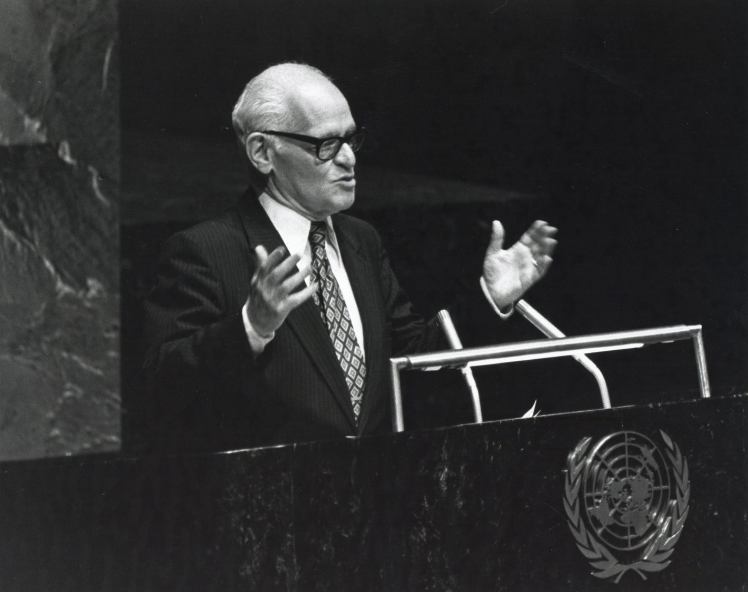
Dr. Homer A. Jack (1916–1993): A Unitarian Universalist minister and IARF luminary. As Secretary-General of the World Conference on Religion and Peace (WCRP), he masterminded the NGO strategy that rescued the Declaration from obscurity.
Two leaders from our community were central to breaking the impasse:
Prof. Auguste-Raynald Werner, the IARF Representative in Geneva. A distinguished Professor of International Law, Werner worked tirelessly within the UN Commission on Human Rights. He used his legal expertise to craft language capable of satisfying opposing political blocs, ensuring the text was robust enough to protect rights but flexible enough to pass.
Dr. Homer A. Jack, a Unitarian Universalist minister serving as Secretary-General of the WCRP. He spearheaded the “Gang of Four” NGOs that refused to let the issue die. When member states moved to shelve the draft, Jack mobilized the NGO community to pressure the General Assembly to prioritize a non-binding Declaration over a doomed Treaty—a strategic pivot that saved the project.
The “Religion or Belief” Compromise
One of the most significant contributions of the liberal religious lobby was the insistence on the phrasing “Religion or Belief.” This distinction was not merely semantic; it was the key to consensus. It ensured that the Declaration covered theistic faiths, non-theistic traditions, and atheistic views equally.
This inclusivity satisfied the Eastern bloc’s demand for the protection of non-religious convictions while aligning perfectly with the IARF’s principle of universal tolerance. It established a precedent that remains vital today: that freedom of conscience belongs to everyone, not just the religious.
Connecting the Dots: A Legacy of Action
The adoption of the Declaration was a victory, but as Dr. Jack noted in his memoirs, Homer’s Odyssey, a declaration without enforcement is just paper. The IARF’s leadership was central to building the machinery that enforces these rights today.
1972: The Pivot
A “Core Group” of NGOs, led largely by liberal religious actors including Homer Jack, petitions the UN General Assembly to abandon the stalled Treaty negotiations and prioritize a Declaration. This strategic shift breaks a decade-long deadlock.
1981: The Victory
The Declaration is adopted by the General Assembly. It explicitly codifies rights that were previously vague, such as the freedom to write and disseminate publications, teach religion, and solicit financial contributions.
1986: The Mechanism
Realizing the Declaration needed “teeth,” the IARF and its partners successfully lobby the UN to create the mandate for a Special Rapporteur (originally on “Religious Intolerance,” now “Freedom of Religion or Belief”). This created the “eyes and ears” of the UN to receive complaints from victims worldwide.
1991: The Watchdog
To ensure the Declaration wouldn’t collect dust, the NGO Committee on Freedom of Religion or Belief is formally established in New York, with IARF leadership at the helm.
Institutionalizing Freedom: The Role of Sue Nichols
The creation of the NGO Committee in New York—the primary body that coordinates civil society advocacy on this issue today—was inextricably linked to the IARF and the UUA.
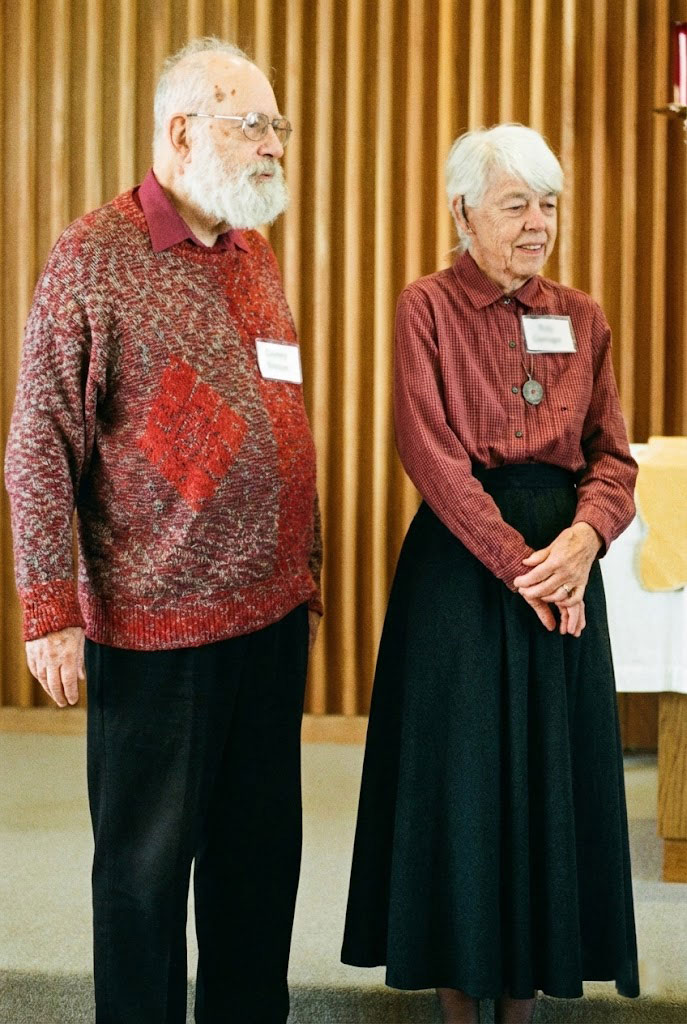
Architects of the Committee: Vernon and Sue Nichols, co-directors of the UU-UN Office. Sue Nichols (right) served as the founding President of the NGO Committee on Freedom of Religion or Belief in New York. (Photo courtesy of UUA Retired Ministers and Partners Association)
Sue Nichols, who co-directed the Unitarian Universalist UN Office with her husband Vernon, served as the IARF’s representative on the ground in New York during this critical period. Following the commissioning of the seminal “Salzberg Study” by Dr. Jack to explore implementation strategies, Nichols took the lead in formalizing the NGO coalition.
She became the founding President of the NGO Committee in New York. Under her leadership, the committee moved from an informal pressure group to a recognized powerhouse within the UN system. It established the tradition of the “Annual Day” to commemorate the 1981 Declaration and works directly with the Special Rapporteur to highlight violations globally.
A Continuing Responsibility
The 1981 Declaration remains the most important international instrument for religious freedom since the Universal Declaration of Human Rights. It serves as the basis for the mandate of the Special Rapporteur and laid the groundwork for modern diplomatic breakthroughs, such as Human Rights Council Resolution 16/18, which shifted the focus from protecting abstract religions to protecting living human beings from discrimination.
Today, the IARF continues this work as an active member of the NGO Committees on Freedom of Religion or Belief in both New York and Geneva. We honor the legacy of Fradkin, Werner, Jack, and Nichols not by looking backward, but by continuing to press for the rights of all people—regardless of their creed—to believe, or not believe, in freedom.
We Are Still Active Today
The IARF continues to honor this legacy. We remain an active member of the NGO Committees on Freedom of Religion or Belief in both New York and Geneva, working with the Special Rapporteur to ensure rights are respected.
Get Involved: IARF members are warmly invited to join our International Engagement Working Group to support our continued advocacy at the United Nations.
Dive Deeper into this History:
Read “Centennial Reflections”: The full chapter on the IARF at the United Nations by Ruth Neuendorffer and Sue Nichols is available in our library for detailed historical context.
Memoirs: For a personal account of the diplomatic struggle, see “Homer’s Odyssey” by Dr. Homer Jack.
Interfaith Statement Supporting Trans, Intersex and Nonbinary People
On the International Transgender Day of Remembrance, the International Association for Religious Freedom welcomes the statement on the rights of Trans, Intersex and Nonbinary People issued by the Unitarian Universalist Association, our member group, in coalition with several faith groups, including the United Church of Christ, the Episcopal Church and other Christian denominations, Union for Reform Judaism and other Jewish organisations, and others.
“…there is a disgraceful misconception that all people of faith do not affirm the full spectrum of gender – a great many of us do. Let it be known instead that our beloveds are created in the image of God – Holy and whole.”
Statement Supporting Trans, Intersex and Nonbinary People
As an organisation uniting free and liberal religious communities and individuals, we advocate religious freedom as first and foremost freedom within religion, a freedom to live one’s life creatively and without coercion in a shared experience of the divine and a shared pursuit of justice. We acknowledge the value of the prophetic voice of progressive religion and humanistic philosophy as many still suffer discrimination, alienation, vilification and ridicule, and, in many parts of the world, may lose their freedom or even their lives for failing to conform to social norms, even though they inflict no harm on others.
Regrettably, religion often plays a role in providing justification for condemning and persecuting them, and inflicts great spiritual suffering by proclaiming their identity, their experience and expression of humanity as sinful and abominable in the eyes of the divine. This makes voices like these, where people of faith come together to speak both to society at large and to those often excluded by religion, not mere statements, but acts that have the power to change lives. By offering a different perspective and testifying to the healing, transformative power of faith, we can make a difference, just as we strive to do so in the daily lives of our communities.
Your Privacy & Consent
We use cookies and local browser storage to keep you securely logged in and maintain your preferences. No third-party trackers or ad networks are used. Read our Privacy Policy.
Strictly NecessaryAlways Active
Keeps you logged in and protects forms from submission forgery. Necessary for account operation.
Usability & UI PreferencesOptional
Remembers details like chat widget coordinates and records if you have voted in a poll to prevent repeated popups.
JavaScript Core PlatformAlways Active
JavaScript is required to render the interactive app, direct messaging, offline caching, and calendars. No tracking libraries are loaded.
Why do we use JavaScript?
Our platform runs as a modern, interactive single-page application for logged-in members. We connect securely to socket.iarf.net via WebSockets for instant message delivery and online status indicators.
Where does my data go?
All data belongs exclusively to IARF and is stored on our secure VPS located in the EU. We do NOT run Google Analytics, Facebook Pixels, or other tracking code. External requests are only made to fetch FontAwesome icons and Google Fonts from public CDNs to display symbols and typography.
What happens offline?
We install a Service Worker to cache layout elements locally. No personal information is stored inside the local cache; it only speeds up navigation and enables basic offline views.