
Sanctions, Embargos and Human Rights: British Chapter resolution
18 December 2012
Preamble
“Sanctions and embargos directly affect Religious Freedom and other human rights. In December we learned that the United States’ economic blockade against Cuba has forced the postponement of the 6th General Assembly of the Latin American Council of Churches (CLAI), scheduled for 19 to 24 February 2013 in Havana, Cuba. (as reported 14 Dec 2012 <http://www.ekklesia.co.uk/node/17614>).
The American branch of the Ecuadorian bank Pichincha in Miami froze a deposit of 101,000 US dollars made by the CLAI headquarters in Quito, Ecuador. The transfer to Cuba was to cover costs of food and lodging for the 400 delegates and other participants expected to attend the meeting in that nation.
“This is greatly disappointing to the member churches of CLAI and to the entire constituency of the World Council of Churches (WCC),” the Rev Dr Olav Fykse Tveit said on Thursday 13 December 2012, after learning of the decision by CLAI to postpone the assembly.
“This shows that the decades old economic blockade of Cuba is out of touch with the realities in the world today, particularly in the faith-based communities, and should be ended for the sake of justice and peace,” Dr Tveit added.
The social effect of sanctions upon civilian populations historically may be seen in the shift of Cuban policy from left-wing nationalism to austere communism, the birth of the Russian Mafia in the black markets of the former Soviet Union and the growth of terrorist organizations in Palestine, Iraq and Syria. The current situation in Iran for people with long- term illnesses has recently been highlighted. International banks refuse to process payments for medicines because they fear incurring penalties for sanction-breaking.
Resolution
The British Chapter of the IARF questions the morality and long-term effectiveness of the indiscriminate use of sanctions, embargoes and blockades as ‘peaceful’ proxies for direct military action in pursuance of political, territorial or commercial aims or for collective punishment. Such actions inflict real and unjust harms upon the most vulnerable members of targeted nations. They often become an obstacle to the peaceful resolution of disputes. Sanctions and embargoes may in times of peace appear to be a less reprehensible response to ‘provocations’ than overt military action. However, this is only true if their consequences upon the human rights of the powerless are fully considered. They may directly and indirectly cause widespread personal injury and loss of life. This entrenches divided opinion, encourages violent response, and presents an obstacle to genuine meaningful negotiations.
We therefore urge states and nations enforcing or responding to sanctions, to act humanely, proportionately and moderately, to accept the responsibility to avoid or limit the harms caused by their actions, and to respect the Human Rights of vulnerable civilian populations.”
Rev. Dr. Richard Boeke, Chair, British Chapter IARF
Rev Chris Hudson MBE, Vice-Chair
Rev Feargus O’Connor, Secretary
With contributions by Shaykh Muhammad Amin Evans, Charanjit Singh, and Derek McAuley
Islam, Democracy & the Pursuit of Civil Society – Tariq Ramadan
September 10, 2012
Professor Tariq Ramadan at the University of Michigan
“From the Arab Awakening, Forward: Islam, Democracy & the Pursuit of Civil Society” (YouTube)
The new book: Islam and the Arab Awakening
Pew Report: Rising Tide of Restrictions on Religion
September 20, 2012
…third in a series of reports by the Pew Research Center’s Forum on Religion & Public Life analyzing the extent to which governments and societies around the world impinge on religious beliefs and practices.
These reports have drawn widespread attention to the fact that a substantial portion of the world’s population – 75% as of mid-2010 – lives in countries where governments, social groups or individuals restrict people’s ability to freely practice their faith.
The new report looks at the extent and direction of change in religious restrictions from the year ending in mid-2009 to the year ending in mid-2010. Where appropriate, it also compares the situation as of mid-2010 with the situation in the baseline year of the study (mid-2006 to mid-2007).
Peace Commission statement on Syria
Statement on Syria
09 September 2012
The Peace Commission of the International Association for Religious Freedom has noted with great concern that in the pursuit of geostrategic policies, ill-considered military and material support of ‘popular’ revolutions with poorly-defined aims and structures has led to situations where human rights have been systematically abused, religious freedom has been denied, and transnational violence exacerbated.
Amongst the consequences of such support has been the inability of affected countries to sustain democratic governance; the destruction of sites of international cultural or religious importance; large-scale military intervention; and the spread of conflict to neighbouring democratic states.
The growing conflict in Syria has seen the development of terrorist organisations with ideologies of religious and ethnic hatred which threaten the peace and security of all nations in the region. They are funded and supported by non-democratic states with sectarian rulers who are known to promote enmity towards Christians, Jews and various denominations of Islam within their own national territories.
It is therefore essential for the long-term peace and stability of the region, and for the safety of countless citizens of Syria’s neighbours, that the international community applies diplomatic pressure to ensure that aid from any state is not intended or diverted to support sectarian or racially motivated terror.
British Chapter AGM: talks
2012 Annual General Meeting of the IARF British Chapter
19 May 2012, Unitarian Church Croydon, London
“Challenges to Civil & Religious Liberty Today”
(350th Anniversary of the Great Ejection of 1662)
Rev. Andrew Hill spoke on The Great Ejection in 1662, of two thousand Puritan clergymen from Church of England, which eventually led to the foundation of religious communities dissenting from the established church.
Sheikh Muhammad Amin-Evans spoke on The Mihnah, an inquisition instituted by the ‘Abbasid Caliph al-Ma’mun in 218 AH/833 AD against religious scholars who opposed the doctrine of the created nature of the Qur’an. Like the 1662 Great Ejection, the Mihnah occurred after a period of revolution, at a time of counter-revolution when people were trying to establish or re-establish states, authority and the identity of the ‘good’ citizen.
Rev Andrew Hill, ‘2012 – 350 = 1662’ (PDF, 6 pages)
Sheikh Muhammad Amin Evans, ‘The Mihnah (833 to 848) & encouraging inclusive Islam in Birmingham today’ (PDF, 8 pages)
Note: A Service of Reconciliation was held at Westminster Abbey on 7 February 2012 to mark the 350th anniversary of the Great Ejection. Dr Rowan Williams, the Archbishop of Canterbury, preached at the service which was attended by clergy and laity of the Church of England and the United Reformed Church.
IION Meeting 2008
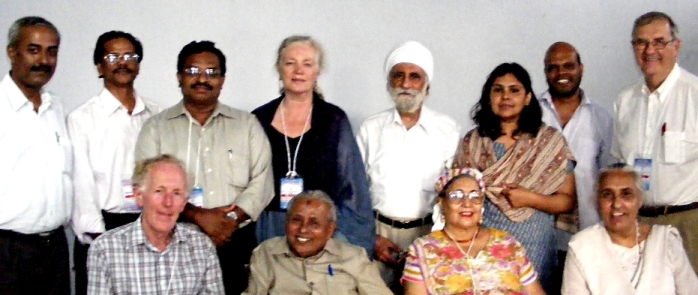
The 2008 meeting of representatives of International Interfaith Organisations (IION) was held in India from October 4th-7th at the Renewal Centre, Azad Road, Kochi, Kerala, in conjunction with the Assembly of the WORLD FELLOWSHIP OF INTER-RELIGIOUS COUNCILS (WFIRC), which is a member of IION.
Report by Marcus Braybrooke – IION Kochi 2008 (PDF, 8 pages)
Report by TK Jyothiraj – IION Kochi 2008 (PDF, 2 pages)
Celebrating Together
by Doris Hunter
At 5:30am one morning last week at the monastery I joined the monks and nuns for morning meditation. Going into the great hall I looked up at the three gigantic golden Buddhas looming over me. I stood in the line with other visitors and I heard over 500 voices chanting the sutra, words that I have just shared with you. The devotion and serenity of those voices overwhelmed me. Here were the words coming from one of the Buddhist scriptures celebrating the Mahayana tradition. Its emphasis is on the compassion of the Buddha and the way for spiritual happiness for both laity and monks. This was the setting for the 32nd Congress of the International Association for Religious Freedom. More…