
Spring 2026 IARF Study Tour to Japan
One valuable aspect of IARF is the opportunity for members from different countries, religions, and cultures to meet and inspire each other. IARF is now planning a tour to Japan for spring 2026 to study Japan’s religious and spiritual traditions, with a particular focus on those connected to our member organisations.
The programme will include meetings with various groups associated with our members and member organisations, as well as activities commemorating the end of World War II and the atomic bombings of Hiroshima and Nagasaki.
Courses from IARF’s online Free Religion Institute, such as the one announced in this newsletter, will be one way to prepare for the study tour. Plans are still in their early stages, but if you are interested, please send an email to [email protected]. This also applies if you have specific suggestions or wishes for the tour (for instance, a particular theme) or if you would like to be part of the preparatory committee. We will keep you informed through future newsletters.
Express Your Interest
Celebrating 40 Years: A Report on the IARF JLC Anniversary Gathering
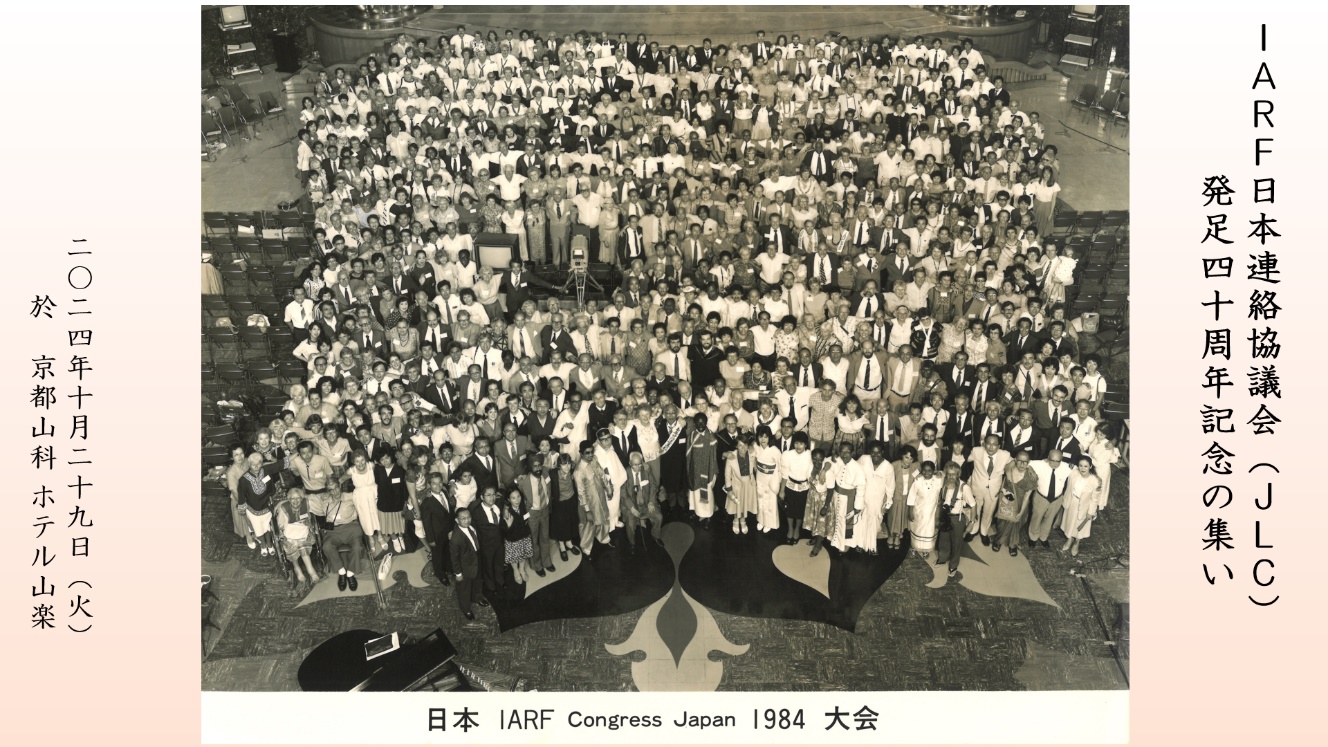
Objective
The year 2024, it has been 40 years since the IARF Japan Liaison Committee (JLC) was established on the occasion of the 25th IARF World Congress in Tokyo in 1984. To commemorate this, a gathering was held to celebrate the 40th anniversary of the JLC.
We looked back on the 40 years of the JLC, reflected on the passion of the original members, deepened the exchange between members and wished to continue developing IARF activities in Japan in the future.
Summary
Part 1: Slideshow Session ‘JLC – 40 years of history through images’
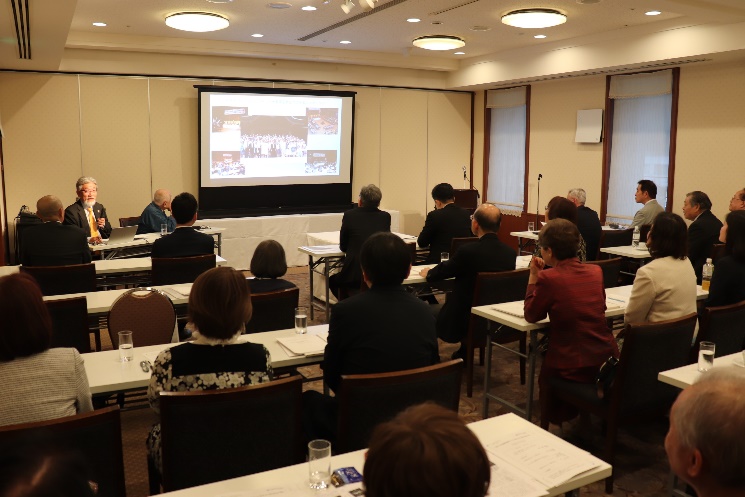
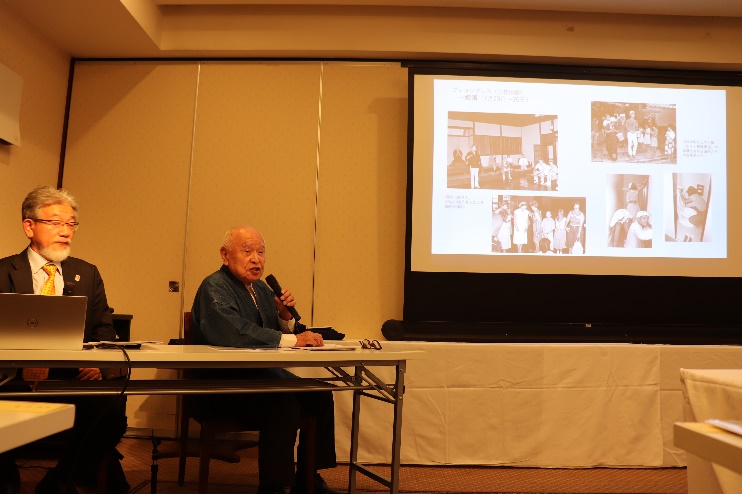
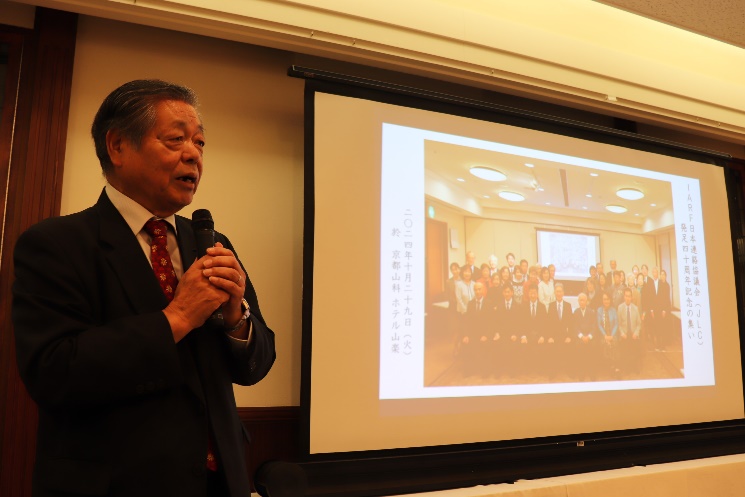
After the MC, Rev. Torazo Tanino, declared the meeting open, Rev. Yukinobu Sahara gave the opening address. The moderator, Rev. Yoshinobu Miyake, and commentator, Rev. Takashi Nishida, were then introduced, and the history of the JLC was reviewed through a slide presentation entitled ‘JLC – 40 years of history through images’.
The history of the JLC was reviewed with detailed explanations by Rev. Miyake of the photos on each slide, as well as reminiscences told by Rev. Nishida and other participants.
While the Tokyo Congress is highly regarded for its overall programme management, it also made a strong impression on international participants in terms of human exchange.
Representatives of Rissho Kosei-kai, Konko Church of Izuo and Tsubaki Grand Shrine first participated in the 20th World Congress held in Boston, USA, in 1969, when the ‘International Congress of Free Christians and Other Religious Liberals.’ was renamed the ‘International Association for Religious Freedom’.
In 1981, Rev. Nikkyo Niwano of Rissho Kosei-kai was elected as the first Japanese president of the IARF. In 1984, Tokyo was chosen as the venue for the 25th World Congress of the IARF, the first time in Asia.
The Japanese member groups organised the JEC (Japan Congress Executive Committee) and meticulously prepared for the Tokyo Congress. Several options were prepared not only for the main congress programme but also for pre-congress tours and post-congress tours, including programmes to introduce and exchange Japanese culture in particular.
After the great success of the Tokyo Congress, the ‘Japan Congress Executive Committee’ was taken over by the ‘IARF Japan Liaison Committee (JLC)’, which later developed IARF’s activities in Japan. Since then, several members of the JLC have served continuously on the IARF International Council, and have also made their significant international contributions, such as the election of Rev. Yukitaka Yamamoto of the Tsubaki Grand Shrine as International President in 1996 and Rev. Mitsuo Miyake of the Konko Church of Izuo in 2010. A number of JLC members have also willingly participated in IARF World Congresses held in various cities around the world.
In addition to these international activities, the JLC has held regular liaison meetings several times a year to share information on domestic and international activities, and has also organised fieldworks and study sessions in Japan.
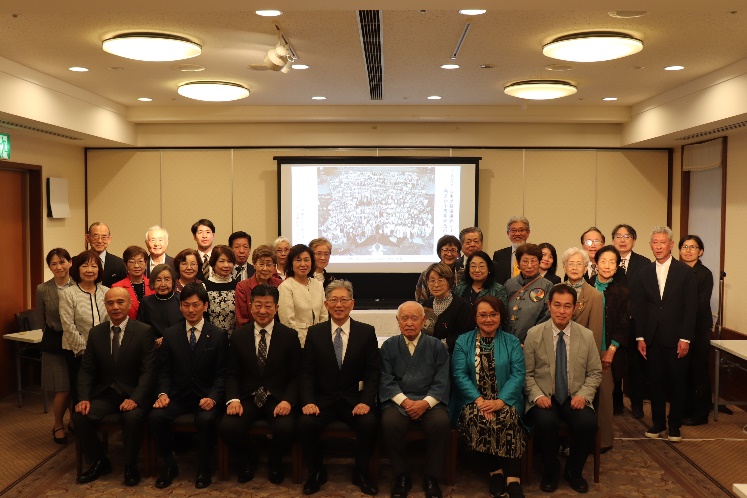
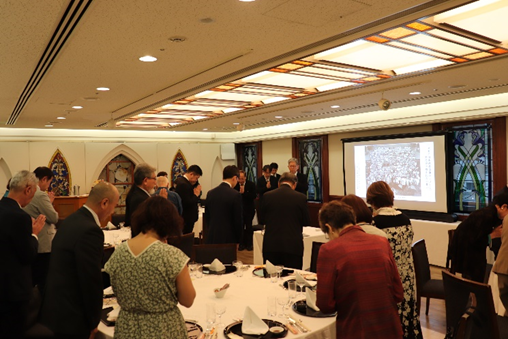
After showing the slides, Rev Kosuke Shiba of the Japan Chapter gave a closing address and led the closing prayer to conclude the first part of the meeting. And then, all of a ll the participants took part in a group photo.
Part 2: Social Gathering
The second part of the meeting was a social gathering to celebrate the 40th anniversary and to deepen mutual exchange among members. After an opening address and opening prayer by Rev. Kazuhiro Motoyama of Tamamitsu Shrine, congratulatory speeches were given by three people. First, we received a congratulatory address from Rev. Nichiko Niwano, President of Rissho Kosei-kai, read on his behalf by Rev. Yukinobu Sahara, followed by a congratulatory address from Rev. Mitsuo Miyake of Konko Church of Izuo, who served as the 33rd President of IARF. Dr. George Williams, the current IARF President, also delivered a congratulatory message, which was read on his behalf by the MC, Mr. Souru Tanino.
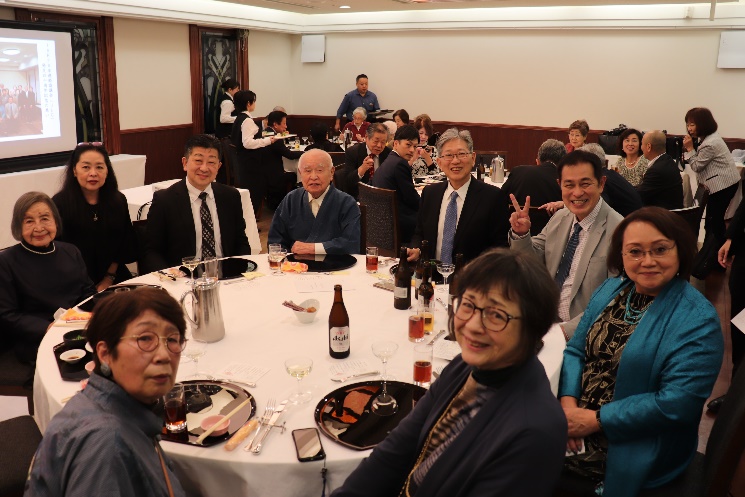
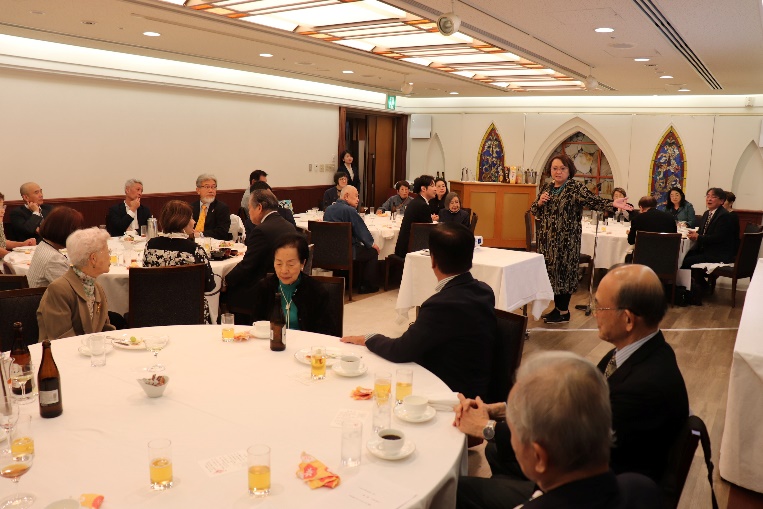
Following a toast led by Rev. Toshihide Yamamoto of the Mutsumikai, participants enjoyed a meal while socialising. Each of the Japan Chapter and IALRW members present was introduced. A short video created by President Williams to commemorate the Tokyo Congress was also shown, as well as photos that could not be included in Part 1 due to time constraints. Ms. Haruyo Masuda, a participant from the Japan Chapter, spoke about her experience of hosting participants at the 1984 Tokyo Congress, which included a programme of ‘home visits’. Rev Mitsuo Miyake expressed his gratitude and appreciation to the secretariat staff and others involved in the preparations for the day.
We also enjoyed a video recording of the 25th IARF Congress held in Tokyo in 1984. All of the participants shared cheerful moments. With the closing speech and prayer led by Prof. Kathy Matsui, the whole programme of the gathering came to a joyful close.
Japan: Memorial Symposium on the 200th JLC Meeting
Below you will find a report prepared by the Japan Liaison Committee of the IARF (you can read more about it here) from its most recent symposium.
Date: 9th October, 2016 14:00-17:00
Place: Hall of Soryo, Ittoen, Kyoto
Theme: Eliminate the Borders ~ Actual Situation of Refugees in Japan
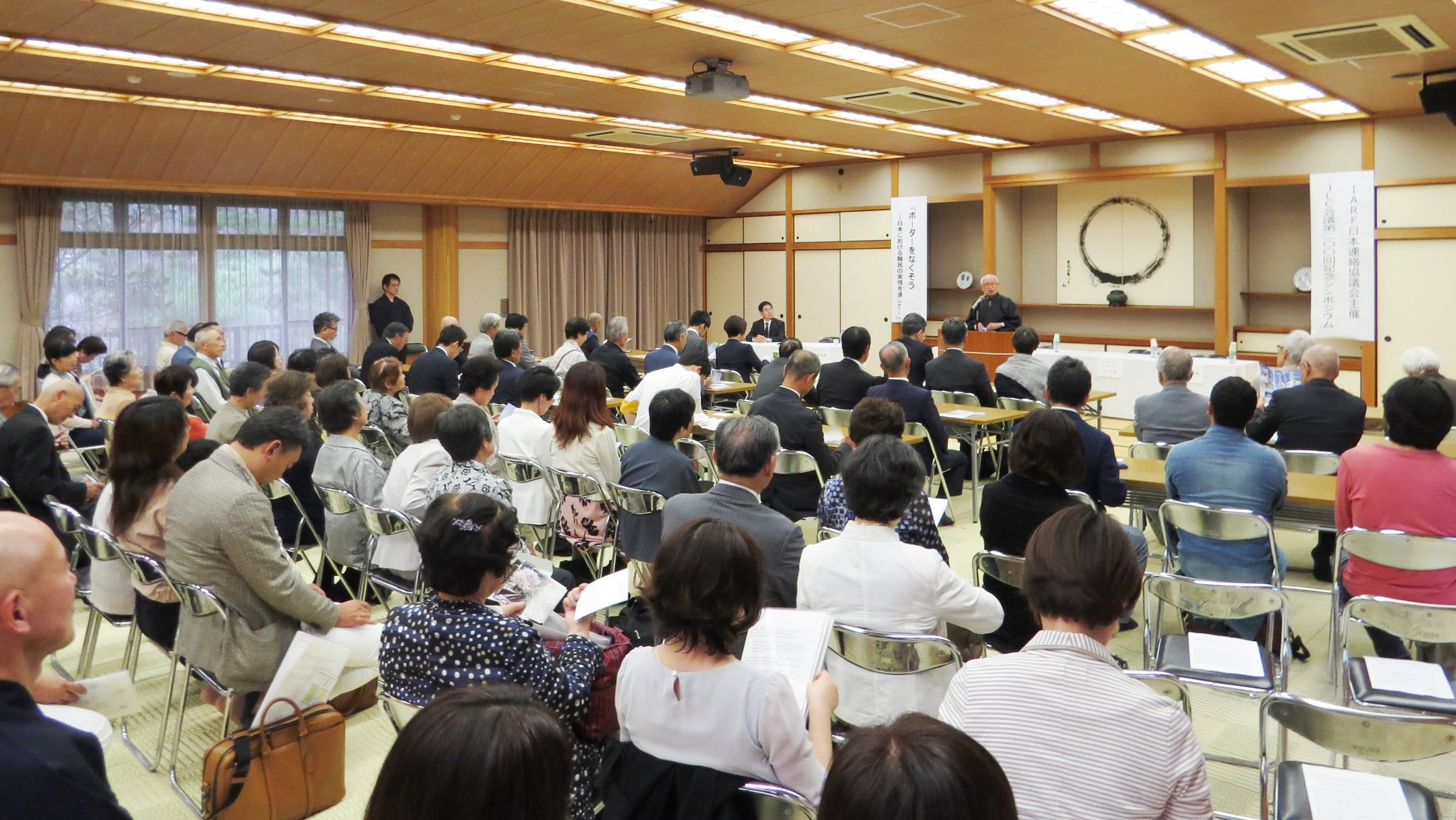
A symposium in commemoration of the 200th JLC meeting took place at Ittoen, on a fine autumn afternoon. At 2.00pm, following welcome remarks by Rev. Toshifumi Takisawa of Mutsumi-kai, the MC of the day, Rev.Takeshi Nishida, the head of our host Ittoen, delivered an opening speech that gave a brief history of IARF and JLC. He enjoined the Symposium to be fruitful. Then, Ms.Peggy Kanada, Vice-President of IALRW, led the audience in an opening prayer. She offered a prayer for peace with the hope that refugees, and all victims of violence and social persecutions could go back eventually to their old homes, but meanwhile should be guaranteed basic human rights (including jobs and education) to maintain hopes for the future in their host countries.
Session 1 “Actual Situation of Refugees in Japan”
The Program consisted of two sessions.
In the first session, three speakers delivered presentations aimed at showing the present situation of refugees in Japan. The first speaker was Mr.Hiroaki Ishii, the Executive Director of Japan Association for Refugees (JAR). The second one was Mr.K.C.Deepak, a refugee from Nepal, accepted to residency in Japan. And the last was Mr.Eedak Mohammad Reza, who has escaped from Afghanistan and is seeking permission to stay.
1) Mr. Hiroaki Ishii
The first speaker was Mr.Hiroaki Ishii, the Executive Director of JAR. He gave a brief overview, especially about the legal system concerning refugees in Japan, using Power Point slides. He referred to different kinds of procedures/requirements a refugee must meet when arriving in Japan, what kind of assistance they need, and what JAR is doing for help them. He also mentioned that ‘nanmin’ (‘refugee’ in Japanese) is recently used not only in an original meaning of the word (a person who has escaped from their own country due to politics, religious persecution, war etc.) but also in a broader sense (any person confronting difficulties in living in their home countries, such as millions of people who cannot return to their residential area by public transportation’s trouble caused by natural disaster, or people who have no fixed address which was triggered by disemployment and family infighting, etc.). This larger conception of ‘nanmin’ makes it difficult to understand the real refugee issue.
2) Mr. K.C. Deepak
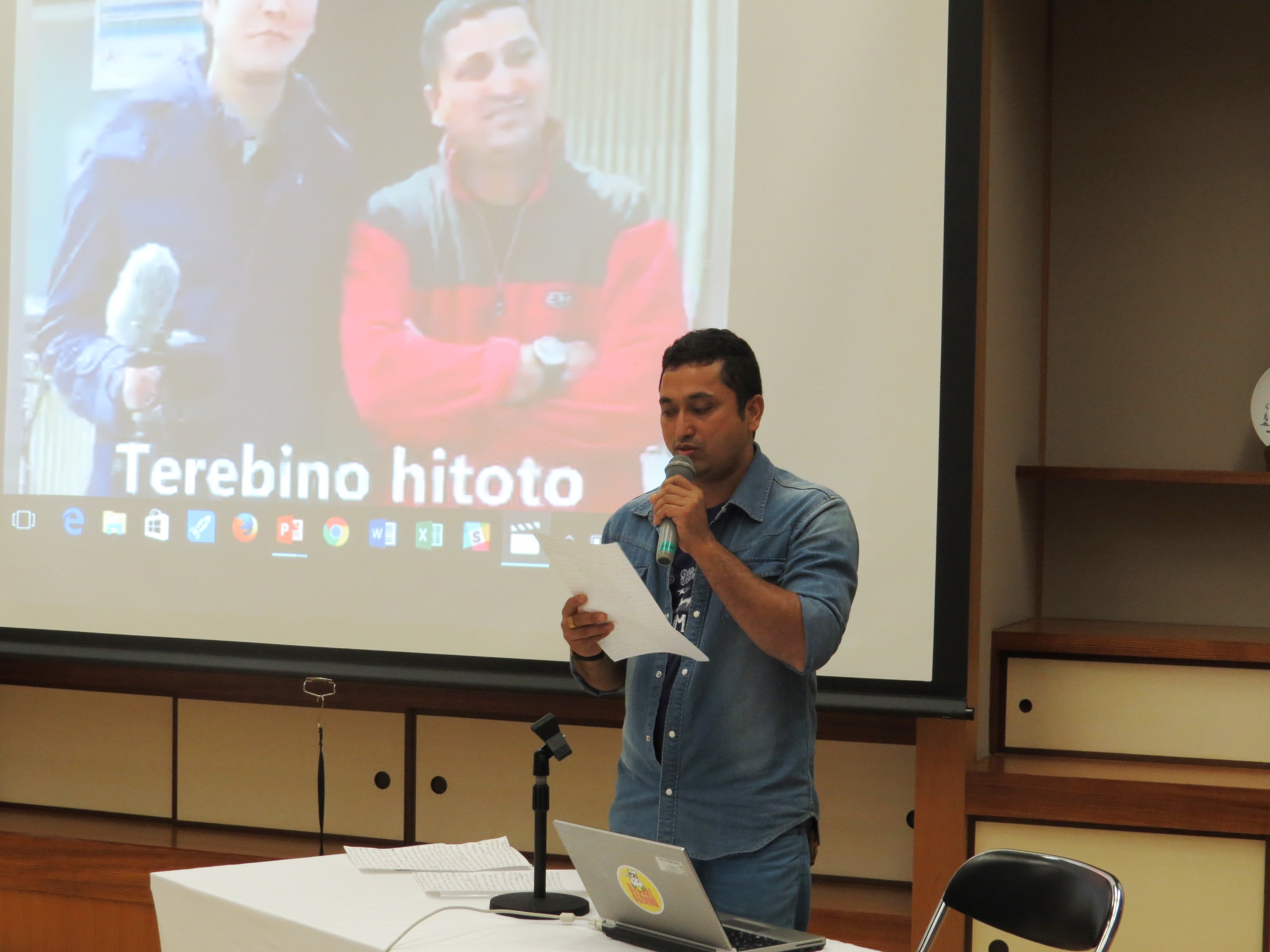
Mr.Deepak told the story how he came to Japan as a refugee, and how he lives in Japan, by explaining many pictures in fluent Japanese, which he learned after he came to Japan.
He and his family had worked for the King of Nepal, so they were persecuted by Maoist antigovernment forces. He escaped to Japan in 2004. For the first several years, he had difficulty finding food and shelter and it took 4 years of applying to be given refugee status by Immigration Authorities. His leg was hurt by torture from Maoists, but he was not able to access any medical care at hospitals in Japan at first because he could not get health insurance coverage without receiving refugee status. He would have had to pay prohibitively high medical expenses. Thanks to many people’s support, he found a place to live in Toyokawa, Aichi Prefecture. After he was given proper status, he was allowed to work and could go to any hospital using national health insurance (but has suffered permanent damage to his leg).
In 2015, a big earthquake hit Nepal and caused huge damage. He stood often in front of Toyokawa Station with his friends to ask for donations for the earthquake victims. Bonding over this, he made a community with other Nepali in the area.
The organization has grown to 82 members now, and they are committed to volunteer activities such as cleaning local areas, or aiding Japanese victims of disasters.
3) Mr. Eedak Mohammed Reza
Mr. Mohammed Reza was born an Afghan in a refugee camp in Iran, and got back to Afghanistan at age 10. Then he lost his parents at age 15 and had to take care of his 3 younger sisters. He worked as staff for the Japanese NGO called “Lala Association” which helps orphans in Afghanistan. This work led Taliban enforcers to label him ‘Kaffir’ (= one who has apostatized from Islam). They suddenly attacked and jailed him. Taliban allows only Muslims to exist in Afghanistan. When someone helps Kaffirs, they are deemed to be the same non Muslims. Mr.Reza emphasized that he is Muslim. However, he also said that all the religions are equal with every religion having moral precepts. Despite his Muslim faith, he was attacked and driven to leave his homeland in fear for his life.
When he arrived in Japan, he was really uncertain about his future. Although some people advised him that it would be very difficult to be given official refugee status in Japan, he felt he had no choice but to apply. It has been rejected already twice, but with nowhere else to go he has re-applied. He also confronted many difficulties of living in Japan: language, jobs, lodging and so on. But he said that he was lucky to be able to get support from the people around him. Now he studies at Doshisha University in Kyoto, and is preparing for further study in graduate school.
He emphasized that he never wanted to be a refugee. He thinks that getting refugee status is not the way to be happy for him, but he has no other options. Japan is a livable and peaceful place but it is not his own country. His sisters, of whom he has sole responsibility, cannot come to Japan. He eagerly desires to find a way to return his homeland and live with his family someday in the future.
Session 2 Panel Discussion: “Eliminate the Borders – Actual Surroundings of Refugees-“
After having a tea break, the Second session, a panel discussion themed on “Eliminate the Borders- Actual Situation of Refugees-“, started.
The Rev. Masahiro Nemoto, the special appointed executive for Inter-religious Cooperation of Rissho Kosei-kai, was invited as a panelist in addition to the three speakers of the first session. An energetic discussion was conducted by the moderator, Rev.Yoshinobu Miyake, Superior General of Konko Church of Izuo.
The Rev.Nemoto expressed his thoughts as following:
‘Through my longtime involvement to support refugees, I always consider “refugees” as “my family”. I want to help them the same as a family member living together. Accepting them as a family, what can “we (an organization)” or “I (individual)” do for them as necessary aid until the time comes when they will be able to go back to their homeland? I hope those gathered here today, will develop your thinking on this issue, and share it with others’.
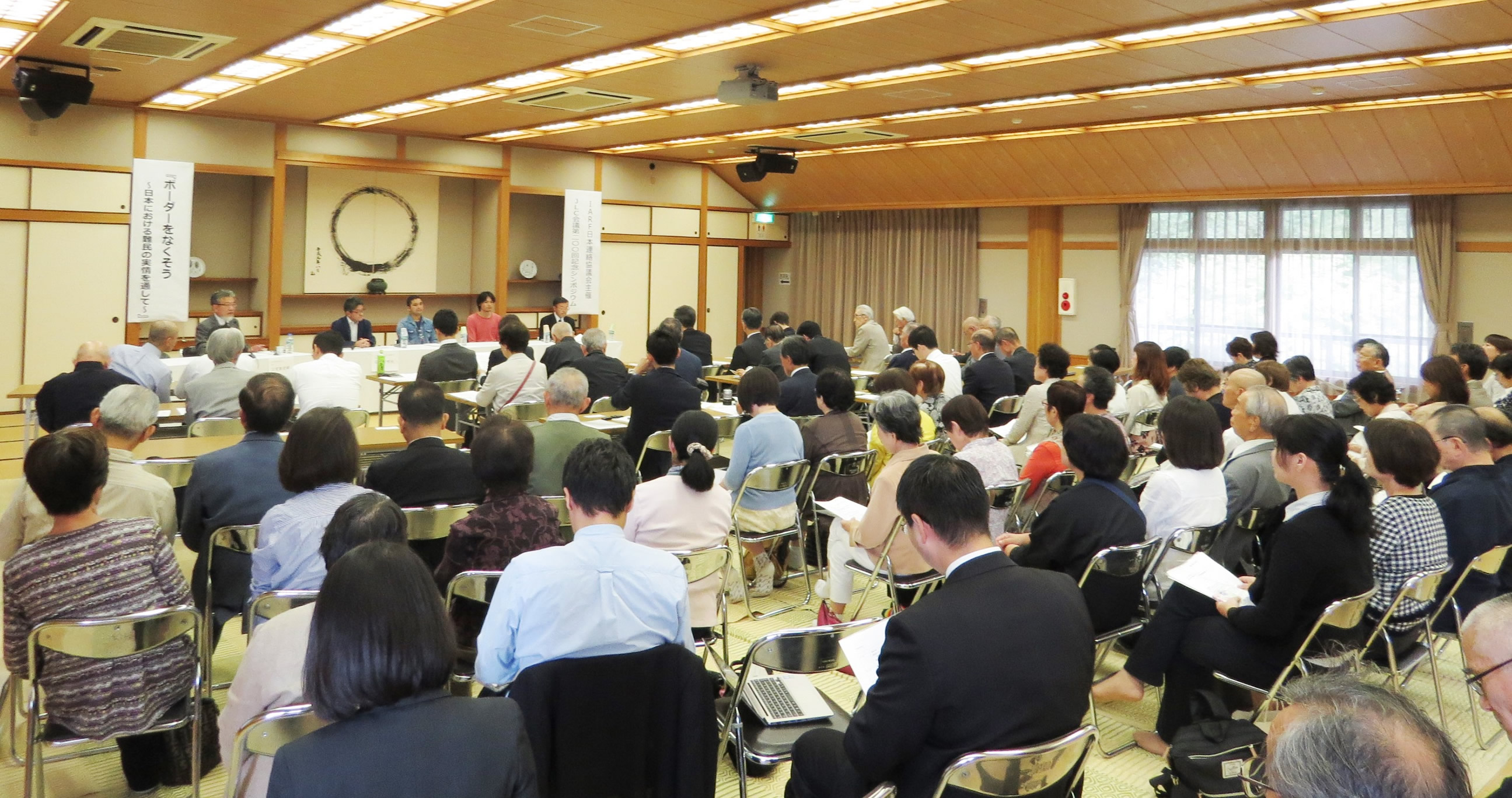
After explaining the vague concern of the general public that some terrorists may enter into the country with refugees, Mr.Ishii pointed out the incorrect nonsense of this fear. It is much easier to enter the country as a tourist than as a refugee if a terrorist should want to come to Japan. Further, in Europe, “home-grown” terrorists are more serious problem than “visitors.” In Japan, it seems that our political leaders hesitate to make decisions to admit more refugees because of this tiny perceived risk. On the other hand, Japan can be considered a safe and hospitable country where people are kind to the others. He hopes to exploit this advantage to help refugees.
Rev. Yoshinobu Miyake, the moderator of the symposium, asked Mr.Deepak about the situation of communities of Nepali in Japan. Mr.Deepak answered that he does not know about other Nepali communities in Japan, but since he launched his own Nepali community organization in Toyokawa, where he lives, he can point to their responsible behavior and civic commitment to volunteer activities in their locality.
Rev.Miyake pointed out one big flaw of Japanese immigration rules about refugees, that is to say, that refugees who came to Japan due to the persecution only by their government, are acceptable but those who were threatened by rebel groups or guerrillas are not recognized as a refugees at the first application stage. Then he asked Mr.Reza about the current situation of Afghanistan. Mr.Reza replied, “It is too complex to describe in a short summary. There occurs every possible type of violence, conflicts and accidents, and these bad events continue. This complexity stems from the rough rapprochement process between the current Afghani government and the Taliban that ignores the responsibility of perpetrators and the bloodshed of the recent past.
In reacting the questions from the audience, discussion was ongoing about how can we break the cycle of hatred, or what kind of educational approach is required for the future generation.
In conclusion of the QandA session, Mr.Ishii expressed his gratitude to religious groups which have offered great support since Japan accepted refugees from Indochina 40 years ago, and his thoughts about more possible support from the private sector. For this, it is necessary to make the public understand the issue, and to make them feel that to assist refugees is our “responsibility”, no a “burden”. He also hopes religious people will foster an atmosphere that dissolves the negative views about refugees.
Mr.Reza said that he sometimes feels that some people look down on refugees, and it makes him very sad. Even if there are differences of languages, nationality or cultures, we have the same worth as a human. He appealed that they should know that anyone who is in such a situation is only a refugee because of unavoidable reasons.
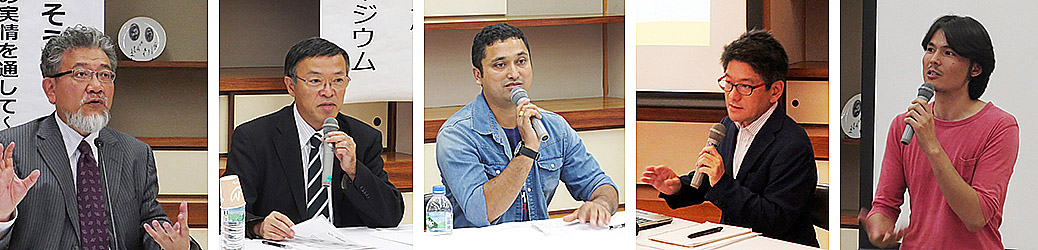
Concluding the session with a big applause, Rev. Takisawa announced some information about the next IARF World Congress.
Then Rev. Kosuke Shiba, a priest of Tsubaki Grand Shrine, took the rostrum as the representative of IARF Japan chapter and led the audience in a closing prayer. It is ‘arigatai’ (thankful, literally ‘hard to be happening’) that we can live in a country at peace. Please join in a prayer for the peace, not only for Japan, but also for other countries.”
At the end, the Most Rev.Mitsuo Miyake, Chief Priest of Konko Chuch of Izuo, who gives a strong support to the IARF as vice president, delivered a closing address. He looked back on the 32 year path of JLC to come to this 200th regular meeting with deep feeling, and expressed his gratitude for the efforts of his predecessors. He directed us to think of people who have no chances to study, or even to lead lives safe from dangers. He expressed thanks for this opportunity to learn about refugees, and took a vow that the JLC and each member of us will contribute for mutual prosperity. Then he closed his speech with a word of thanks.
Just before the Rev. Takisawa wrapped up the session, the Rev. Nishida introduced Ittoen briefly for those who visited here for the first time. The program of a fruitful symposium was complete.
*Number of Participants: 93
Breakdown:
Rissho Kosei-kai: 24; Konko Church of Izuo: 20; Mutsumi-kai: 7; IARF Japan Chapter: 12; IALRW 1, Ittoen: 26, Press: 3.
Council meeting 2013
[nggallery id=31]
REPORT: 2013 International Council meeting at the Konko Church of Izuo in Osaka, 17-19 April 2013
Preceded by the annual Executive meeting – hosted once more by our Osaka member group Shitennoji Temple – the two-day annual board meeting ended on Friday (19 April), in general agreement that this was the most positive so far during the presidency of Rev. Mitsuo Miyake, which ends next year at the General Meeting to take place within our 34th World Congress, in 2014.
This meeting was tasked with considering three different proposals for a location for the congress within IARF’s Europe & Middle East (EME) region. (By historical tradition the event cycles between our four regions. It now takes place every four years).
Very keen and compelling motivations were put forward by our Israeli member group the Interfaith Encounter Association (for Jerusalem as a site) and our Swiss member group Libref (for Geneva), but in the end most votes went to a last-minute bid by the British Chapter for an event in the multi-faith city of Birmingham, supported by the city’s council and a range of interfaith organisations there. So in the last week of August 2014, Britain will attempt to match the success of the last, 33rd IARF world congress held in India and featuring the Dalai Lama.
Much more information to follow once the Host Committee gets to planning, which has begun already since the event is now only just a little over a year away.
Other major decisions taken were: to reduce the size of the governing board, and to introduce from next year a membership fee that will cover support costs in a sustainable manner.
A Nominating Committee was appointed to choose the slate for the next Council (2014-2018); the IARF Bylaws were modified for the approval of the General Meeting next year; project work in India & Israel was commended, along with our representatives’ work at the UN in Geneva; and new membership was approved from groups in Austria, Bahrain, Ghana & Malawi – with additional new chapters under formation in Kenya, Togo & Benin receiving conditional acceptance.
A budget will be presented to the board for discussion and approval very shortly.
Altogether, IARF has restored its fortunes considerably since the mid-2010s, and looks forward to welcoming its membership to a vibrant congress in Birmingham next year – an event that will assure them of our place among the handful of liberal internationalist organisations that are confronting, within their means but with serious intent, the human rights agenda of a troubled world – and in particular, as always, the now-burning issues of freedom of faith and interfaith awareness-raising.
Shinto and Japanese New Religions
On Shinto
- Shinto Kokusai Gakkai (Japanese research body)
National Christian Council in Japan – Center for the Study of Japanese Religions
On “NEW RELIGIONS”
IARF leaders meet the Dalai Lama again
In early November 2010, two months after the IARF’s 33rd Congress in India which His Holiness inaugurated, he came to the Kansai region of Japan, on 7th attending a Peace Conference of Youth in Osaka (where our Secretariat has been based); and on 8th November he was guest of honour at World Heritage site of Todai-ji Temple in Nara.
Its Great Buddha Hall (大仏殿 Daibutsuden) is the largest wooden building in the world. It houses the world’s largest bronze statue of the Buddha Vairocana, known in Japanese simply as Daibutsu (大仏).
The temple also serves as the Japanese headquarters of the Kegon school of Buddhism. See www.dalailama.com/gallery/album/0/108 for more photos…
put Flickr fotos here
RFYN Empowerment Training
Davao, Philippines 26 Dec 2003 – 3 Jan 2004
Thirty young people from all over the Philippines attended the IARF’s RFYN empowerment training at Waterfront Hotel in Davao City, Mindanao – ‘IPs’ (indigenous people), Christians, Moslems and Unitarians.
Oxford-based Ramola Sundram, the RFYN International Co-ordinator, came to Davao, as did Japan-based Morse Flores, a Filipino ‘IP’ (indigenous person), to help Angie Grapa with facilitation.
The training was based on experiential learning, where the ‘here and now’ was given emphasis. It was process-oriented, while the content was fitted to the different issues in religious freedom. The participants also had sessions in self-awareness, team building and leadership training.
General objectives of the programme were for participants to:
· receive an experiential training enabling them to appreciate the value of one’s own spiritual practice at the same time as that of others;
· nurture a genuine concern about one’s own freedom of religion or belief as well as that of others;
· find ways of teaching and influencing others so that they too will be able to uphold the values of respect and acceptance of others;
· become critical thinkers and agents of change through the leadership skills learnt.
At the beginning, the group was polite and a bit distant from one another – especially the new members without any idea of what they would be going into. But those who were able to attend an earlier activity tried to reach out to the new ones, and helped them integrate. They learned that religion is not a hindrance in relating to others, and in the end all agreed that harmony can be attained in spite of our faith differences.
[nggallery id=1]
There were also meetings with elders from Moslem groups and indigenous tribes, in which the youth are not normally free to ask questions of their seniors; here, therefore, the opportunity was taken to give them this chance. In the caucus that preceded the opening programme, participants considered the questions they would put to the elders: would they be appropriate, and how would they frame them?
Some of the other activities were: Weaver’s Triangles as taught during Budapest Congress (which are a training in how to make workable RF [religious freedom] projects in one’s respective areas); sharing of RF stories; a dance workshop teaching indigenous dances that everyone performed in the closing ceremony; and, cement-flooring the Aromanon tribal hall, as a gift offering to the tribe. This was the social action section of the project.
Aromanon tribal hall
Some of the participants belonged to the Aromanon, whose spiritual site had been visited during the April 2003 tour, when it was seen that they worshipped on the bare earth in their communal hall. After consultations, it was decided that it would be a great offering to the tribe if the bare floor of the worship space were concreted. The chief and his wife were very pleased to host an interfaith group of young adults, but first they had to perform a ritual before the participants’ arrival, to ask permission from their ancestor spirits. Once they considered that this had been granted, the project plan was finalised.
The young adults travelled quite a distance to get to the hall, and the only access was on foot. In order to formalise the gift of our service, a sheet of white cloth & some betel nut were presented according to the traditional symbolism of the tribe. Sand etc. was carried up on a bullock cart and by the young adults. We were joined there by other young adults from the tribe and the chief’s family & helpers. It was great not only to achieve something concrete by the end of the afternoon, but also to share in discussions with young people from the community. Finally, the chief and his wife performed a special ritual of thanks, attended by the participants in a sacred place near the tribal hall.
Great team spirit had been built up by the end of the project. Many thanks to the following: Rev. Rebecca Sienes for handling the finances; National Co-ordinator for the Philippines Woodrow Maquiling, who did a great job seeing to it that the venue and participants were well taken care of; Myrna Ecdang and Pacita Raz for chaperoning; and Dr. Sebellon Wale, who with great dignity led the Mindanao delegation to the venue with their musical instruments and equipment, and stayed to the end.


Japan 2011 disaster response
Relief donations to Japan 2011 superquake & tsunami victims
The devastation of North-Eastern Japan’s provinces by the unprecedented earthquake and tsunami occurred shortly before our 2011 Council meeting.
IARF members in several countries spontaneously raised donations of £4,574, which was added to considerable donations made by IARF members in Japan, and given to relief work in Sendai.
Report of IARF Donation to Japan earthquake victims (PDF illustrated, 3 pages)
2006 Congress ~ Fo Guang Shan Taiwan
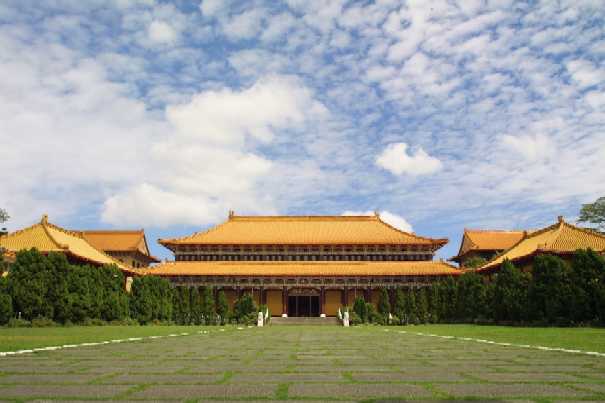
From March 26th—30th 2006, some 400 of our members from around the world gathered at the monastery headquarters of our Buddhist member group in southern Taiwan:
Fo Guang Shan ( 佛光山 ) near Kaohsiung…
Congress Reports
President’s report on Congress 2006
IARF-Kongressbericht Taiwan 2006
Young Adults at IARF Congress 2006
Addresses:
Religion & Peace by Master Hsing-Yun
Elizabeth Harris talk – Religion & Peacemaking
Rev R Boeke, spiritual journey
Young Adults’ talks:
Articulating spirituality – Linda’s journey
Dotan Arad, Nangroi Suting, Salah Aladdien, Yvonne Pangsiw
Slideshow of 2006 Congress
[nggallery id=21]