In Memoriam: Br. M.D. Sebastian, SHJ
The International Association for Religious Freedom (IARF) remembers with deep gratitude the life and legacy of Br. M.D. Sebastian, SHJ (1941–2025), who dedicated his life to promoting peace, harmony, and interfaith understanding.
Br. Sebastian was not only a committed religious leader but also a tireless advocate for dialogue across faiths. As a long-time member and supporter of IARF, he actively participated in numerous IARF conferences, where he spoke with conviction on the importance of interfaith dialogue. He had a special love for guiding the younger generation, often addressing students, motivating them to embrace diversity, and inspiring them to become ambassadors of peace.
One of his remarkable contributions was the publication of a book for students on interfaith understanding, a pioneering effort to nurture young minds with values of tolerance, acceptance, and universal brotherhood. Through his writings, teachings, and community service, Bro. Sebastian consistently emphasized that interfaith dialogue is not only necessary for peace but also essential for the growth of humanity.
Even until his last days, he remained deeply committed to the cause of IARF, offering his wisdom, guidance, and blessings to its mission of building bridges between communities.
Today, as we honor his memory, we also celebrate his vision, a world where people of all faiths can live together in peace and friendship. Br. M.D. Sebastian’s life continues to be an inspiration to all who walk the path of interfaith harmony.
Br. Britto, SHJ
National Secretary
IARF India Chapter
International Day of Peace 2025 – Report from BV Foundation
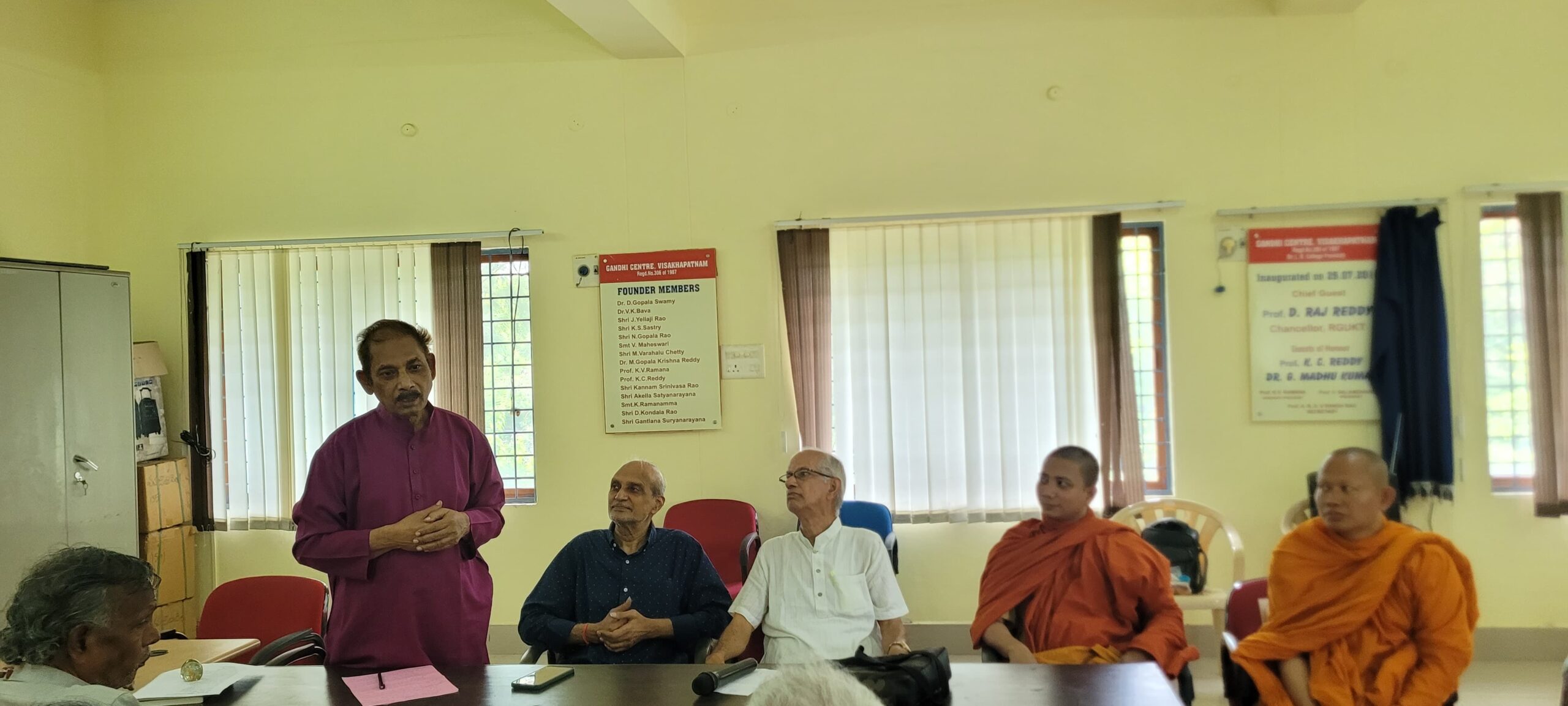
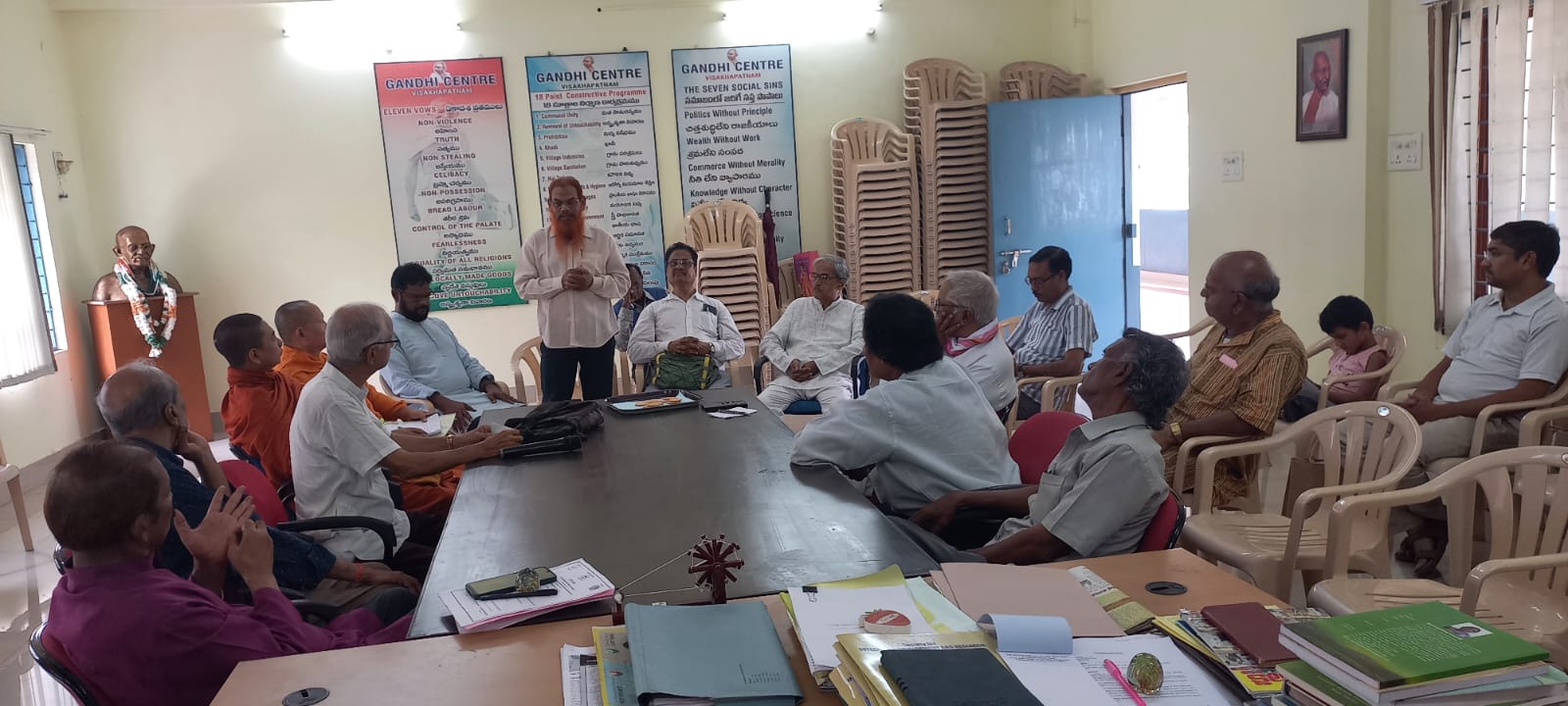
Under the auspices of the B.V. Foundation for Peace and Harmony, South India (a Member Group of the International Association for Religious Freedom – IARF) and the Gandhi Centre, Visakhapatnam, a grand meeting was held at the Seminar Hall of L.B. College to mark the International Day of Peace. The event was presided over by the noted social worker, Prof. Narava Prakash Rao.
The distinguished invitees and chief speakers of the occasion were Professor V. Balamohan Das (Former Vice-Chancellor, Nagarjuna University and President of Gandhi Centre) and Professor K. Ravi (Former Director, Academic Staff College, Andhra University).
The programme commenced with all members garlanding the statue of Mahatma Gandhi at the Peace Centre and paying their homage. In his presidential address, Prof. Narava Prakash Rao explained the purpose of holding such a meeting on this day. He spoke on the growing unrest in the world, highlighted the role of IARF in protecting human rights, and enlightened the gathering about its advisory contributions to the United Nations and the significance of such efforts.
The eminent speakers present emphasized that violence can never be justified and elaborated on the responsibilities of governments and citizens in building peace.
Professor K. Ravi reiterated that violence is never justifiable, reminding that history itself has been altered because of violence. He called upon scientists, technologists, citizens, and rulers to work for peace. He observed that peace today has been reduced to a mere ornamental word, while world leaders have grown increasingly war-hungry. As a result, unrest has spread everywhere, and nations are engaged in amassing power. He warned that artificial intelligence too is taking distorted forms, leading to further threats to world peace.
Buddhist monks Rajdham Bhikshu and Kanth Bhikshu remarked that before global peace can be realized, inner mental peace must first be cultivated.
Professor V. Balamohan Das, President of the Gandhi Centre, shared his grave concern about the rising hatred across the world and the unrest it is fostering. He expressed deep anguish, pointing out that as of today, 108 civil wars are raging across the globe. He praised the tireless efforts of many organizations striving to prevent a third world war, but confessed his own fear at the very thought of what might happen if such a war were to break out. He stressed the urgent responsibility of governments to initiate and implement programmes that can dismantle this culture of hatred and violence.
Dr. Kochchrlakota Venkata Satyanarayana Murty (Joint Secretary, Gandhi Centre) stated that wars are dangerous, and drew attention to the views expressed in the Vedas and Indian epics regarding such destructive culture. He expressed hope that better days would surely come, but emphasized that war is indeed a great obstacle to world peace. He urged that every individual and every family must develop an earnest yearning for peace.
Dr. L. Prajnan Kumar (URI Convener) and Abdul Munir Mushad (IARF Convener) also participated and shared their views.
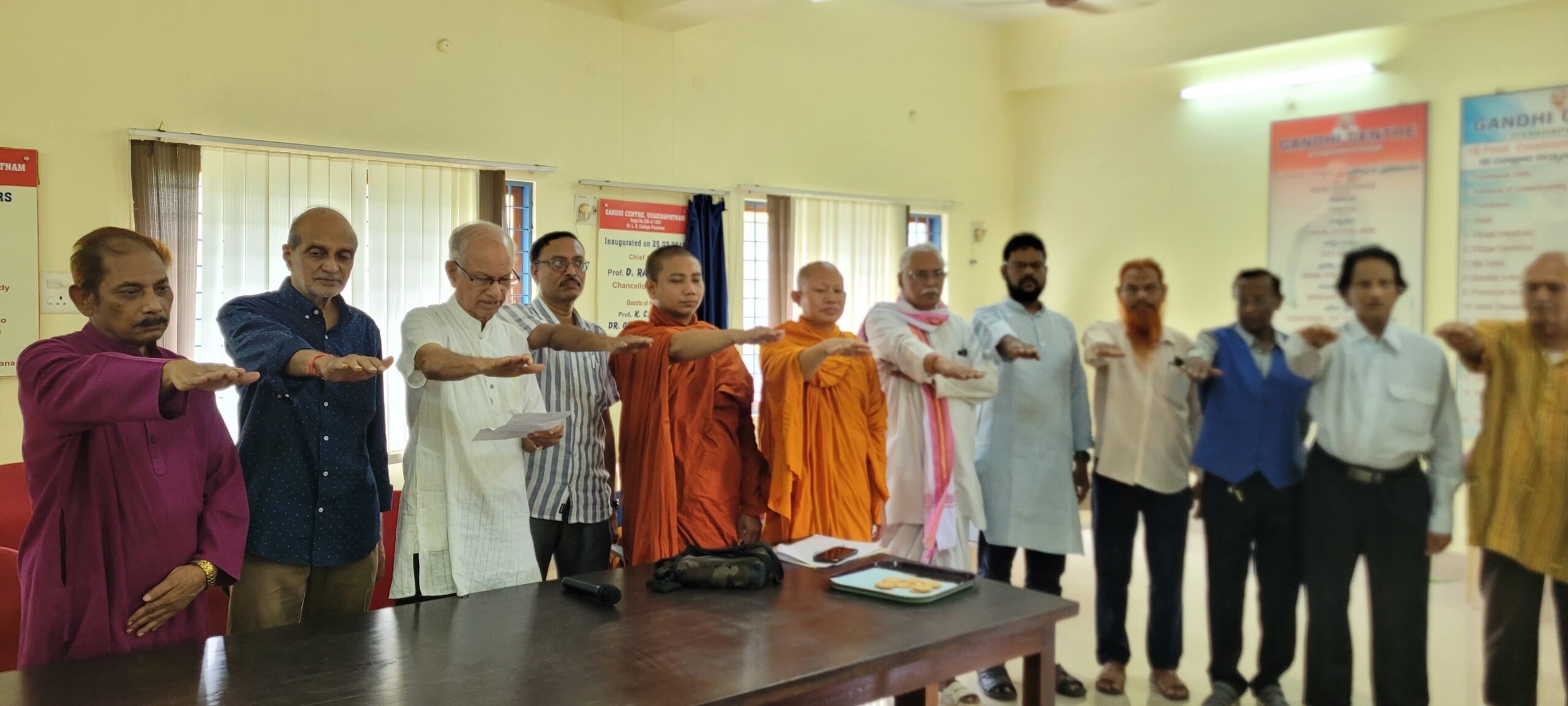
At the conclusion of the meeting, all the participants took a solemn pledge to safeguard world peace.
Among those present were Sri Suresh (Commissioner of Police Office), Sri Jogarao, Sri Hussain, Sri Naidu, members of IARF, and several prominent citizens of Visakhapatnam.
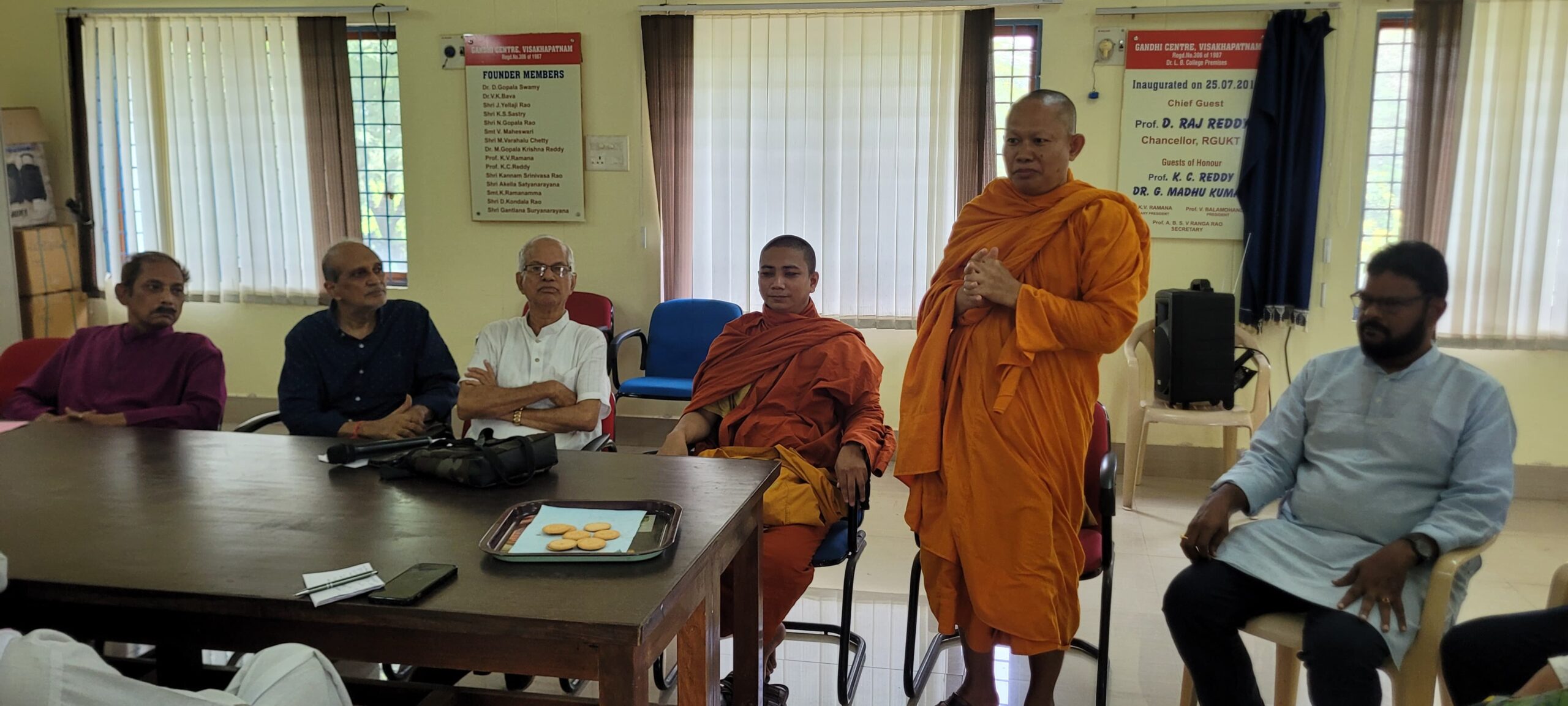
2569th Buddha Birth Anniversary Celebration at Gandhi Centre, Visakhapatnam
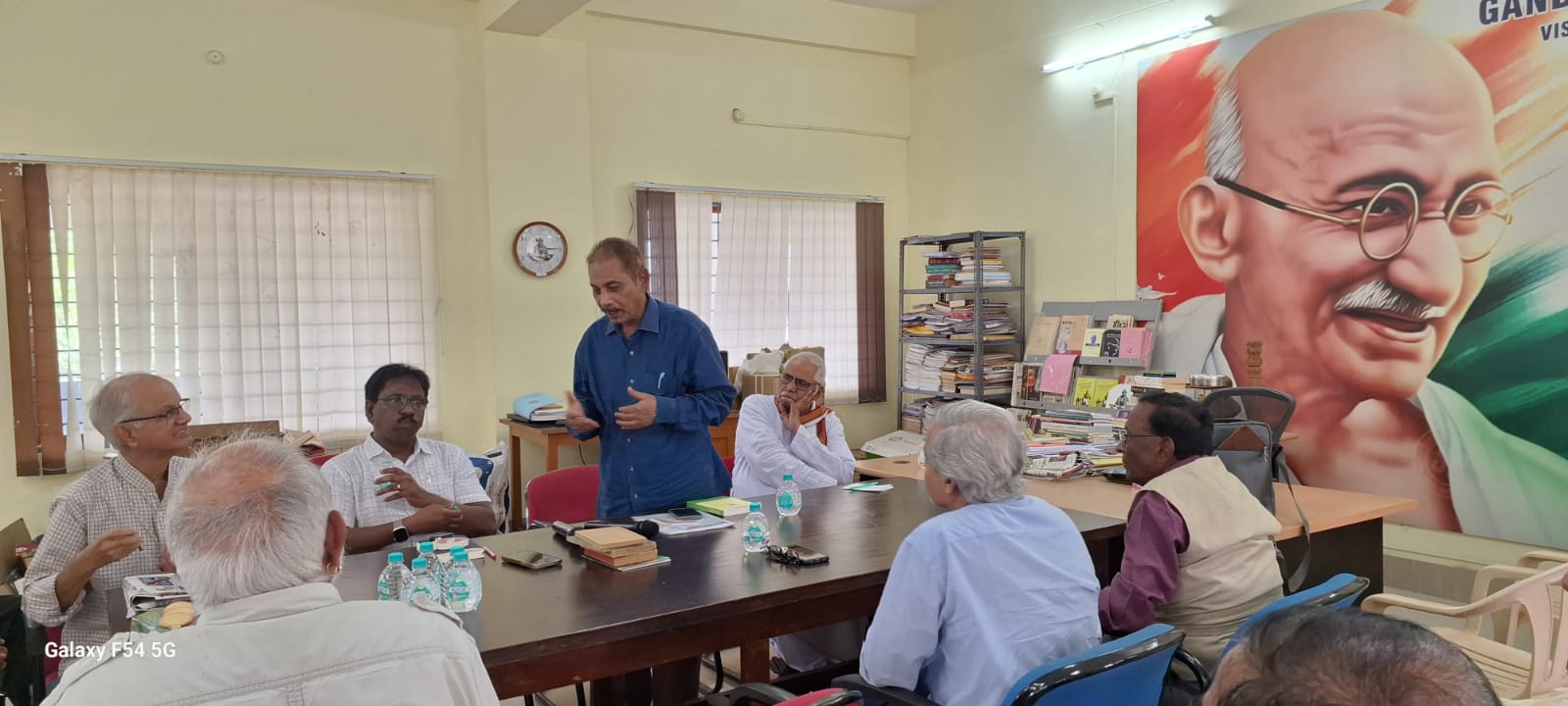
On May 24, 2025, the B.V. Foundation for Peace & Harmony (a member group of IARF), in collaboration with United Religions Initiative and the Gandhi Centre, Visakhapatnam, hosted a lecture on “Buddhism in Promoting Peace and Harmony” to mark the 2569th Buddha Birth Anniversary.
Dr. Maturi Srinivas, a noted pulmonologist and Buddhist scholar, delivered a powerful keynote emphasizing Buddhism’s role in advancing human rights, non-violence, and ethical living. Highlighting principles such as Mudita (sympathetic joy), Maitri (friendship), and Karuna (compassion), he stressed the relevance of Buddhist teachings in fostering interfaith understanding, social harmony, and ecological balance. He also addressed how Buddhism encourages self-reflection and a mindful “let-go” approach to life, which means accepting life as it comes, while also acting with awareness, responsibility, and ethical clarity.
In his presidential address, Professor Narava Prakash Rao, BVF Chairman, called on attendees to promote harmony through religious understanding, lamenting Buddhism’s diminished presence in its homeland. He affirmed that religion should support human welfare, not dominate daily life.
Professor V. Balamohan Das (Former Chancellor of Nagarjuna University and President of the Gandhi Centre) shared personal reflections on Acharya Nagarjuna (known as “the Second Buddha) and his efforts to reintroduce Buddha Purnima celebrations in academia.
Professor Paddaiah, a professor of Human Genetics, described yoga and meditation from the viewpoint of genetics and society, in the context of following the principles of Buddhism.
The session concluded with a customary vote of thanks, reinforcing a shared commitment to interfaith peace and human dignity.
IARF 124th Annivesary Celebrated by BV Foundation for Peace and Harmony
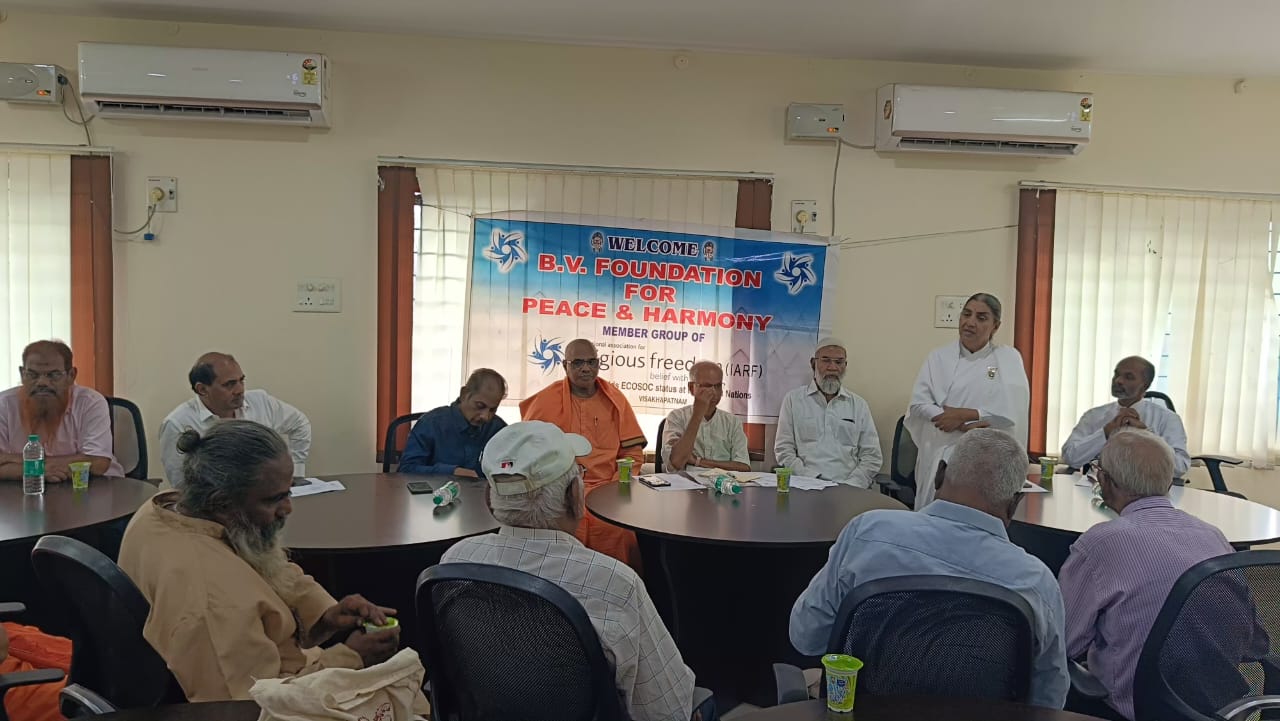
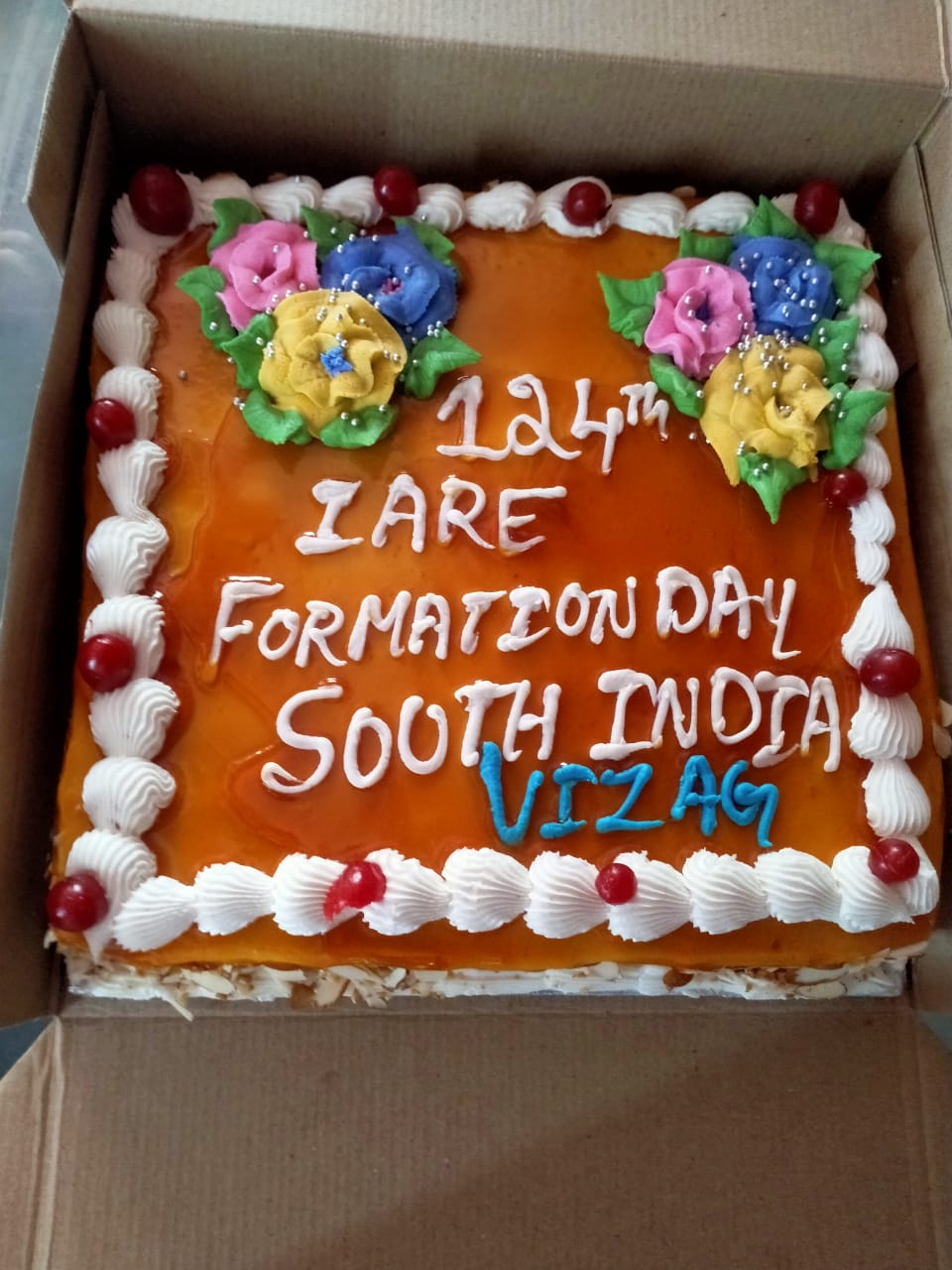
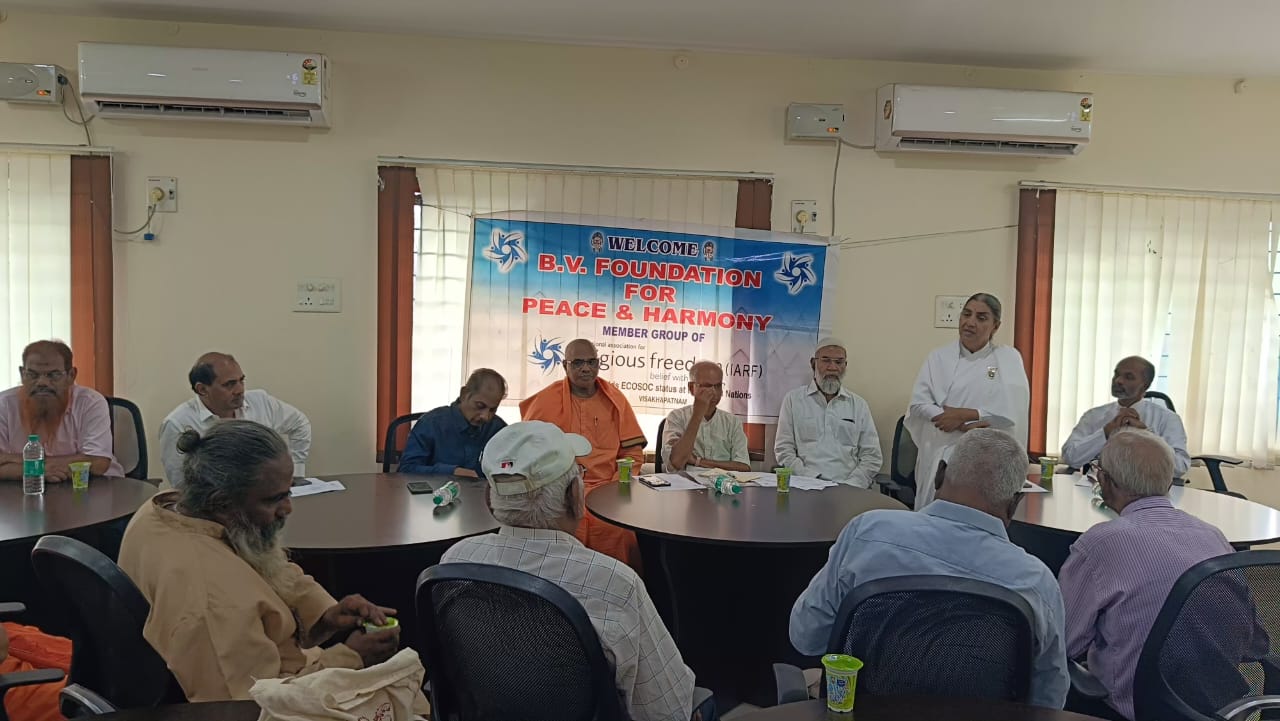
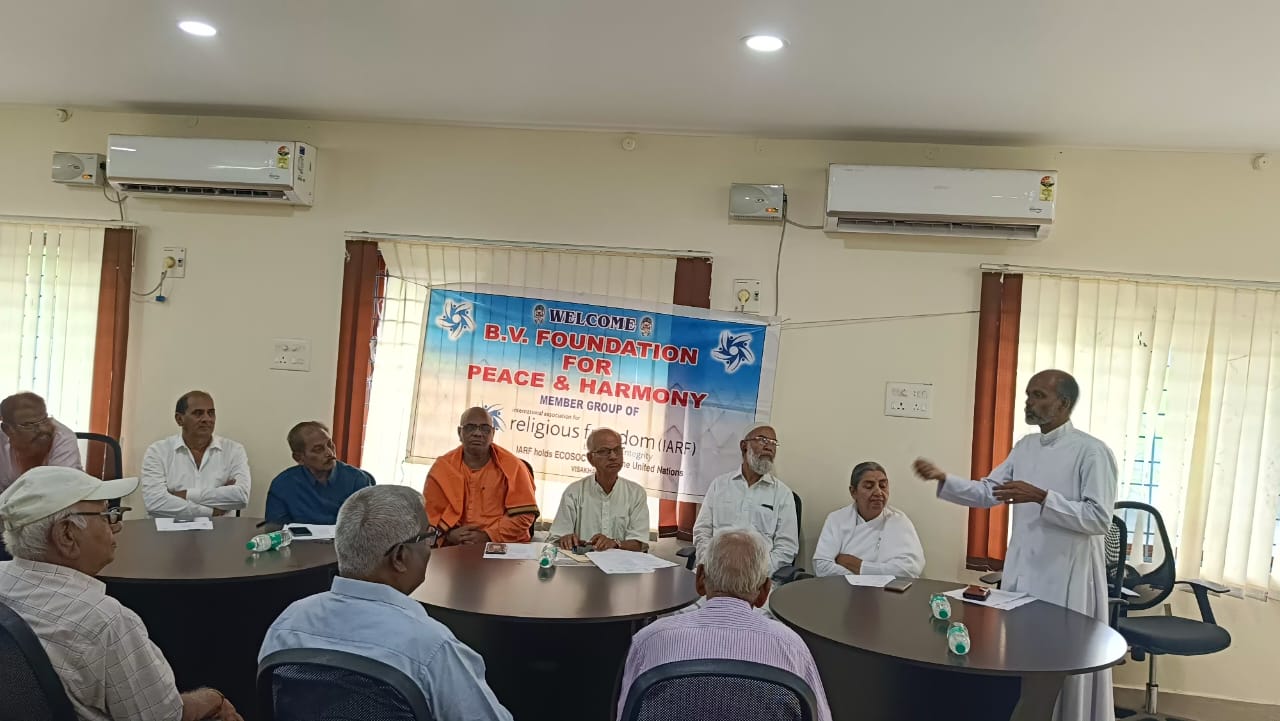
The BV Foundation for Peace and Harmony, a member group of IARF South India, celebrated the 124th IARF Formation Day on Saturday, May 25th, at the Gandhi Center Seminar Hall located at Dr. LB College in Visakhapatnam, Andhra Pradesh, South India. Prof. Prakasa Rao, chairman of the foundation, presided over the meeting.
The celebration began with an interfaith prayer, followed by a cake-cutting ceremony. In his presidential address, Prof. Rao highlighted that the IARF was established on May 25th, 1900, in Boston to realize the vision of the World Parliament of Religion held in 1893. As the oldest interfaith organization in the world, IARF collaborates with religious communities and secular organizations committed to openness, free religious inquiry, human dignity, social responsibility, and service. The organization also works to protect religious freedom and fundamental human rights through its representatives at the United Nations.
The chief guest, Prof. V. Balamohandas, former vice-chancellor of Acharya Nagarjuna University and president of the Gandhi Center, commended IARF’s remarkable 124-year history and called for improved religious tolerance worldwide. He emphasized that while religious worship and beliefs are personal matters, the coexistence of people belonging to different religions is a tradition that IARF should continue to uphold. Prof. Balamohandas termed atrocities committed in the name of caste, color, and community as barbaric, stressing that peace is only possible when all religions coexist and live in harmony.
Other speakers who endorsed the chief guest’s statement included:
- Swami Swasamvedya Nanda, secretary of Ramakrishna Mission
- Syed Shamsuddin, Additional District Government Qazi
- Fr. Ratna Kumar, Deputy GM of RCM schools
- Smt. B.K. Rameswari, Prajapita Brahmakumari Eeswari Vidyalayam
- Sushil Sekhani Jain, chairman of Mahaveer International
- B. Gowtam Babu, the Buddhist Society of India
The convener, Abdul Muneer Mushhad, proposed a vote of thanks. The meeting concluded with participants taking a peace pledge and singing the Indian national anthem, “Jana Gana Mana.”


Can a purpose for religion be deduced?
It seems clear that religion has a purpose because it has so many adherents.
In Karen Armstrong’s CharterforCompassion.org website there is a demonstrated consensus that
The principle of compassion lies at the heart of all religious, ethical and spiritual traditions, calling us always to treat all others as we wish to be treated ourselves.
(Some call this Goldenruleism as this is widely known as the Golden Rule)
Quotes from religious documents accepted as authoritative by the existing religious authorities in each tradition are provided in the language of the tradition and also in other languages. Her scholarship has been widely recognized as rigorous and exhaustive. The Golden Rule, as a simple, reasonable and logical rule, elicits behavior that supports the survival of the human race. It is altruistic, and altruism has been widely credited with the success of the human race so far.
When the Golden Rule is mentioned, it seems someone always wants to respond with: what about the “Platinum Rule” – do to others what they would want you to do. Clearly, if you would want to do something for someone, you would ask them if that is what they wanted, or ask them to tell you what they want. However, as a principle of behavior, it is obviously asking for the behavior of a slave. A slave must always respond to the wants of others with what they want.
Rev. A. Powell Davies proposed a purpose for a “Unitarian Advance” in 1943:
Our purpose is liberation from the tyranny of hate and greed, and from the barriers of race and class.
(If the name Davies does not ring a bell, a UU World article in the 2002 July/August edition sums up his bonafides.)
This purpose includes what can be seen as a summing up of the current world ills that we can address with purpose as an implementation of the Golden Rule. We want liberation from the tyranny of hate and greed, and the barriers of race and class for ourselves and for everyone else.
Along the same lines, a new purpose has been proposed for the Unitarian Universalist Association:
The Unitarian Universalist Association will actively engage its members in the transformation of the world through liberating love.
This purpose can be read as a version of Davies’ purpose. If our world was liberated from the tyranny of hate and greed, and from the barriers of race and class, would it not be transformational and require liberating love as a motivational force? Liberating love (would anyone want controlling love?) can be seen as very like the compassion required to act in consonance with the Golden Rule. Some see “transformation of the world” as ridiculously ambitious. Compassion and liberating love do call us to have no barriers or geographical boundaries in their exercise. But we exercise liberating love in the world we perceive and interact with, and that is the world we transform. We can transform our worlds with compassion and liberating love. To start, we can each invite a friend to come with us to our religious, ethical or spiritual community to see why we go.
So can the purpose of religion be deduced? I believe so, but I leave it to you. If the great majority of humanity were living by the Golden Rule, would we not fulfill Rev. Davies stated purpose above while living in peace and community? What higher purpose than promoting the Golden Rule could we ask for?
My goal here is not to make any definitive statements, but rather to open up a thoughtful discussion.
New Book: “Fideology: A journey of Faith and Trust by Richard Boeke”, long-time IARF bridge-builder.
Rev. Dr. Richard Boeke’s latest book is Fideology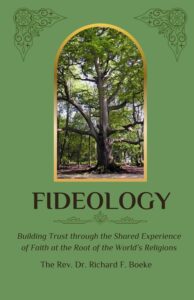 : Building Trust through the Shared Experience of Faith at the Root of the World’s Religions.
Fideology refers to “faith as trust. The word, coined by Richard, is based on the same Greek roots as fidelity, confidence, and bona fide. Richard credits his teacher, Professor Wilfred Cantwell Smith, and friend and mentor Huston Smith, along with many other faith leaders, with much of the inspiration for the subject of this book.
Fideology affirms that it is possible to build trust without the necessity of a common theology. Such trust-building between nations and religions is essential to overcome the present “clash of civilizations.” We need not just a global ethic, but the practice of a global virtue, TRUST.
Unitarian minister Richard Boeke has been a pioneer in the interfaith movement since the 1950s. Holding graduate degrees from both Yale Divinity School and Columbia University, and a Doctor of Divinity from Pacific School of Religion, he studied with some of the leading theologians of the 20th Century, from Wilfred Cantwell Smith to Huston Smith–the latter with which he enjoyed a long friendship. Fate smiled upon his life journey to sow seeds of peace and experience a sense of oneness, leading him to real-life encounters with everyone from Pope Pius XII, to Jomo Kenyatta, Malcolm X, Erik Erickson, Charles Schultz, and Nancy Pelosi, as well as lasting friendships with Shinto priests, Muslim imams, and Sikhs. He was instrumental in furthering the mission of the International Association for Religious Freedom (IARF), and received the 2018 IARF Distinguished Service Award.
The book is part personal faith journey, part autobiography, part resources for liturgical services, and part scholarly discourse. This compilation is a documentation of a remarkable life’s work, weaving the personal the political, and the spiritual into a tapestry-like tribute to world peace. It provides a valuable record of the religious and secular discourse on many IARF themes throughout its history, and captures crucial moments in the development of interfaith work in the past century.
The book is available as an e-book (Kindle) or paperback on Amazon.
Watch “Levels of Dialogue: Religious Experience in an Interfaith Context”
In this session, recorded on 13 November 2023 during Inter Faith Week, the British Chapter of the International Association for Religious Freedom, in collaboration with the World Congress of Faiths, embarked on a deep exploration of interreligious dialogue’s dynamic tension between the unique characteristics of different faiths and their universal connections.
The event, held via Zoom, provided a platform for participants to engage with the complex interactions between various religious origins, developmental paths, belief systems, and spiritual practices, highlighting the potential for a familial resemblance among diverse faith traditions.
Featuring a keynote by the Reverend Canon Dr. Alan Race, Chair of the World Congress of Faiths and editor of Interreligious Insight, this recording offers invaluable insights into the challenges and opportunities presented by interfaith dialogue.
Dr. Race, a retired Anglican priest-theologian with an extensive background in the theology of religions and interreligious dialogue, shares perspectives from his latest book, My Journey as a Religious Pluralist (Wipf and Stock, 2021), enriching our understanding of how religious experiences and dialogues intersect with the broader quest for mutual understanding and respect among faiths.
Join us in this recorded session to explore the intricate landscape of interfaith dialogue, where the particularities of each religion meet the universal quest for spiritual connection and understanding.
https://www.youtube.com/watch?v=WzH6Yo58Gxg
9th Annual UN Symposium on the Role of Religion and Faith-Based Organizations in International Affairs
The Ninth Annual Symposium on the Role of Religion and Faith-based Organizations in International -affairs attracted more than 600 people. It was held online on January 24, 2023 exploring the theme “Securing People’s Wellbeing and Planetary Sustainability”, and was organized by the World Council of Churches and a coalition of around 27 faith-based organizations, institutions and UN-partner organizations with experts on climate change, disarmament and other relevant topics related to the SDGs.
The annual symposium on the role of religion and faith-based organizations in international affairs was initiated in 2015, parallel to the SDGs by the General Board of Church and Society of the United Methodist Church, the Seventh-Day Adventist Church and the WCC. Today the symposium co-organizing entities and partners have grown to include denominational, ecumenical, multireligious and faith-based groups including long-time co-organizers ACT Alliance, Religions for Peace, Islamic Relief-USA and the United Religions Initiative. From 2017 onwards the Interfaith Task Force on Religion and Sustainability Development – currently representing 27 entities within the UN system cooperated as a co-organizer. The annual symposium was conceived as a space to focus on how religious and partner faith-based organizations could reinforce engagement around shared concerns of human dignity, human rights and sustainable development. It serves as an event for conversation to identify and deepen the multidisciplinary aspects of the permanent general theme on human rights and human dignity. The symposium is held annually on a date in January close to the birthday (January 15) of the Rev. Dr. Martin Luther King Jr.
Rev. Dr. Liberato C. Bautista, assistant general secretary for UN and international affairs, Methodist, President of the Conference of NGOs in Consultative Relationship with the UN (CoNGO) opened the over five hours lasting symposium and reminded of former symposiums: the 6th symposium 2020 was intended to reflect on the planned processes to review progress 25 years after the Beijing Platform for Action and the state of multilateralism at the 75th anniversary of the UN, but was postponed. Given the importance of the theme, a smaller but well-resourced workshop for faith-based organizations was held instead. In 2021 a virtual symposium focused on accelerating Gender Equality, Equity and Justice. The succeeding 2022 symposium was also held virtually on a theme focused on “Mobilizing Moral Influence and Governance to end the Systematic Injustices of Racism, the Legacy of Colonialism and Slavery”.
The themes identified with work by faith-based organizations are not alien to UN partners. The active collaboration by faith-based organizations, UN partners and member-states underscore the concern for joint and concerted action and transformative solidarity among all actors.
Some UN officials and leaders of civil society reflected why faith-actors are critical actors:
Maria Fernanda Espinosa (former President of UN-GA) reflected the necessity to retool and spiritually reground the UN system. Backsliding is happening in almost all SDGs. What does keep us back? Either are we paralyzed and dispaired or the crisis is pushing as to act. It is a multiple crisis. We have knowledge and technics to make it better. The big gap lies between knowledge and action. If faith as religion or faith in humanity, UN or other is motivating and pushing us to action, do not accept that science is the leader, that was the case for a very long time.
Beatriz Schulthess (Priestess, Founder and President of Indigenous Peoples Ancestral Spiritual Council and member of Qulla/Kolla Nation and Co-president Religions for Peace) informed that indigenous people gathered and asked, what sustainability could mean. They discovered that it means what they always were doing. But other cultures decided that it means to serve themselves at the detriment and damage for other cultures.
Prof. Dr. Azza Karam (General Secretary Religions for Peace) moderated the panel on “Framing Human Security as Shared Security for People and the Planet”. She explained that she started her work at UN 20 years ago to show how relevant the role of religion is.
Audrey Kitagawa criticized the five belligerent veto nations in the Security Council which since its foundation fended off threats of wars and failed with Russia. “How can we support the security council?” she asked. NGOs, Faith-based and multifaceted institutions all should speak in one voice to protect human rights. Religious faith leaders should cooperate with governments for the security of people and their coexistence. Although this is difficult. Humans are egoistic.
Bishop Heinrich Bedford Strohm (Moderator oft he Central Committee of the World Council of Churches, Lutheran Church of Bavaria) encouraged that religion not only reaches the heads of people but their hearts. Therefore religious communities are so important in questions of human wellbeing and planetary sustainability for questions about life-style and behavior. They only can successfully put forward if political change is connected with a change of mind, of hearts. He is persuaded that churches and religious communities in general are ideal agents for the world wide civil society. They are deeply rooted in local communities and at the same time they live in a global horizon in strengthening their faith in God who created heaven and earth. Bedford Strohm reminded the WCC Consultation on Justice, Peace and Safeguard of Creation in 1990 in Seoul: all appeals in this connection were already made as recommendations and only now they reached governments. The Assembly of WCC in Karlsruhe 2022 has again emphasized and focused on the necessary change to be made.
Archbishop Gabriele Giordano Cacca (Apostolic Nuntius and Permanent Observer of the Holy See at UN) considers the crisis, out of a Christian understanding, as an imbalance of the human heart. Truth is that God created every human being to his (her) image. We should carry responsibility about our actions, for the four pillars for peace are: truth, justice, freedom and solidarity.
Amanda Ellis (former Ambassador, New Zealand) reminded that women are still excluded from preace processes and negotiations. Her question is: “Can human security become an unifying paradigm for humanity?” This question was taken up into further consideration.
IARF India Chapter’s Engagements in October: Solidarity and Discourse
By Dr. James Arputharaj Williams, India Chapter of the International Association for Religious Freedom
An Inter-Faith Journey of Solidarity to Manipur
Backdrop of the Crisis:
Manipur, a state nestled in Northeast India, recently witnessed devastating ethnic unrest. Since 3 May 2023, long-standing tensions between the Kuki tribe, primarily Christians, and the Meitei community, who are majority Hindus, erupted into violence. The conflict led to the tragic burning of over 230 churches, deaths of more than 60 Christians, and displacement of countless individuals. This surge of violence has its roots in decades of tension, but recent decisions by the Manipur government, favoring the Meitei and sidelining the Christian Kukis, acted as a catalyst for the current situation.
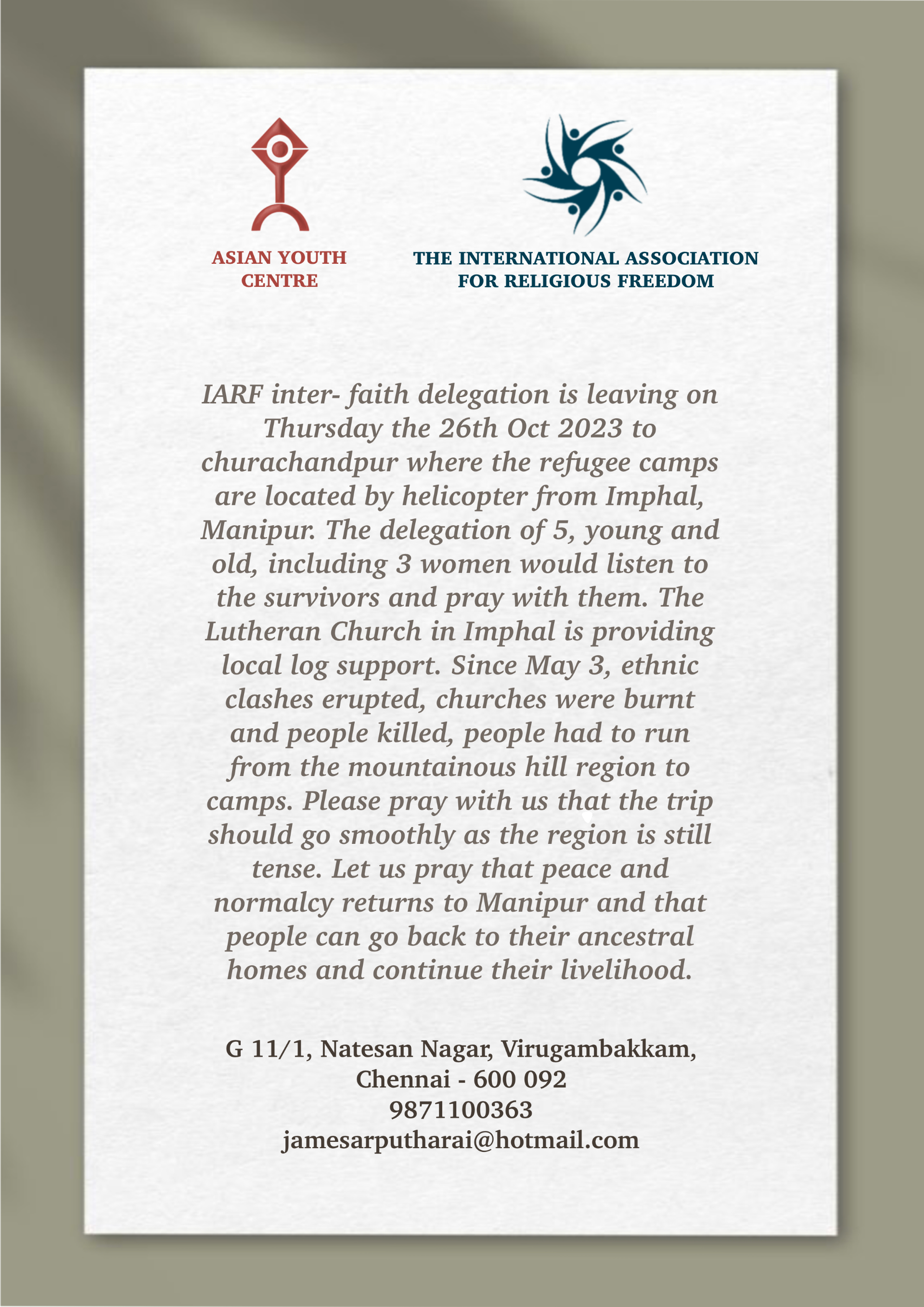
Against this somber backdrop, the India Chapter of the IARF is dispatching a delegation to Churachandpur on 26th October 2023. Comprising five members, both young and seasoned, including three women, the team aims to extend a hand of solidarity and support to those affected by the conflict.
Using a helicopter for transit from Imphal, the delegation’s primary mission is to spend time with survivors, listen to their stories, and offer prayers. Their endeavors are being supported logistically by the local Lutheran Church in Imphal. We request your prayers and well wishes for the safety of our team and the success of their mission in this challenging region. It is our collective hope that peace and stability will soon return to Manipur, allowing its inhabitants to reclaim their homes and livelihoods.
UN Day Inter-Collegiate Debate – 2023
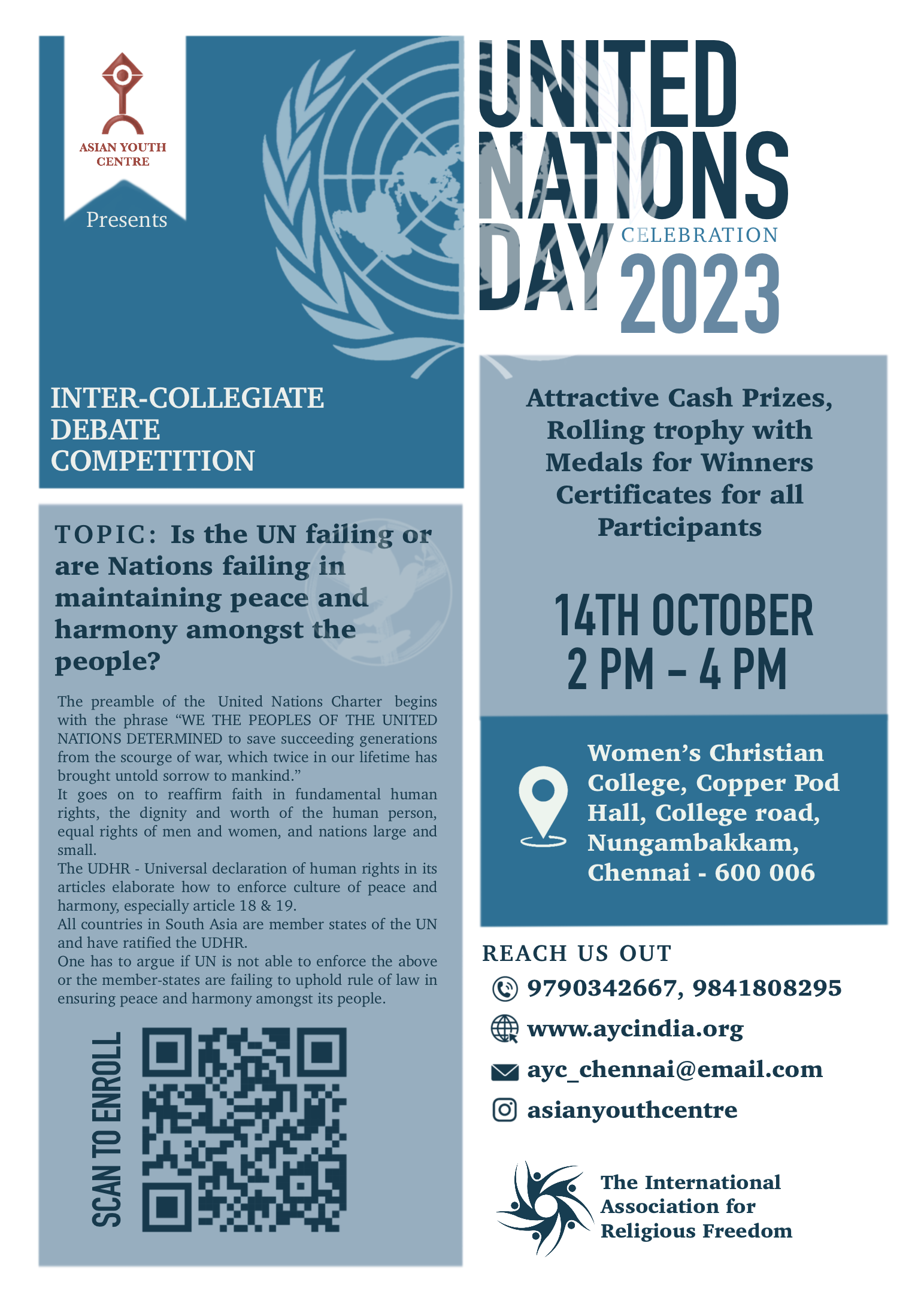
In line with a tradition of over 30 years, the India Chapter of the IARF is organizing the Inter-collegiate debate to commemorate UN Day on 24th October. This year’s debate, scheduled for 14th October 2023, centers on the thought-provoking topic: “Is the UN failing or are Nations failing in maintaining peace and harmony amongst the people?”
Previously hosted at Loyola College, Chennai, last year saw the debate being conducted at Hotel Ibis, Chennai. This year, around 25 city colleges have been invited, with the anticipated attendance of former AYC associates and volunteers.
Our distinguished judges for this event are:
- Mr. Sambandam, Section Director, The Hindu, Chennai
- Dr. Suchismita Pattanaik, Environmentalist, CISRS, Bhubaneshwar
- Dr. James Arputharaj Williams, AYC/IARF
We are also privileged to have Prof. Venkateshwar Rao from the International Association for Religious Freedom, Vishakapattinam, as our keynote speaker.
All are welcome to join these events as we strive to promote peace, understanding, and unity. Your continuous support and prayers are invaluable.
Contact: G 11/1, Natesan Nagar, Virugambakkam, Chennai – 600 092
Phone: 9871100363
Email: [email protected]
BV Foundation Commemorates International Day of Peace 2023
Summary
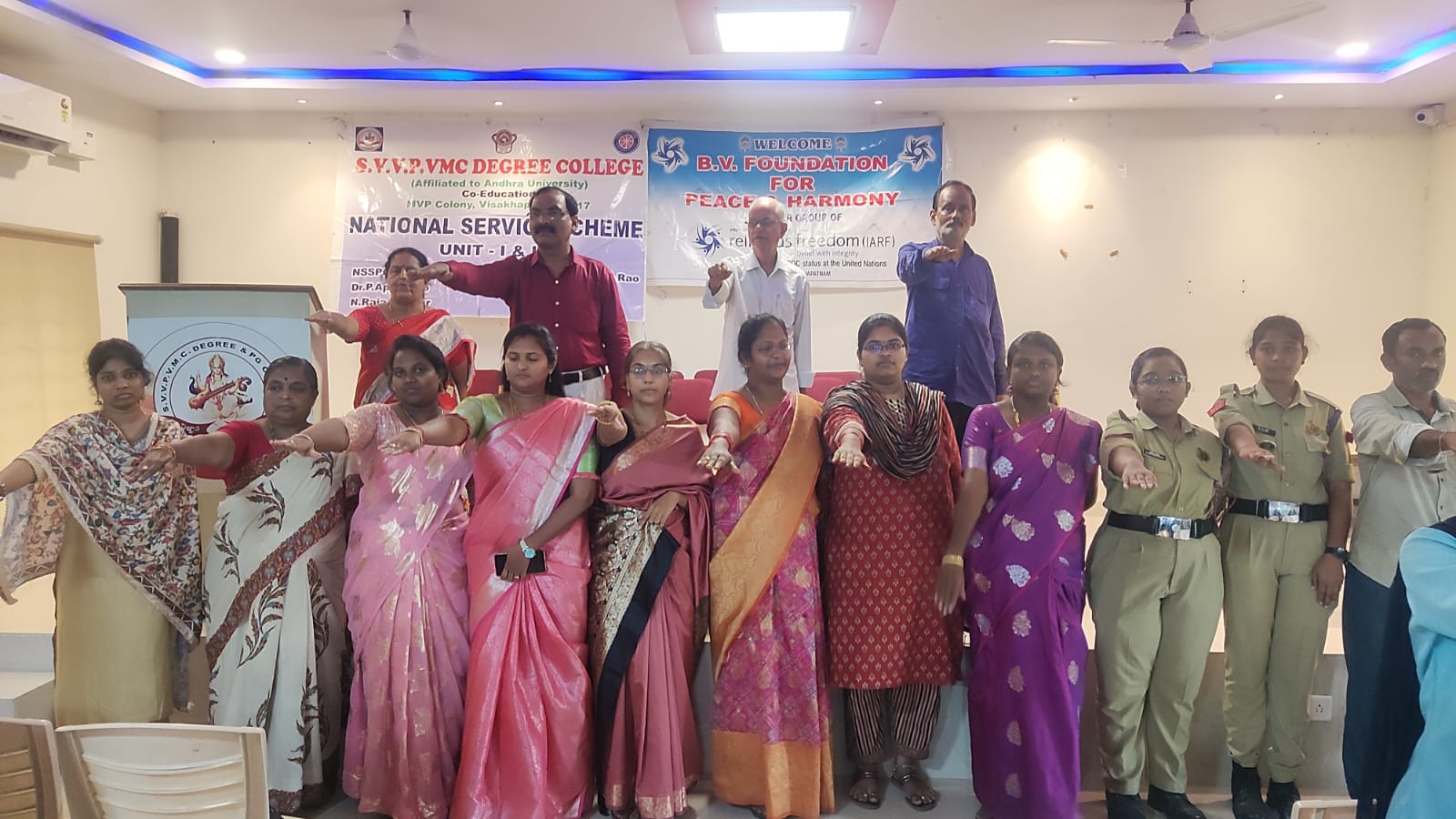
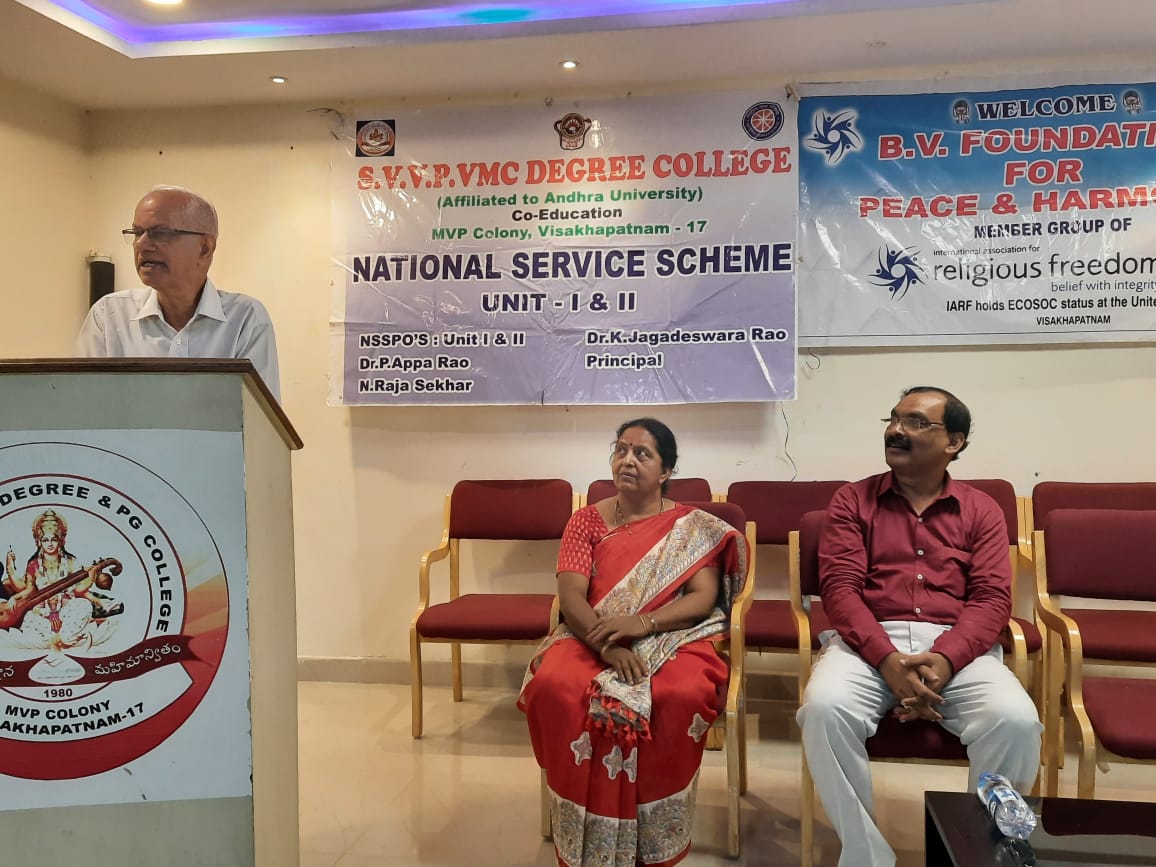
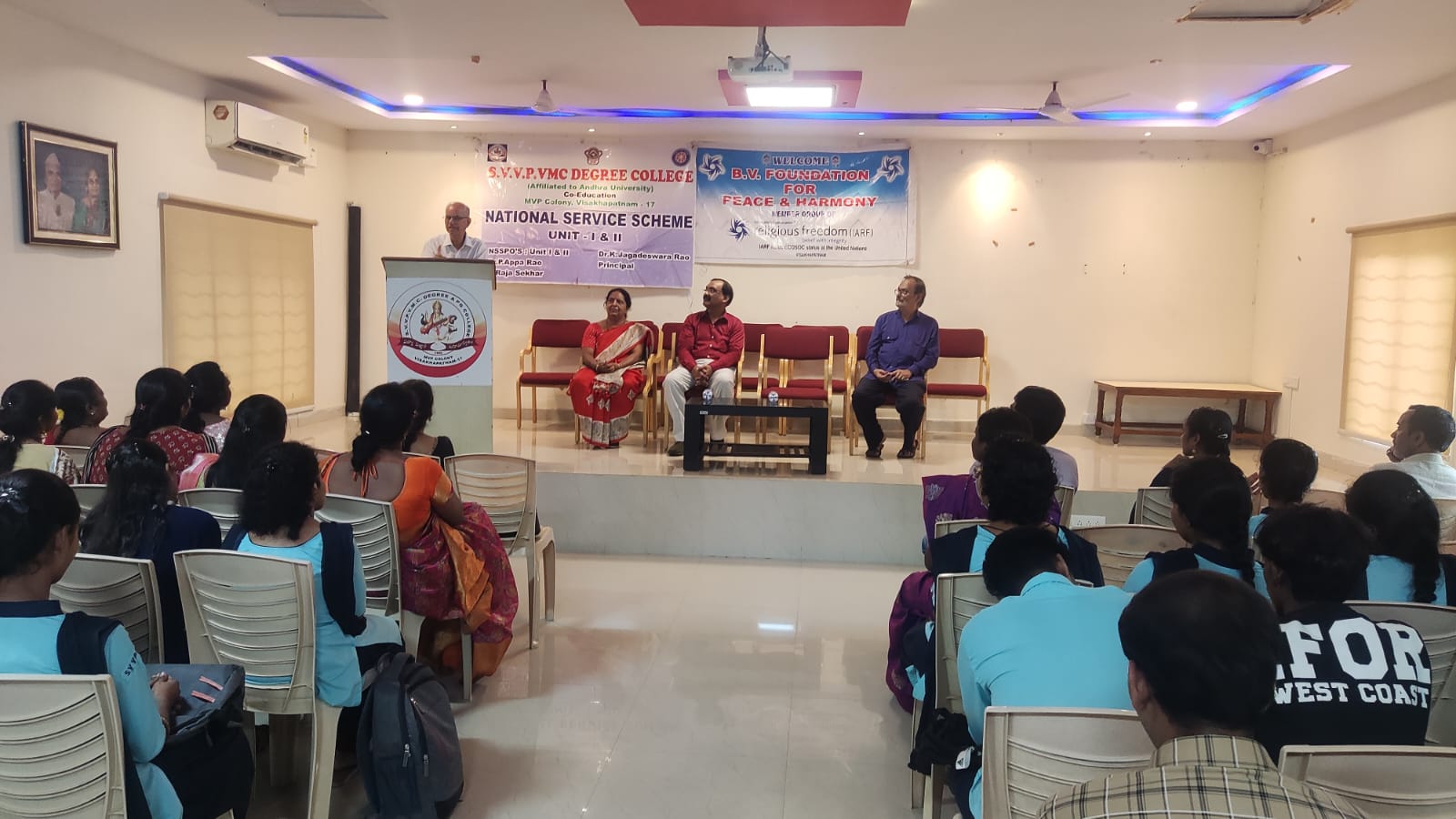
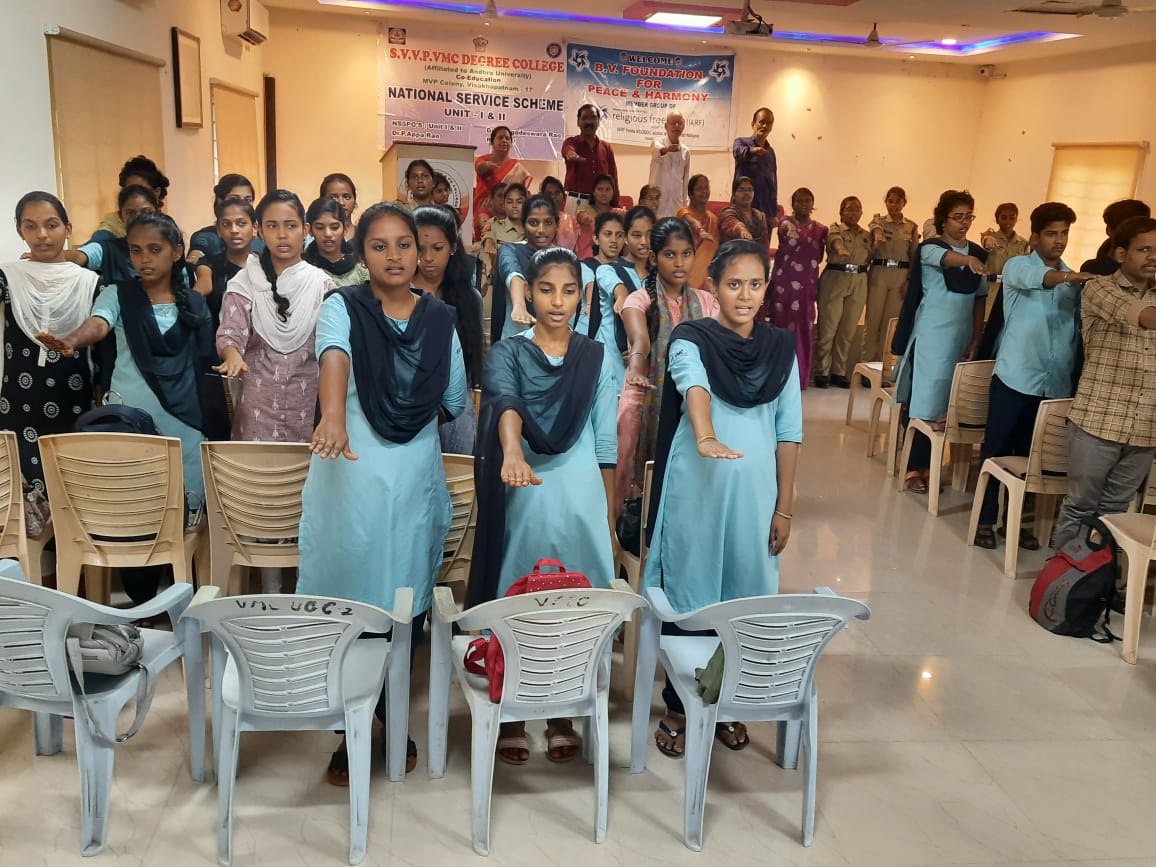
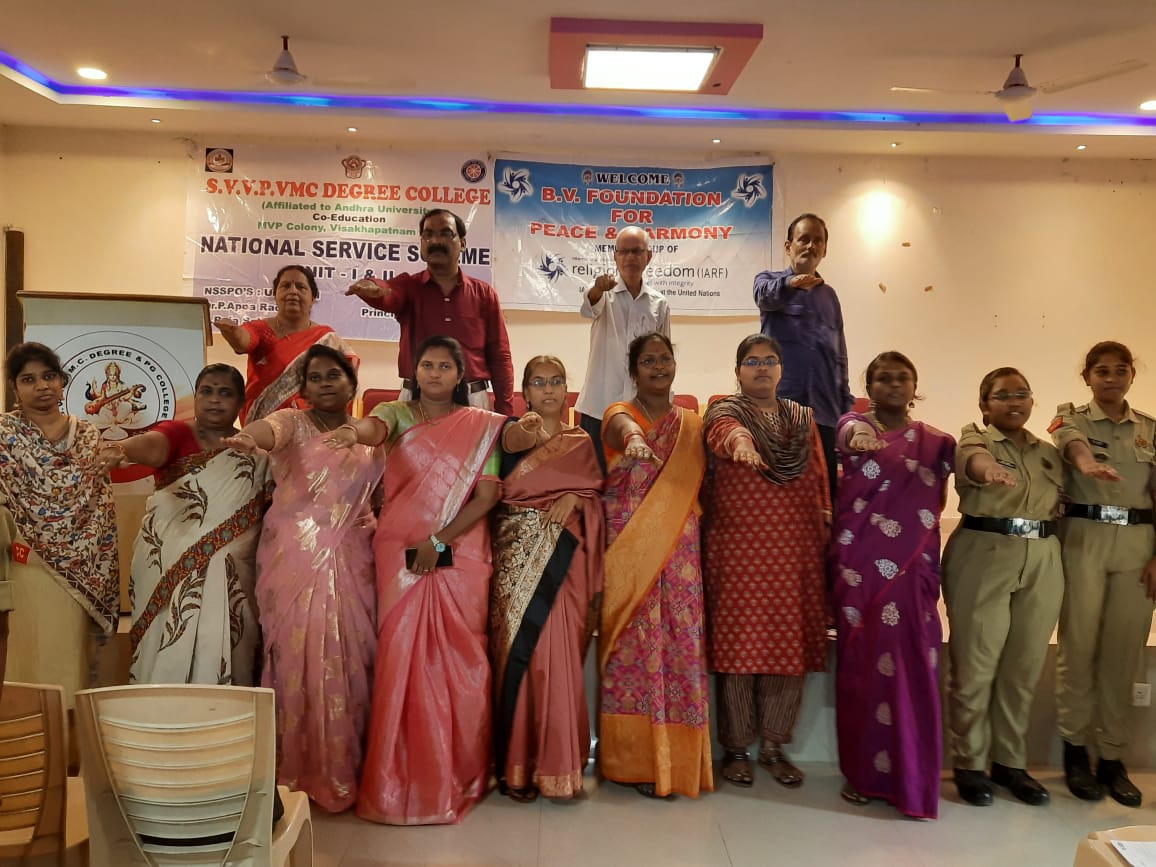
The BV Foundation for Peace and Harmony, a member group of the International Association for Religious Freedom (IARF), hosted a special event in honor of the International Day of Peace on September 21, 2023. The event was conducted at SVVP Degree College in MVP Colony, Visakhapatnam, Andhra Pradesh, under the chairmanship of Prof. Prakasa Rao.
Lighting the Lamp of Peace
The day began with the time-honored tradition of lighting a lamp to signify the commencement of the celebrations. Dr. K. Jagadeshwara Rao, the Principal of SVVP Degree College, served as the chief guest for the occasion. A multi-faith prayer session was conducted to unite all attendees in a solemn commitment to peace.
Advocating for Global Harmony
The focal point of the event was a series of speeches highlighting the critical need for fostering global peace. Prof. Prakasa Rao took the audience on a historical journey, elaborating that the International Day of Peace was established by the United Nations General Assembly on September 21, 1981. The goal behind this designation is to promote nonviolence, peace, and ceasefire among nations and individuals worldwide.
This Year’s Theme: End Racism and Build Peace
The current year’s theme resonated strongly with the audience, emphasizing the necessity to “End Racism and Build Peace.” Prof. Rao stressed that maintaining social harmony is of utmost importance, especially in an era where antisocial elements are disturbing the peace through violent activities.
Allocating Resources for Peace Over War
The speakers also discussed how nations often allocate extensive budgets for defense at the expense of vital sectors such as healthcare, food security, social welfare, and education. They argued for a reevaluation of priorities, emphasizing the significance of peace for societal wellbeing.
A Standing Ovation for UNO’s Efforts
Dr. K. Jagadeshwara Rao applauded the relentless efforts made by the United Nations to uphold peace despite numerous challenges. He suggested that educational institutions have a pivotal role to play in sensitizing the youth about methods to maintain global peace.
Taking the Peace Pledge
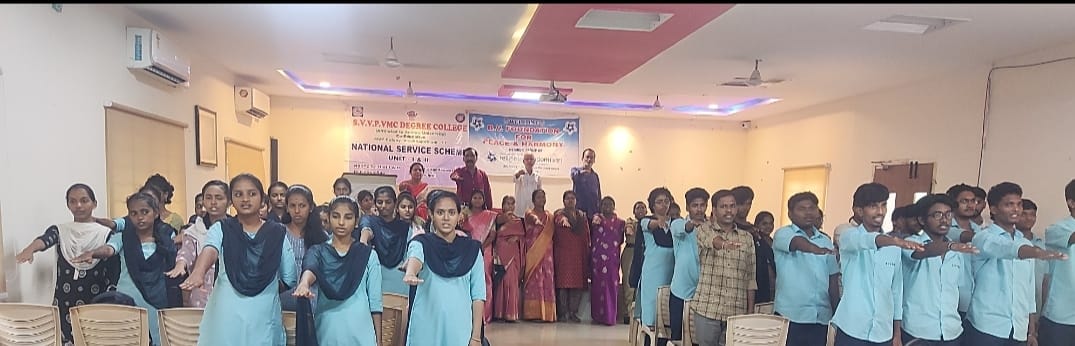
The event concluded with all attendees taking a pledge for peace, thereby symbolizing a collective commitment to promoting harmony across communities, nations, and religions.
For more information on upcoming events and how you can participate, please contact the BV Foundation at [email protected].