
Bahrain Interfaith Centre, our newest associate
The IARF has recently (April 2013) welcomed the Bahrain Interfaith Centre as an associate member group.
Contacts with this group have been established in 2012 through our representative with the UN ECOSOC in Geneva, Mr. Morse Flores.
IARF welcomes groups that are multi-faith and that are working non-violently and peacefully to promote religious freedom. Groups which have a limited scope and have not been rooted deeply in their societies for a length of time are being received as associate members.
IARF expects to invite the Bahrain Interfaith Centre to join it as a full member in coming years. The group has submitted the following account of the situation which led to it being called into existence, followed by a description of its aims and purposes.
Rev. Drs. Wytske Dijkstra, Chair of Europe & Middle East region
Introducing the Bahrain Interfaith Centre
by Sheikh Maytham Al-Salman, Chairman
Sectarianism in Bahrain
Throughout history, men and women of religion have stood against tyranny and fought for the natural right of all individuals to practice their own faiths and beliefs, free from harassment, suppression and persecution. Regimes and social powers have utilized sectarianism to divide human societies into sects living in conflict in many scenarios in history. Bahrain, after the unfortunate events which took place in the aftermath of 14 February 2011, has faced mass criticism at a public and governmental level for practicing, nurturing, developing and tolerating sectarianism.
Sectarianism is defined as discrimination or hatred arising from attaching importance to perceived differences between subdivisions within a group, such as between different denominations of a religion, class, regional or factions of a political movement.
The ideological underpinnings of attitudes and behaviours labelled ‘sectarian’ are extraordinarily varied. Members of a religious or political group may believe that their own salvation, or the success of their particular objectives, requires aggressively seeking converts from other groups; adherents of a given faction may believe that for the achievement of their own political or religious project their internal opponents must be purged.
At a governmental level the government of Bahrain claims to refuse sectarianism, however the Report of the Bahrain Independent Commission of Inquiry, released to HM King Hamad bin Isa Al Khalifa on 23rd November 2011, finds that sectarianism was practiced at a governmental level especially in the following areas:
- Sectarianism has been broadcast, practiced and escalated in the public national media, especially on Bahrain TV
- Sectarianism was the drive to demolish more than 37 centres of worship;
- Sectarianism was the drive to expel and suspend thousands from their jobs in the private and public sector;
- Sectarianism was evident in the mass punishment of villages in Bahrain;
- Sectarianism is practiced in the linguistic and physical behaviour of the police forces
At a public level, reports have found that sectarianism is practiced, enrooted and escalated between Shi’a and Sunni, between local nationals and naturalized Bahrainis, those of Bedouin descent and of urban descent, the opposition and the government-loyal communities, and other social groups.
Bahrain: An instance of Religious Discrimination?
Religious discrimination is valuing or treating a person or group differently because of what they do or do not believe. A concept like ‘religious discrimination’ is necessary to take into account ambiguities of the term ‘religious persecution’: the most infamous cases in which people have been executed for beliefs perceived to be heretic are generally recognizable as persecution.
Although the constitution in Bahrain claims that Freedom of Religion is a constitutional right, the religious Shi’a majority claim religious discrimination is practiced on a mass scale against them.
Shi’a feel that they are denied the equal protection of the laws; equality of status under the law; equal treatment in the administration of justice; and equality of opportunity and access to employment, education, housing, public services and facilities, and public accommodation – all due to their exercise of their right to religious freedom and opinion.
Bahrain Interfaith Center
Bahrain Interfaith Center is a non-profit team of open-minded, moderate Bahraini volunteers attempting to protect religious rights, prevent religious and social discrimination and sectarianism, encourage interfaith dialogue, denounce sectarian violence and support peace initiatives.
Bahrain Interfaith Center was created in 2012 to cultivate harmony amongst religious groups and sects in Bahrain. We intend to be dedicated to protecting the religious and social rights of people in Bahrain. We will attempt to prevent discrimination, to uphold religious freedom, to investigate cultural and religious rights violations, and pressure the government to end abusive sectarian and religious practices, and respect international human rights law.
To accomplish this, we invite individuals and communities who respect religious and faith pluralism to join our mission in promoting tolerance, confronting sectarianism and religious discrimination and encouraging interfaith dialogue.
Our Vision
We believe that achieving internal and external peace is an agreed upon goal in the majority of religions and faiths. Thus it is the role of religious leaders to promote understanding among people of all faiths, and to strongly prohibit all forms of violence and aggression against all people, regardless of their faith or race. If religious leaders promote this vision, religious and cultural fears and hatreds will be replaced with understanding and respect.
Core Values
- Personal worth: People are worthy of respect, support, and caring simply because they are human. Everyone should be treated in a fair manner regardless of race, religion, and sect
- Lack of discrimination: Working towards promoting a culture in Bahrain that is relatively free of discrimination on the basis of religion, thought and social background
- Dignity: The dignity of the human person. We oppose the use of torture and cruel or unusual punishment against people regardless of their thought, religion or social background.
- Democracy: We believe that the promotion of true(not fake)democracy eliminates discrimination. We also support democratic processes within religious, political, and other structures.
- Promoting religious neutrality within government: We believe governments should treat everyone equally regardless of religion or sect. The government should not promote one religion or sect over another, promote religion over secular beliefs, or promote secular beliefs over religion, accuse a sect of being national and the other being a betrayer.
- Personal freedom: The freedoms of religious beliefs, speech, association, and expression at the individual, congregational and denominational level.
- Freedom of speech: “The freedom for faith groups to discuss each other’s traditions”.
Religious Freedom Unit
Bahrain Interfaith Centre has established a Religious Freedom Unit to report violations of religious freedom in Bahrain. The Unit is also heading the Religious Freedom Committee at the Bahrain Human Rights Observatory. The Unit has been active internationally and locally in issuing reports on violations of religious freedom.
—————————————————————————-
Introducing the Bahrain Interfaith Centre – PDF copy, 3 pages
Conference Report: Religious Freedom & Responsibility for Planet & People
IARF Peace Commission / World Congress of Faiths / Horsham Interfaith
Report on 2013 Conference “Religious Freedom and Responsibility for Planet and People”
@Unitarian Church in Horsham, Sussex
20-23 August 2013
Report: Horsham hosts international conference (PDF 4 pages)
PAPERS (available as a print publication)
- French, Prof. Hal – The Genius of Interfaith
- Gehrmann, Dorle – Doing the Splits
- Hunter, Rev. Dr. Doris – Religion and Violence
- Matsui, Prof K. – Teaching Conflict Resolution Processes through Animation Resource Materials
- Manoja, Dr. Kishan – Apostasy and Conversion
- Kannanchira, Fr. Roby – Celebrating Diversity
- McKanan, Dr. Dan – Ethics and Magic
- Stolov, Dr. Yehuda – Peace in the Holy Land
- Yamamoto, Guji & Ochiai, Rev. – Shinto Shrines & Reverence for Nature
Video: Dr. Yehuda Stolov – “Peace in the Holy Land: It can be done“
Video: Rev Dr Marcus Braybrooke – “A Widening Vision (Interfaith Pioneers)”
Video: Music interlude, Stuart Coupe
[portfolio_slideshow]
Freedom of Expression & Freedom of Religion and Belief: government memorandum
Human rights policy memorandum ‘Freedom of Expression and Freedom of Religion and Belief’
….details the Netherlands’ efforts to help achieve universal respect for the freedoms of expression and religion.
Congress 2014 venue familiarisation
6 July 2013
Rev. Yoshinobu Miyake, representing IARF’s president Most Rev. Mitsuo Miyake, visited Birmingham together with IARF Treasurer Jeff Teagle and British Chapter committee member Derek McAuley (Chief Officer of the Unitarian General Assembly of Unitarian and Free Christian Churches), as guests of Shaykh Muhammad Amin-Evans, Chair of the Congress Host Committee.
They were given a broad overview of the prospective setting and hosting arrangements in Birmingham city centre and the University of Birmingham campus.
Since it was a Saturday most of the campus buildings and services were closed, but a walk around the grounds took in a visit the Chaplaincy Centre at St Francis Hall and the Barber Institute of Fine Arts, and a look over four-star accommodation at one of UoB’s conference buildings.
A small early-evening reception at the nearby Al-Mahdi Institute introduced Yoshinobu-sensei to some local faith representatives and supporters of Congress. Sensei made a short inspiring talk to introduce IARF and express the aims of Congress.
[portfolio_slideshow]
British Chapter committee member elected to IFN-UK Executive
1 July 2013
The British Chapter of IARF has congratulated committee member Derek McAuley on his election to the Executive Committee of the Inter Faith Network for the United Kingdom.
The Inter Faith Network plays a key role in promoting good relations between people of different faiths in this country and advancing public knowledge and mutual understanding of the teachings, traditions and practices of the different faith communities in Britain.
The Executive Committee are the trustees and directors of the organization which is a registered charity and company.
Derek was nominated in the category of ‘Other Inter Faith Organisations’ at the Annual General Meeting held in Birmingham on 1 July 2013 and acts in an individual capacity.
Derek said:
“I am pleased to have the support of the IARF in my new role. IFN plays a significant role in promoting inter faith dialogue which as recent events have shown is key to good community relations. I am proud of the long-standing commitment of IARF, from its establishment in 1900, to developing good inter faith relations among the religions of the world and was a founder member of the Inter Faith Network”.
EU Guidelines on FoRB Promotion & Protection
On 24 June 2013, the Council of the European Union adopted the Guidelines on the Promotion and Protection of Freedom of Religion or Belief, and said the EU will:
recall at all appropriate occasions that laws that criminalize blasphemy restrict expression concerning religious or other beliefs; that they are often applied so as to persecute, mistreat, or intimidate persons belonging to religious or other minorities, and that they can have a serious inhibiting effect on freedom of expression and on freedom of religion or belief; and recommend the decriminalisation of such offences.
forcefully advocate against the use of the death penalty, physical punishment, or deprivation of liberty as penalties for blasphemy.
Document (PDF, 18 pages)
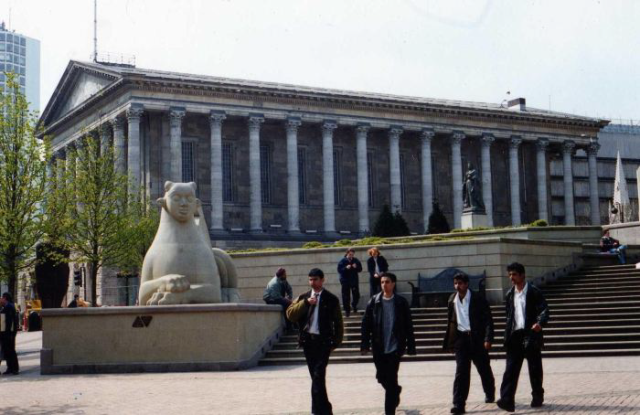
Announcement of 34th World Congress, 2014

“Challenges for Religious Freedom in the digital age”
Sun 24 to Weds 27 August 2014
University of Birmingham,
United Kingdom
Announcement flyer (PDF)
Updates (also on Twitter and Facebook Friends and Event pages)
Information to date on the Congress
Tehmina Kazi on Religion, Religious Freedom and Secularism
Religion, Religious Freedom and Secularism
– by Tehmina Kazi
This article appeared in the March 2013 edition of the IARF British Chapter’s Newsletter and IARF Peacemaking Commission News
For the last three and a half years, I have been the Director of a registered charity named British Muslims for Secular Democracy. When I tell other people what I do at networking events and dinner parties, most are delighted, a small proportion give me funny looks, and the rest remain abjectly confused about what secularism actually means (as well as its attendant implications for religious minorities living in the UK).
Hence, I was pleased to find out about the publication of Jacques Berlinerblau’s book, How to Be Secular: A Call to Arms for Religious Freedom last year. While it was written from an American perspective, it also provided a rigorously-researched blueprint for addressing some of these issues in the UK. As Berlinerblau summarises, “So everyone uses the term (secularism), but its definition remains vague. One of my conclusions is, if there’s ever going to be a coherent secular movement in the United States, there will have to be clear articulation of its core values and principles.”
The associate professor says his definition of secularism does not in any way denigrate religion, but rather stresses a core secular goal of “enabling citizens to live peaceably with other citizens whose creed is different than their own.” While many political scientists have articulated pluralistic visions of a secular society, Berlinerblau goes several notches further by embracing the symbiotic relationship between religious communities and secularists. He describes how their respective success as civic actors is often dependent on each other, and outlines a 12-step programme to revive secularism, which actively includes and empowers people of faith. For example, he states, “Either secularism and Catholicism, whose relations have often been strained, must have this peace pipe moment or secularism in America isn’t going to go very far.”
How does all of this apply to a British context, particularly to Muslims? Very well, as it happens. In Contextualising Islam in Britain, a ground-breaking research project conducted by Cambridge University, a diverse group of Muslim participants were asked “What does it mean to live faithfully as a Muslim in Britain today?” An overwhelming majority of them affirmed their support for the British model of procedural secularism (which means that it is theoretically possible for all voices, whether religious or not, to access the public sphere equally). The participants observed that procedural secularism provides many benefits for British Muslims, including religious freedom. As British Muslims we are able, for the most part, to practice our faith in an atmosphere of respect and security, with recourse to established anti-discrimination provisions if this is not the case. Many public sector workplaces now have multi-faith prayer rooms, and halal food options (notwithstanding occasional pork DNA scares!) are available in school canteens and prisons.
Secularism in the UK can only thrive on the basis of specific pacts that different communities make with each other. Non-religious groups and individuals must accept the fact that some people view their faith as the most important part of their identities, even if this may seem perplexing. The onus is also on religious groups and individuals to forge common ground on contentious issues such as women’s rights, LGBT rights, freedom of expression and the establishment of good inter-faith – and, crucially, intra-faith – relations. While certain commentators have argued that these issues have become a stick with which to beat religious minorities, I don’t think we should be encouraging the victim mentality and “Get out of jail” card that this analysis engenders.
First, we should be putting our “equalities hats” on – and keeping them there. This means acknowledging the six protected equality grounds – gender, age, disability, race, religion and sexual orientation – and respecting their rights, but also insisting that each group upholds their responsibilities. For example, this means that a religious group who believes gay marriage to be sinful is entitled to hold such a view, but never entitled to prevent other religious organisations from holding such ceremonies if they so wish.
They should also expect to be robustly challenged on those views. By the same token, an employer who finds Islam repugnant should never be empowered – either by tacit acceptance or active collusion – to bully their Muslim employees. Thankfully, there are many wonderful initiatives like the Measuring Anti-Muslim Attacks project (Tell MAMA) which provide support to people who have been treated badly due to their “Muslimness,” or even perceived “Muslimness”.
Second, we should revisit religious texts that speak of civic engagement in positive terms. Within a procedural secular state such as Britain, Muslims have rights and responsibilities that are in keeping with Islamic teachings. Far from advocating withdrawal from society, mainstream Islamic scholarship regards civic engagement as highly desirable for Muslim citizens. Understanding that being a religious Muslim in Britain today also means living a full life as a citizen – with all the rights and responsibilities that entails – is a crucial step towards becoming well-integrated citizens in today’s Britain.
For example, Imam Abu Ishaq al-Shatibi, a 14th-century Andalusian scholar, articulated this principle in his work on the Maqasid al Sharia (goals of the sharia, or Islamic principles). He drew parallels between citizens’ rights and responsibilities in a state – such as freedom of conscience and the obligation to speak out against tyranny – and the objectives of Islam.
More needs to be done to highlight this area of thought, and how it can be used as inspiration in the lives of British Muslims, and followers of any faith, today.
______________
Tehmina Kazi is a Law Graduate of the LSE, and the Director of British Muslims for Secular Democracy.
TEDx ViadellaConciliazione
IARF and HRWF co-sponsor HRC UPR side event
UN Human Rights Council, Universal Periodic Review (UPR)
Side Event on freedom of religion in Russia
29 April 2013
in conjunction with the review of the human rights records of Russia through the Working Group on the UPR of the Human Rights Council.
Jointly organised by IARF and Human Rights Without Frontiers International (HRWFI)
Topics & Speakers:
- The law on extremism – Alexandr Verkhovsky from Sova Center in Moscow
- A number of court cases in Russia – Sergey Ivanenko, a Russian lawyer
- European Court decisions against Russia in religious matters – Attorney Patricia Duval from Paris
- Religious intolerance fostered by the state and anti-sect movements in Russia – Willy Fautré from Brussels
HRWF Report: Russia Side Event, UPR 2013 (PDF 1 page)