
Launch of Human Rights Resource Centre (HRRC)
Hindupur, Andhra Pradesh, India
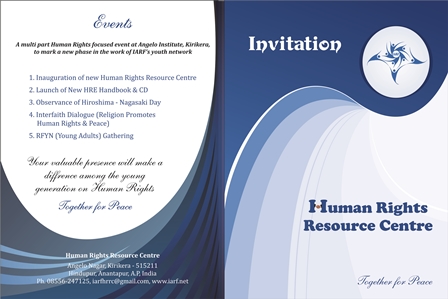
On Thursday 8 August 2013, a multi-part event marked a new phase in the Human Rights work of RFYN (IARF’s youth network) in India.
Council member Br. Albert Xaviour, young adult representative on IARF’s international governing board, organized the event, with the indispensable help of his team of co-workers Janhvi Gupte, Immanuel Manish, Kausrajan, Clinton Moses, Vijaysinh N. Dhandhukiya, Yashika Kim, Sathya Narayanan, G. Vishnupriya & Ruzbeh Vistasp Hodiwala.
The event comprised:
1. Inauguration of new Human Rights Resource Centre
Office space at Angelo Institute outside Hindupur, Andhra P., has been donated by Brothers of the Sacred Heart of Jesus, India (SHJ-India), and will provide a base for trainings of young adults across several states.
2. Launch of new Human Rights Education handbook & CD for trainees
The handbook will be used as a training manual for all programs to be offered by RFYN through its network.
3. Hiroshima-Nagasaki Day
Observance of the Day (August 6th), with ceremony of remembrance.
4. Interfaith Dialogue
Involving local religious leaders answering questions from RFYN young adults, this ‘multi-logue’ will mark the inception of a new branch of IARF-India Chapter, for the town of Hindupur (Angelo Institute is located just outside Hindupur).
5. RFYN gathering
Members of our young adult network from around the country will hold planning and training sessions over two days.
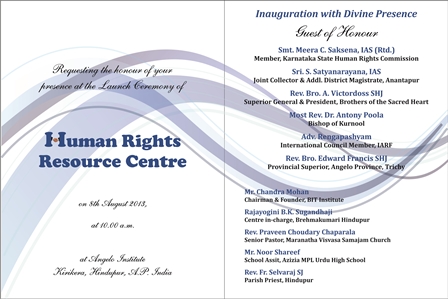
Dignitaries attending:
- Smt. Meera C. Saksena, Hon. Member, Karnataka State Human Rights Commission (SHRC);
- Most Rev. Dr. Antony Poola, Bishop of Kurnool;
- Sri S. Satyanarayana, Joint Collector & Addl. District Magistrate, Anantapur;
- Rev. Bro. A. Victordoss, Superior-General & President, SHJ-India;
- Adv. V. Rengapashyam, IARF Council member;
- Rev. Bro. Edward Francis SHJ, Provincial Superior, Angelo Province, SHJ-India;, Trichy;
- Mr. Chandra Mohan, Chairman & Founder, BIT Institute;
- Rajayogini B.K. Sugandhaji, Centre In-charge, Brahma Kumaris, Hindupur;
- Rev. Praveen Choudary Chaparala, Senior Pastor, Maranatha Visvasa Samajam Church;
- Mr. Noor Shareef, School Asst., Azizia MPL Urdu High School;
- Rev. Fr. Selvaraj SJ, Parish Priest, Hindupur;
- Rev. Br. Michael Raj SHJ, Secretary, Caussanel Province.
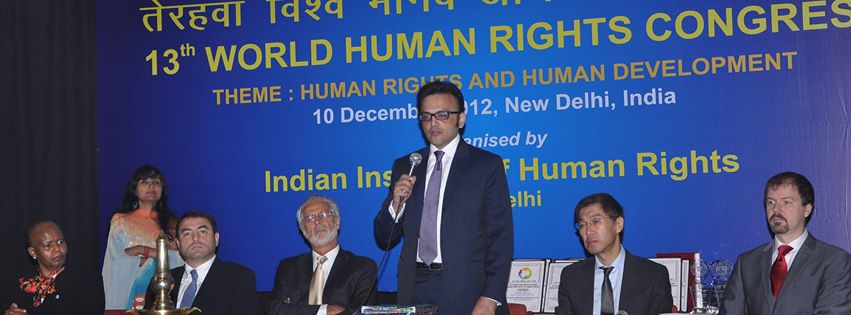
A message of congratulations was received from Dr. Rahul Rai, Director of the Indian Institute of Human Rights:
“On the occasion of the establishment of The Human Rights Resource Centre
(HRRC) under the aegis of the International Association For Religious Freedom (IARF),
I take this opportunity to extend my best wishes to HRRC and its functionaries.
Human Rights Education lies at the heart of our efforts to build a society based on
the twin principles of Justice and Equity. The endeavour of HRRC in partnership
with Brothers of Sacred Heart of Jesus to promote Human Rights Education will go a
long way in creating a culture of respect for Fundamental Human Rights”.
IARF welcomes warmly the practical as well as moral support extended by Rev. Bro. Victordass, Superior-General of BSHJI, in the form of office space for the centre, and anticipates a fruitful collaboration toward the mutual goals of our respective organisations.
And RFYN-India youth network acknowledges with much gratitude the gift of INR 276,000 (GBP3,000) from the UK-based International Interfaith Centre, an old colleague of IARF in Oxford days, toward the outfitting of the centre.
Tehmina Kazi on Religion, Religious Freedom and Secularism
Religion, Religious Freedom and Secularism
– by Tehmina Kazi
This article appeared in the March 2013 edition of the IARF British Chapter’s Newsletter and IARF Peacemaking Commission News
For the last three and a half years, I have been the Director of a registered charity named British Muslims for Secular Democracy. When I tell other people what I do at networking events and dinner parties, most are delighted, a small proportion give me funny looks, and the rest remain abjectly confused about what secularism actually means (as well as its attendant implications for religious minorities living in the UK).
Hence, I was pleased to find out about the publication of Jacques Berlinerblau’s book, How to Be Secular: A Call to Arms for Religious Freedom last year. While it was written from an American perspective, it also provided a rigorously-researched blueprint for addressing some of these issues in the UK. As Berlinerblau summarises, “So everyone uses the term (secularism), but its definition remains vague. One of my conclusions is, if there’s ever going to be a coherent secular movement in the United States, there will have to be clear articulation of its core values and principles.”
The associate professor says his definition of secularism does not in any way denigrate religion, but rather stresses a core secular goal of “enabling citizens to live peaceably with other citizens whose creed is different than their own.” While many political scientists have articulated pluralistic visions of a secular society, Berlinerblau goes several notches further by embracing the symbiotic relationship between religious communities and secularists. He describes how their respective success as civic actors is often dependent on each other, and outlines a 12-step programme to revive secularism, which actively includes and empowers people of faith. For example, he states, “Either secularism and Catholicism, whose relations have often been strained, must have this peace pipe moment or secularism in America isn’t going to go very far.”
How does all of this apply to a British context, particularly to Muslims? Very well, as it happens. In Contextualising Islam in Britain, a ground-breaking research project conducted by Cambridge University, a diverse group of Muslim participants were asked “What does it mean to live faithfully as a Muslim in Britain today?” An overwhelming majority of them affirmed their support for the British model of procedural secularism (which means that it is theoretically possible for all voices, whether religious or not, to access the public sphere equally). The participants observed that procedural secularism provides many benefits for British Muslims, including religious freedom. As British Muslims we are able, for the most part, to practice our faith in an atmosphere of respect and security, with recourse to established anti-discrimination provisions if this is not the case. Many public sector workplaces now have multi-faith prayer rooms, and halal food options (notwithstanding occasional pork DNA scares!) are available in school canteens and prisons.
Secularism in the UK can only thrive on the basis of specific pacts that different communities make with each other. Non-religious groups and individuals must accept the fact that some people view their faith as the most important part of their identities, even if this may seem perplexing. The onus is also on religious groups and individuals to forge common ground on contentious issues such as women’s rights, LGBT rights, freedom of expression and the establishment of good inter-faith – and, crucially, intra-faith – relations. While certain commentators have argued that these issues have become a stick with which to beat religious minorities, I don’t think we should be encouraging the victim mentality and “Get out of jail” card that this analysis engenders.
First, we should be putting our “equalities hats” on – and keeping them there. This means acknowledging the six protected equality grounds – gender, age, disability, race, religion and sexual orientation – and respecting their rights, but also insisting that each group upholds their responsibilities. For example, this means that a religious group who believes gay marriage to be sinful is entitled to hold such a view, but never entitled to prevent other religious organisations from holding such ceremonies if they so wish.
They should also expect to be robustly challenged on those views. By the same token, an employer who finds Islam repugnant should never be empowered – either by tacit acceptance or active collusion – to bully their Muslim employees. Thankfully, there are many wonderful initiatives like the Measuring Anti-Muslim Attacks project (Tell MAMA) which provide support to people who have been treated badly due to their “Muslimness,” or even perceived “Muslimness”.
Second, we should revisit religious texts that speak of civic engagement in positive terms. Within a procedural secular state such as Britain, Muslims have rights and responsibilities that are in keeping with Islamic teachings. Far from advocating withdrawal from society, mainstream Islamic scholarship regards civic engagement as highly desirable for Muslim citizens. Understanding that being a religious Muslim in Britain today also means living a full life as a citizen – with all the rights and responsibilities that entails – is a crucial step towards becoming well-integrated citizens in today’s Britain.
For example, Imam Abu Ishaq al-Shatibi, a 14th-century Andalusian scholar, articulated this principle in his work on the Maqasid al Sharia (goals of the sharia, or Islamic principles). He drew parallels between citizens’ rights and responsibilities in a state – such as freedom of conscience and the obligation to speak out against tyranny – and the objectives of Islam.
More needs to be done to highlight this area of thought, and how it can be used as inspiration in the lives of British Muslims, and followers of any faith, today.
______________
Tehmina Kazi is a Law Graduate of the LSE, and the Director of British Muslims for Secular Democracy.
Guidelines for arranging group visits to Houses of Worship
From Scarboro Missions, comprehensive guidelines for visiting houses of worship of various faiths, authored by renowned Canadian multifaith educator, JW Windland.
RFYN meets UN official India visit
27 April 2013, Chennai
Following the wave of concern over women’s issues in India since the New Delhi rape atrocity of December 2012, the Office of the High Commissioner for Human Rights (OHCHR) in the United Nations arranged, under the ‘Special Procedures’ instrument for human rights issues, a country visit by the Special Rapporteur on Violence against Women, from April 22 to May 1, 2013.
The SR herself (Ms Rashida Manjoo) was unable to attend a scheduled meeting with civil society organisations in Chennai on 27th April 2013, but our RFYN representatives met with her proxy.
Please read their report here (PDF, 3 pages).
TEDx ViadellaConciliazione
IARF and HRWF co-sponsor HRC UPR side event
UN Human Rights Council, Universal Periodic Review (UPR)
Side Event on freedom of religion in Russia
29 April 2013
in conjunction with the review of the human rights records of Russia through the Working Group on the UPR of the Human Rights Council.
Jointly organised by IARF and Human Rights Without Frontiers International (HRWFI)
Topics & Speakers:
- The law on extremism – Alexandr Verkhovsky from Sova Center in Moscow
- A number of court cases in Russia – Sergey Ivanenko, a Russian lawyer
- European Court decisions against Russia in religious matters – Attorney Patricia Duval from Paris
- Religious intolerance fostered by the state and anti-sect movements in Russia – Willy Fautré from Brussels
HRWF Report: Russia Side Event, UPR 2013 (PDF 1 page)
IARF co-sponsors Multi-faith Coalition event at UN
Report to the “Multi-Faith Coalition on Partnering with the United Nations”
On a meeting during the 22nd session of the Human Rights Council
United Nations, Geneva.
7 March 2013
Sponsored by the Republic of Kazakhstan;
FICIR (Forum Intercultural & Interreligious);
IARF (International Association for Religious Freedom)
Report to the Multi-Faith Coalition (PDF, 6 pages)
President joins signatories to G8 letter
IARF President Most Rev. Mitsuo Miyake and Council member Rev. Takeshi Nishida were among 80 religious leaders signatory to a letter to the Financial Times urging G8 countries to follow the UK in meeting existing commitments to spend 0.7% of national income on aid.
Original FT article requires subscription to view, but this story is reported on the Archbishop of Canterbury’s site.
Their names appear in the list of signatories below the article (Pres. Miyake #74, Rev. Nishida #77).
HRE-RFYN KLE Law College, Bengaluru
Human Rights Education training by RFYN
@KLE Law College, Bengaluru (Bangalore)
4-5 April 2013
Facilitators: Mr. K. Ramachandran, Prof. Anbumani Arumugam
Report (PDF, 7 pages illustrated)
HRE-RFYN Women’s Day 2013
Human Rights Education training by RFYN
@Brothers Integrated Rural Development Society (BIRDS), Bangalore
9 -10 March 2013
Facilitator: Bro. Albert Xaviour
Report (PDF 9 pages, illustrated)