

How Liberal Religion Spearheaded Protection of Belief: Anniversary of the 1981 UN Declaration
“Considering that religion or belief, for anyone who professes either, is one of the fundamental elements in his conception of life…”
November 25 marks a pivotal, yet often overlooked, milestone in the history of human rights. On this day in 1981, after nearly two decades of geopolitical gridlock, the United Nations General Assembly adopted Resolution 36/55: the Declaration on the Elimination of All Forms of Intolerance and of Discrimination Based on Religion or Belief., the first international instru ment dedicated solely to freedom of religion.
While the 1948 Universal Declaration of Human Rights laid the foundation, it was this 1981 document that finally codified the specific rights of conscience—freedom to worship, to teach, to publish, and to organize—into international norms. But this victory was not inevitable. It was achieved through the tenacious intervention of civil society when governments had all but given up.
The story of the 1981 Declaration is, in large part, a story of liberal religion. Through the leadership of the IARF and our member groups—particularly the Unitarian Universalist Association (UUA)—our representatives spearheaded the consensus that protects the rights of believers and non-believers alike.
Deep Roots: A Legacy of Visionary Activism
Long before the Declaration was drafted, the IARF recognized that religious freedom required a global political framework. As detailed in the IARF’s Centennial Reflections, this engagement began with Elvira Fradkin, a visionary American Unitarian from Montclair, New Jersey.
Present at the founding of the United Nations in San Francisco in 1945, Fradkin understood early on that the new world order needed the voice of liberal religion. It was her persistence that convinced the IARF to register with the UN Economic and Social Council (ECOSOC) in the 1950s—one of fewer than 300 NGOs to do so at the time. Her work laid the logistical and moral groundwork for the battles that would come decades later.
The Cold War Deadlock: Diplomacy Over Dogma
By 1972, the UN’s effort to create a binding treaty on religious freedom had stalled completely. The drafting process was paralyzed by the rigidity of the Cold War. The Soviet bloc refused to sign any document that did not explicitly protect atheism and shield the state from “religious interference.” Meanwhile, various Western and Islamic nations clashed over the definition of religious rights, particularly regarding the right to change one’s religion.
In this vacuum of political will, religious freedom was becoming a casualty of superpower posturing. This is where the IARF and the UUA played their most decisive role. Because liberal religion honors the inherent dignity of all paths—theistic, non-theistic, and atheistic—our representatives were uniquely positioned to bridge the ideological divide.
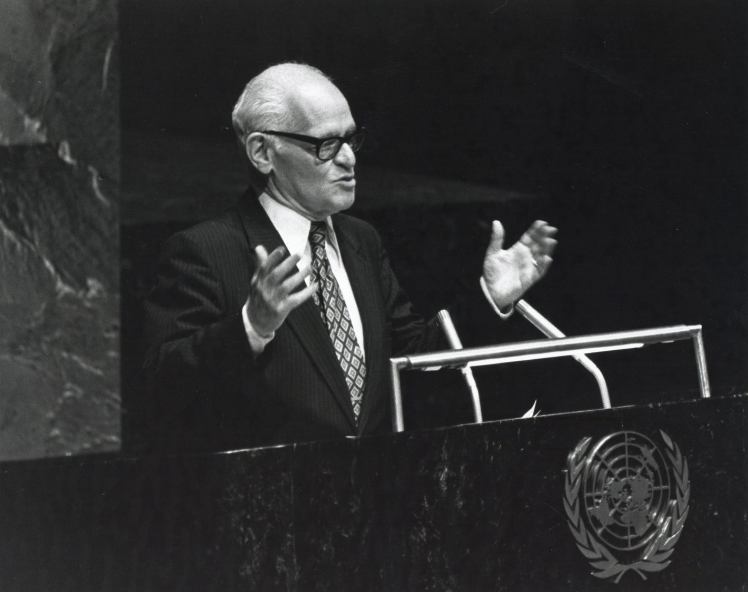
Two leaders from our community were central to breaking the impasse:
- Prof. Auguste-Raynald Werner, the IARF Representative in Geneva. A distinguished Professor of International Law, Werner worked tirelessly within the UN Commission on Human Rights. He used his legal expertise to craft language capable of satisfying opposing political blocs, ensuring the text was robust enough to protect rights but flexible enough to pass.
- Dr. Homer A. Jack, a Unitarian Universalist minister serving as Secretary-General of the WCRP. He spearheaded the “Gang of Four” NGOs that refused to let the issue die. When member states moved to shelve the draft, Jack mobilized the NGO community to pressure the General Assembly to prioritize a non-binding Declaration over a doomed Treaty—a strategic pivot that saved the project.
The “Religion or Belief” Compromise
One of the most significant contributions of the liberal religious lobby was the insistence on the phrasing “Religion or Belief.” This distinction was not merely semantic; it was the key to consensus. It ensured that the Declaration covered theistic faiths, non-theistic traditions, and atheistic views equally.
This inclusivity satisfied the Eastern bloc’s demand for the protection of non-religious convictions while aligning perfectly with the IARF’s principle of universal tolerance. It established a precedent that remains vital today: that freedom of conscience belongs to everyone, not just the religious.
Connecting the Dots: A Legacy of Action
The adoption of the Declaration was a victory, but as Dr. Jack noted in his memoirs, Homer’s Odyssey, a declaration without enforcement is just paper. The IARF’s leadership was central to building the machinery that enforces these rights today.
Institutionalizing Freedom: The Role of Sue Nichols
The creation of the NGO Committee in New York—the primary body that coordinates civil society advocacy on this issue today—was inextricably linked to the IARF and the UUA.
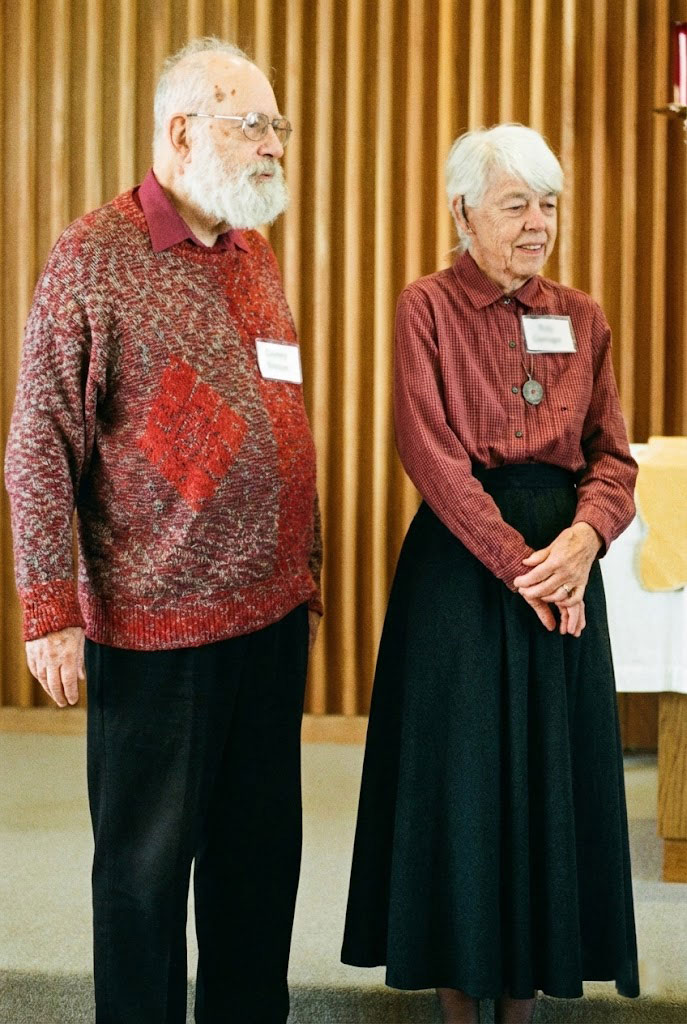
Sue Nichols, who co-directed the Unitarian Universalist UN Office with her husband Vernon, served as the IARF’s representative on the ground in New York during this critical period. Following the commissioning of the seminal “Salzberg Study” by Dr. Jack to explore implementation strategies, Nichols took the lead in formalizing the NGO coalition.
She became the founding President of the NGO Committee in New York. Under her leadership, the committee moved from an informal pressure group to a recognized powerhouse within the UN system. It established the tradition of the “Annual Day” to commemorate the 1981 Declaration and works directly with the Special Rapporteur to highlight violations globally.
A Continuing Responsibility
The 1981 Declaration remains the most important international instrument for religious freedom since the Universal Declaration of Human Rights. It serves as the basis for the mandate of the Special Rapporteur and laid the groundwork for modern diplomatic breakthroughs, such as Human Rights Council Resolution 16/18, which shifted the focus from protecting abstract religions to protecting living human beings from discrimination.
Today, the IARF continues this work as an active member of the NGO Committees on Freedom of Religion or Belief in both New York and Geneva. We honor the legacy of Fradkin, Werner, Jack, and Nichols not by looking backward, but by continuing to press for the rights of all people—regardless of their creed—to believe, or not believe, in freedom.
We Are Still Active Today
The IARF continues to honor this legacy. We remain an active member of the NGO Committees on Freedom of Religion or Belief in both New York and Geneva, working with the Special Rapporteur to ensure rights are respected.
Get Involved: IARF members are warmly invited to join our International Engagement Working Group to support our continued advocacy at the United Nations.
- Read “Centennial Reflections”: The full chapter on the IARF at the United Nations by Ruth Neuendorffer and Sue Nichols is available in our library for detailed historical context.
- Memoirs: For a personal account of the diplomatic struggle, see “Homer’s Odyssey” by Dr. Homer Jack.
- Primary Source: Read the full text of the 1981 Declaration.
Remembrance of Transylvania 2005 Flood
Two decades ago, on August 23rd, 2005, villages in the valley of the Nyikó river in Transylvania (Romania) suffered the most catastrophic flood in memory. Sixteen people have died. The flood destroyed the livelihood of thousands of people of that region. Two thousands of them lost everything, their houses, barns, animals, workshops, machinery, their cars. And all the remaining buildings were badly damaged. However, the devastation of the agriculture made all the people victims. Beside the farms, the flood also damaged the public buildings, such as churches, schools, town halls, and cultural halls. Some of the bridges and the roads became temporarily inaccessible.
Grief took hold of not only those families losing their loved ones, but entire communities. A thirty second video film by a teenager surfaced afterward as a dramatic witness. A family who tried to find refuge in the attic of their house already covered by water, lost hope of surviving. The teenager recorded their farewell:
“This is …. talking from Székely-Szentmihály. It’s over… The end of the world has come. That’s it… If someone finds this, please remember us.”
This family did survive.
Later the cause of the tragedy became evident: the post-communist era opened ways for unchecked greed and criminal negligence. Those who were to protect the society didn’t. Illegally clear-cut forests above the valley brought disaster upon the villages.
The relief and reconstruction efforts demonstrated compassion and solidarity, true heroism by people and organizations across Transylvania, Hungary, countries in Europe and Unitarians in the United States. They responded with impressive financial support. Perhaps the most significant gift came from the Unitarian Universalist Congregation at Shelter Rock, NY and its Veatch Program.
Beside donations pouring in, hundreds of people from the neighboring region came to help with physical work, participating in the massive cleaning and disinfecting first of all. They sheltered the victims in their own houses and provided food, clothing, basic necessities to them. During the first days even some 50 ministers and priests volunteered. Leaders of the Unitarian Youth Organization carried out the main planning and aid distribution tasks.
Then came the reconstruction work by volunteers and generous donors. Houses were rebuilt one after another, churches, schools and other community buildings repaired. An emergency committee was formed, demonstrating an amazing efficiency.
Remarkably, this local emergency committee created two decades ago, has grown into the Providence Charity Organization, now a major relief organization of the Hungarian Unitarian Church. One of their numerous projects is an ecumenical, sustained support of the Hungarian communities in Ukraine since the beginning of the war.
At the 20th anniversary of the tragedy, villages of the Nyikó valley will hold a commemoration on August 23rd. At this occasion they also wish to express their deep gratitude for all those who helped the victims rebuild their homes and their lives.
They extend their invitation also to anyone close or far to join their commemoration on August 23rd in the village of Kobátfalva (Cobatesti).
To fully appreciate the scale of the relief effort, we are sharing a contemporary account from the time. The following report, titled “After flood chronical,” was written by Szabó László, a key organizer of the initial response, in November 2005. It provides a powerful, on-the-ground look at the days and weeks immediately following the disaster.
After flood chronical
On August 23rd, 2005 a terrible flood has destroyed the lifetime work of thousands of people along the Nyikó river and in other regions of Udvarhelyszék. This tragedy not only caused severe economical damages, but also 16 persons have lost their lives. More than two thousand people were affected by the flood directly, but due to agricultural damages almost everyone is a flood victim in these villages. Along the Nyikó river a lot of houses were totally destroyed, and some were highly damaged. Many workshops, equerries, barns and secondary buildings crashed; the water drifted away animals, cars, machinery. The crop was destroyed on many thousands of hectares. The flood took away the already harvested crops and hay stored on the farms. Next to the farms the flood also damaged the public buildings, such as churches, schools, town halls, and cultural halls. Some of the bridges and the roads became temporarily inaccessible.
The catastrophe caused by the flood touched everyone. There are no words to express the grief of those who have lost their loved ones. The fear of death has penetrated into the lives of hundreds, and it will take a long time to overcome this fear. Weeks after the flood a short video film was sent to me, made by a teenager. The film is around thirty seconds recording the flood. He wanted this film to be a farewell on behalf of his family. They found refuge in the attic of their house covered by water: ”This is (…name…) talking from Székelyszentmihály. It’s over… The end of the world has come. That’s it… If someone finds this, please remember us.” Thank God this family survived. Now, months after the flood we remember the victims but we also remember the way in which people joined forces to help those in need. In those days and weeks many people helped the flood victims through voluntary work and through donations. Many people from Székelyföld, from all around Transylvania, from Hungary, from different countries of Europe, from the Unitarian Universalist congregations of the USA, and from all over the world reached out to help. We thank them all!
In the followings my paper will become more personal, because I would like to present to you the happenings in which I have also been participating. On the 18th-21st of August, the current year, the Dávid Ferenc Unitarian Youth Association (DFUYA) organized its annual most important program, the 29th Transylvanian Unitarian Youth Conference in Kobátfalva. We had 230 attenders. The villagers had helped us in a great way organizing this program. They helped us prepare this event, and they assisted us materially and spiritually. The raised donations, they provided us room and board, they cooked for us, etc. In the afternoon of August 23rd after the conference has ended, I also said goodbye to those who became my friends during this great work. But none of us knew that we would meet sooner, than we have expected, namely on the next day.
On the evening of the 23rd of August I was in Segesvár, and there I learned about the catastrophe, so the next day I have changed directions and I went back to Kobátfalva. I drove the car belonging to the DFUYA, holding as much bread and water that I could fit into the car. On my way back I have spoken with some of my fellows from the DFUYA, asking them to come back as soon as they can. In Kobátfalva I have first met Rev. Szombatfalvi József, the dean of the Unitarian Church District of Székelykeresztúr, and Bán Gagyi János, a teacher from Kobátfalva. With the help of some local youth we started to organize the aid. We contacted many people through the phone, to ask for donations and voluntary work.
On the same day I have contacted those – who according to my judgement – were able to lead the aid programme in the neighboring villages. Together we made an assessment of the situation, regarding the flood victims, the destroyed and highly damaged houses, and the most urgent needs. Later that evening we saw the whole picture. We put together a list of the things we had to do, and we helped the locals to form action groups. We also appointed two organizational centers in which we meant to receive the donations: the school of Kobátfalva and the Unitarian parish of Siménfalva. We named the people whose work was to receive, to register and to classify the donations. We did our best to thank all for their help. We tried to stay in touch with them, and to share further needs and requests. We had to store some of the shipment while we were working on making the packages for the families. We have tried to make sure that the donations arrive to the victims according to the possibilities in the affected villages. Sometimes we shipped the packages to each house, in other cases the flood victims were called to the gather for the distribution of the donations. We permanently refreshed the list of needs, and depending on the possibilities, we focused on the exceptional cases too. The parish of Siménfalva was the distribution point for the victims living in that village and in Rugonfalva. The school of Kobátfalva was the distribution point for Székelyszentmihály, Nagykadács, Kiskadács and Kobátfalva.
Other members of our group organized the cleaning and the repairing operations. In the first two weeks many people from different villages and towns came to do voluntary work in the flood zone. Some of them came without calling, others were asked to come and help. There were thirty men from the military squad of Csíkszereda who also helped. (For example on the 27th of August there have been around 100 voluntary workers in Kobatfalva.) In order to manage the cleaning operations quickly, we needed machinery and equipment. In this regard the local sources were very poor. Finally some benefactors offered to help us out. In order to be more efficient both with the action groups and with the machinery we put together a schedule, a list of the things that needed to be done by them. Every night we put together the schedule for the next day, which was often modified in the morning because of the unexpected, but warmly greeted volunteers. These plannings had their results. For example in Kobátfalva nor the voluntary workers, nor the machinery crossed each other’s way, or activity. The whole village was cleaned from top to bottom. Each house, yard, and garden was cleaned. The mud, the garbage, the ruins of the buildings were taken away in a suitable manner. We have also used the industrial water pumps in the same way. Some of the volunteers and engineers stayed for more days at Kobátfalva, so we had to provide them food and shelter. As I have already said, we had a board meeting every evening. There we evaluated the achievements of the day, we checked the stocks in each of the distribution centers, we put together the list for the next day, and shared the work among the action groups. In the beginning this work took a lot of time, especially because we had a board meeting every evening in Kobátfalva, our center, and in two neighboring villages as well.
We were aware of the fact that after a huge flood like the one we had in the Udvarhely region the possibility of an epidemic was very likely, so we urged the officials to start the vaccinations and take the sanitary measures (like the disposal of the animal corpses). In case of future floodings it is essential to be prepared for these things too!
Keeping in touch with the donators and the volunteers, with the representatives of the media, the similar action groups and the different institutions was an important side of our organizational work. We collected the data of the flood damages, we framed the general situation of the damaged region, we summarized the most important requests of the victims, and we channeled this information through flyers printed in three languages to the donators. We also created a database of pictures made about the families and institutions which were highly damaged by the water. So our fundraising activity and our public relation activity was a continuous one.
Let’s take a look to the donations of the first days. What kind of donation did we ask for, what was brought in the first period? Drinkable water, bread and other basic food supplies, disinfecting and cleaning lotions, blankets, clothes, rubber boots, working tools and kitchen equipment etc. Some donators supplied warm food for several days for the flood victims. During the following weeks we started to receive other donations as well, such as grain crops, building materials, school equipment etc. The shipment of all the donations required money. If we couldn’t arrange the transportation we had to cover the expenses. In this situation, asking for cash seemed to be more reasonable. We didn’t distribute cash among the flood victims but purchase tickets. In this activity as well we wanted to be as fair as we could be, so we evaluated the loss of each household and we distributed the tickets proportionally. We created a survey sheet with 121 columns, through which we evaluated the damage made to each household. As you can see, our aim was to get the broader picture of everybody’s individual loss and damage.
In the first two weeks the helping activities were more first aid-like. Later we started the more time-consuming activities such as renovating or, in some cases, reconstructing the damaged or totally destroyed houses, barns and fences. We tried to find those people who were able and willing to donate their money for the constructions. We dreamed about new houses for those whose was completely taken away by the flood. When a certain amount of money came together we did not hesitate to lay the foundation for the first house. Only the fools start constructions in the fall, some told us. But discouragement couldn’t stop us. We worked further… We thought that if the benefactors see that we are really capable of building a house, they will support us in building others too. We were right, so now 4 family houses are being built. We are aware of the fact that we couldn’t respect the traditional architectural style of this area. Next to this the new houses have been built in the flood area, which means that the next flood will have the possibility to hit them again.
It was very clear for us even during the first days that the damage, made by the flood in a few hours, was so enormous that it would take us a long time and very hard work to come back to our normal lifestyle. Because we all understood that we have to work for a longer period of time, we have decided to change our action group into a Relief Committee. So we did on the 5th of September. The aim of our Relief Committee is to provide a long-time assistance for the flood victims from the following villages: Kobátfalva, Székelyszentmihály, Nagykadács and Kiskadács. Our work (still) contains fundraising, channeling the donations in a just way, rebuilding the destroyed homes, restoring the public buildings. To the end of August the mayor’s office in Siménfalva restarted its normal activity; the local government is doing its job again. So we have decided to let the leaders of the local government, and the boards of the two churches, Unitarian and Calvinist, to take care of the flood victims in Siménfalva. We plan to concentrate on other four villages.
The members of the committee are: local organizers, representatives of the church communities, of the DFUYA and of the flood victims. Of course having this committee doesn’t mean that we don’t keep in touch with other institutions or groups. On the contrary, we would like to make as many people involved in this work as it is possible. We actually have a great cooperation with different action groups, with the local governments, with humanitarian organizations, with institutions, and with everybody who is willing to help the needy. We soon started to work together with groups like us from other flooded places, with different aid organizations, churches, institutions and with everyone who wanted to help.
Another important aspect of our work is to keep the village communities informed. As in the previous months, we plan to have village meetings in the future as well. These meetings will offer the possibility for everybody in the village to get to know our work, and to express their suggestions and complaints. Hopefully we’ll mutually be able to clarify the misunderstandings, and rebuild the trust among us.
With the help of professionals we also would like to offer pastoral counseling to the flood victims. With some spiritual help hopefully they will be able to cure the wounds caused by the terrible shock.
I’m sure we’ll keep in our hearts for ever the day when the bishop of the Unitarian Church visited this region together with the leadership of the church and with more then 50 ministers on September 2nd. They came with shovels, with buckets, but also as pastoral counselors, to help the victims keep the faith and hope in themselves and in their future. The same pastoral help came with the Reformed bishop, Tőkés László, who visited us on the 3rd of September. The worship services, the prayers, the counselings helped all of us restart our everyday life.
We try to keep a good atmosphere in this region. We try to emphasize our connectedness to each other. To pursue these two main goals we think it’s important to influence the people through cultural events, such as organizing performances (folkdance, renaissance music, reciting poems etc.) in the villages.
This spring together with our sponsors we plan the renewal of the village center of Kobátfalva. Next to that we plan to rebuild and enlarge the school and the kindergarten, and to deepen the bed of the Bodolló stream in Kobátfalva. In Kiskadács we want to rebuild a bridge and to build a chapel. In Székelyszentmihály we also plan to redesign the village center. It’s a huge plan to do something about the deepening of the bed of the Nyikó river. We plan to educate ourselves regarding the civil action works. There is a lot to learn about how should we act as responsible citizens in a catastrophe situation, such as flood, fire, etc. We are looking for opportunities where we can learn about the above mentioned issues. It’s a heart warming feeling to know that out there in the world there are so many compassionate, wonderful people who would like to help us both financially and being present, working together with us. When I say out there, I’m thinking about Transylvania, Hungary, USA, the Netherlands and the other helpful countries.
After three months of work we felt that it is time to talk about our achievements and future plans especially with those who helped us in our work in solving the problems of the flooded Nyikó valley.
Finally I turn to God, and I ask Him / Her to spare everyone around the world from calamities. However if catastrophes need to happen then I ask Him / Her to send such compassionate, generous, heartful givers, voluntary workers and coorganizers He / She sent us this year, in that sorrowful August and in the following months.
Can a purpose for religion be deduced?
It seems clear that religion has a purpose because it has so many adherents.
In Karen Armstrong’s CharterforCompassion.org website there is a demonstrated consensus that
The principle of compassion lies at the heart of all religious, ethical and spiritual traditions, calling us always to treat all others as we wish to be treated ourselves.
(Some call this Goldenruleism as this is widely known as the Golden Rule)
Quotes from religious documents accepted as authoritative by the existing religious authorities in each tradition are provided in the language of the tradition and also in other languages. Her scholarship has been widely recognized as rigorous and exhaustive. The Golden Rule, as a simple, reasonable and logical rule, elicits behavior that supports the survival of the human race. It is altruistic, and altruism has been widely credited with the success of the human race so far.
When the Golden Rule is mentioned, it seems someone always wants to respond with: what about the “Platinum Rule” – do to others what they would want you to do. Clearly, if you would want to do something for someone, you would ask them if that is what they wanted, or ask them to tell you what they want. However, as a principle of behavior, it is obviously asking for the behavior of a slave. A slave must always respond to the wants of others with what they want.
Rev. A. Powell Davies proposed a purpose for a “Unitarian Advance” in 1943:
Our purpose is liberation from the tyranny of hate and greed, and from the barriers of race and class.
(If the name Davies does not ring a bell, a UU World article in the 2002 July/August edition sums up his bonafides.)
This purpose includes what can be seen as a summing up of the current world ills that we can address with purpose as an implementation of the Golden Rule. We want liberation from the tyranny of hate and greed, and the barriers of race and class for ourselves and for everyone else.
Along the same lines, a new purpose has been proposed for the Unitarian Universalist Association:
The Unitarian Universalist Association will actively engage its members in the transformation of the world through liberating love.
This purpose can be read as a version of Davies’ purpose. If our world was liberated from the tyranny of hate and greed, and from the barriers of race and class, would it not be transformational and require liberating love as a motivational force? Liberating love (would anyone want controlling love?) can be seen as very like the compassion required to act in consonance with the Golden Rule. Some see “transformation of the world” as ridiculously ambitious. Compassion and liberating love do call us to have no barriers or geographical boundaries in their exercise. But we exercise liberating love in the world we perceive and interact with, and that is the world we transform. We can transform our worlds with compassion and liberating love. To start, we can each invite a friend to come with us to our religious, ethical or spiritual community to see why we go.
So can the purpose of religion be deduced? I believe so, but I leave it to you. If the great majority of humanity were living by the Golden Rule, would we not fulfill Rev. Davies stated purpose above while living in peace and community? What higher purpose than promoting the Golden Rule could we ask for?
My goal here is not to make any definitive statements, but rather to open up a thoughtful discussion.
New Book: “Fideology: A journey of Faith and Trust by Richard Boeke”, long-time IARF bridge-builder.
Rev. Dr. Richard Boeke’s latest book is Fideology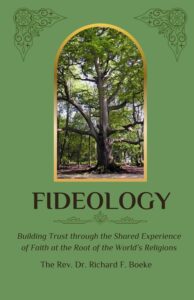 : Building Trust through the Shared Experience of Faith at the Root of the World’s Religions.
Fideology refers to “faith as trust. The word, coined by Richard, is based on the same Greek roots as fidelity, confidence, and bona fide. Richard credits his teacher, Professor Wilfred Cantwell Smith, and friend and mentor Huston Smith, along with many other faith leaders, with much of the inspiration for the subject of this book.
Fideology affirms that it is possible to build trust without the necessity of a common theology. Such trust-building between nations and religions is essential to overcome the present “clash of civilizations.” We need not just a global ethic, but the practice of a global virtue, TRUST.
Unitarian minister Richard Boeke has been a pioneer in the interfaith movement since the 1950s. Holding graduate degrees from both Yale Divinity School and Columbia University, and a Doctor of Divinity from Pacific School of Religion, he studied with some of the leading theologians of the 20th Century, from Wilfred Cantwell Smith to Huston Smith–the latter with which he enjoyed a long friendship. Fate smiled upon his life journey to sow seeds of peace and experience a sense of oneness, leading him to real-life encounters with everyone from Pope Pius XII, to Jomo Kenyatta, Malcolm X, Erik Erickson, Charles Schultz, and Nancy Pelosi, as well as lasting friendships with Shinto priests, Muslim imams, and Sikhs. He was instrumental in furthering the mission of the International Association for Religious Freedom (IARF), and received the 2018 IARF Distinguished Service Award.
The book is part personal faith journey, part autobiography, part resources for liturgical services, and part scholarly discourse. This compilation is a documentation of a remarkable life’s work, weaving the personal the political, and the spiritual into a tapestry-like tribute to world peace. It provides a valuable record of the religious and secular discourse on many IARF themes throughout its history, and captures crucial moments in the development of interfaith work in the past century.
The book is available as an e-book (Kindle) or paperback on Amazon.
Commemorating the Anniversary of Professor Van Holk’s Courageous Stance
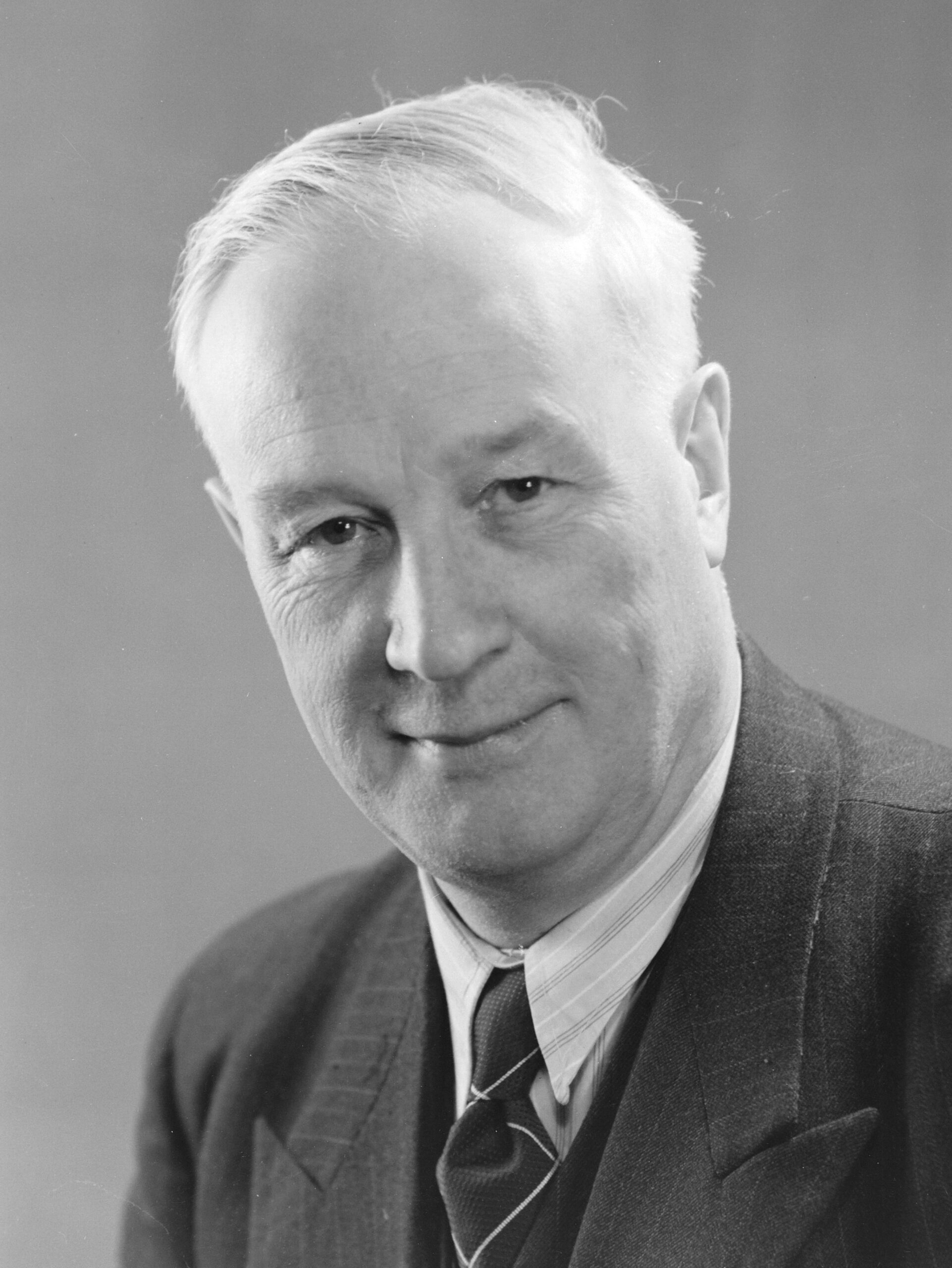 On its 83rd anniversary, we remember Professor L. van Holk’s (1893-1982) historic protest speech against the persecution of Jews at Leiden University. The International Association for Religious Freedom (IARF) commemorates Van Holk not only as a Remonstrant theologian and a revered scholar but also as its dedicated secretary, deeply committed to religious freedom and human dignity.
The Netherlands has always played a pivotal role in the IARF, with Dutch theologians being active members since its inception in 1900. Their liberal Protestant roots, shared by the Remonstrant Church, provided fertile ground for the IARF’s principles. The Dutch contribution was significant, with the first Executive Committee comprising four Dutch members and several congresses, including the momentous 1922 Congress in Leiden, being held in the Netherlands.
Professor Van Holk, a distinguished figure at Leiden University, embodied the spirit of religious freedom and moral courage. On November 26, 1940, in response to the dismissal of Jewish colleagues by the Nazi occupiers, he delivered a poignant protest speech. His words, though not recorded at the time, were captured in the memories of those present and later documented. He stated:
Ladies and gentlemen, students,
The latest domestic policy measures against our Jewish fellow citizens have deeply shocked us all. We see these measures as a smear to the university and our people, a serious damage to education and science, and a moral and religious injustice…
It fully behooves us all to first alleviate the suffering that will now arise in many families, and to faithfully seek out our Jewish friends and acquaintances to express our high regard. Secondly, as Dutch, as university people, and above all as Christians, we must remain faithful to the principles of human value, justice, and charity, rooted in and proclaimed by both the Old and New Testaments. Remember that Christ teaches us in the Holy Scriptures (John 4:22) ‘Ye worship what ye know not: we know what we worship; for salvation is of the Jews.’ May I ask you to join me in a full minute of silence in this spirit?
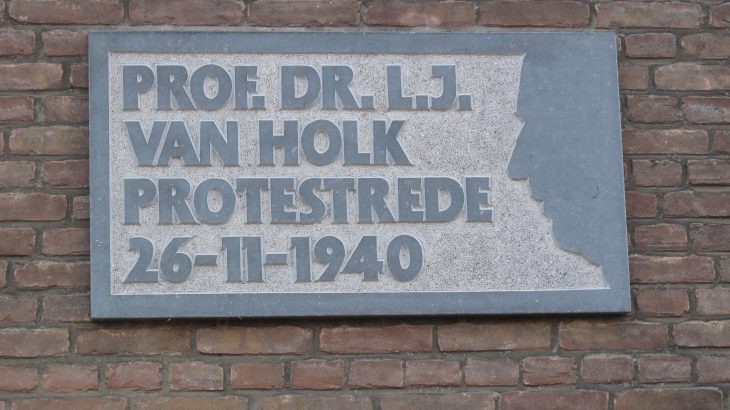 His speech transcended mere words; it was an act of defiance, a beacon of hope and solidarity. He continued his lecture by discussing the Jewish Dutch philosopher Spinoza, powerfully reinforcing his stand against the persecution of Jews.
Despite the risks, Van Holk’s actions exemplified the values central to the IARF. His subsequent arrest and internment in camps didn’t deter his spirit; he continued to inspire and educate, establishing a sort of “people’s university” within the camps.
After the war, Van Holk resumed his academic duties, serving the university and its ideals for two more decades. Among other things, he represented the Remonstrants and the IARF at the Second Vatican Council. His legacy, though less publicized than some of his contemporaries, remains a testament to the power of individual courage and the enduring principles of the IARF.
As we mark this anniversary, let us not only remember Professor Van Holk’s brave stance but also reflect on the ongoing need to uphold the values he so fiercely defended. His life and actions remind us that in times of darkness, voices of truth and compassion can shine the brightest, guiding us towards a more just and understanding world.
For our readers who speak Dutch – Prof. van Holk’s book De Boodschap van het Vrijzinnig Christendom (The Message of Liberal Christianity) can be read online here.
Festive reflections: Chanukah
In the coming year we will be publishing reflections around the time of big festivals of the many religions represented in IARF. We begin with Chanukah, the Jewish festival of light. The author of this piece is Rabbi Robert Carroll, member of the International Council, our governing body, and the Interfaith Encounter Association, one of our Middle Eastern member groups.
Jewish historical memory reflects a constant tension between the particular and universal. To give one example: The Exodus from Egypt was on one level the story of a major incident in the life of a very minor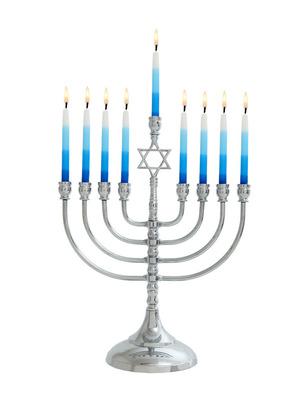 people. It can be read as nothing more than that. But the God of the Exodus is also the God of all humanity and the Exodus, in Jewish teaching, foreshadows the Redemption that God will one day bring to all peoples. For Jews, to remember the Exodus is also to work hand in hand with God to bring that day about. So too the story of Chanukah – on one level it’s only about one small nation fighting for its cultural survival. But on a deeper level it contains many messages for all of us.
The basic story is well-known from the Books of Maccabees and the historical writings of the historian Flavius Josephus:
In the 2nd century BCE Antiochus Epiphanes, king of the Seleucid (Syrian) remnant of Alexander the Great’s empire, began a campaign to forcibly Hellenize the Jews of the land of Israel. A statue of Zeus was erected in the Holy Temple in Jerusalem. Pigs were sacrificed on God’s altar, in brazen defiance of God’s command. Those who kept the Sabbath or circumcised their sons, as Biblical law requires, were executed.
Though the Seleucids had the support of the High Priest and elements of Israelite society, a rebellion quickly took root, led by a group of priests from Modi’in, Mattathias and his son Judah (known as Judah the Maccabee). Despite suffering many initial defeats their guerilla war was successful, recapturing Jerusalem within three years. The word “Chanukah” simply means “rededication” and refers to the eight days of celebration which then took place. Talmudic legend relates that although only one cruze of ritual oil had remained undefiled, it miraculously burned for eight days – hence the origin of the Jewish custom of lighting a Menorah, or 8-branched candelabrum, adding a successive candle during each night of Chanukah.
As we can now see, the Chanukah story is one of a particular people fighting for its religious and cultural self-determination. But like the story of the Exodus, it has elements that speak to all of us.
One of the greatest modern-day Jewish sages, Rabbi Abraham Isaac Kuk, taught that all peoples and cultures reflect and embody the light of God; just as God is infinite, God’s wisdom – His light – shines forth in manifold forms, and in all nations and faiths. Josephus fittingly coined the phrase “Festival of Lights” to describe Chanuka, and indeed over the centuries, the symbolism of light and flame came to be the holiday’s dominant motif. It speaks to us today in more ways than one: Do we want to bring warmth and illumination to the world, or do we want to be arsonists who burn and destroy?
The Chanukah story is almost 22 centuries old, yet it seems that in our day more than ever, the idea of freedom is at risk from those who would use the fire of faith to consume and oppress rather than to illuminate, to show compassion, or to perceive the holiness that all people as children of God have within themselves.
Ultimately, this is the question that Chanuka asks us: What kind of lights do we want to kindle in our world?
IARF Peace Commission 2013 conference publication
Print publication of papers given at the summer 2013 conference of our Peace Commission:
Religious Freedom & Responsibility For Planet and People
Freedom of Expression & Freedom of Religion and Belief: government memorandum
Human rights policy memorandum ‘Freedom of Expression and Freedom of Religion and Belief’
….details the Netherlands’ efforts to help achieve universal respect for the freedoms of expression and religion.
Equality, Freedom, and Religion: book
Introduction
1: Does Religious Freedom Matter?
2: Does Equality Trump Freedom?
3: Religious Beliefs and Institutions.
4: Equal Beliefs?
5: Is Religious Toleration Enough?
6: Freedom from the Law?
7: Belief and Practice
8: Necessary Limits to Religious Freedom
9: The Challenge of Equality
10: The Foundations of Equality and Freedom
Conclusion
In the Name of the Lord: Understanding Blasphemy Laws
Shaykh Ibrahim Mogra serves as an Imam and Scholar of Muslim theology, and appears regularly in print and on television.
In this piece, written for the Spring 2013 edition of Inter-Faith Matters, newsletter of the Edinburgh Inter Faith Association, Shaykh Mogra discusses Blasphemy Laws, a divisive topic that has seen recent protest in Edinburgh.
A number of countries around the world have blasphemy laws. Most of these countries have significant populations of religious people. Some countries like ours, although secular and liberal democracies, also have blasphemy laws. This country has deep rooted connections to Christianity and in turn the blasphemy laws cover only Christianity. Despite this, I, as a Muslim, have no problem with that what so ever. In fact, I have argued against the abolition of our blasphemy laws; especially when the argument of creating equality between religions has been used. I would rather that Christianity in this country continues to be protected by blasphemy laws than not have any such laws – if no other religion is protected then at least Christianity has some protection. Thankfully, in the UK these laws are not utilised to target us as non-Christian people. Unfortunately that is not true of other countries.
I have no problem with what kind of legislation and laws any country’s population want to have in place. Their legislature and their government decides for them. Pakistan’s blasphemy laws are not there to prevent the abuse of the Qur’an and the Messenger Muhammad (peace be upon him) but equally to protect what other religions consider sacred. However my issue is with some recent cases in which these blasphemy laws have been used, or more accurately, misused in Pakistan.
The blasphemy laws of Pakistan are increasingly used to target Christians to oppress them and carry out unacceptable injustices. Some shocking cases have seen Christians prosecuted on the basis of false allegations and false evidence and their homes attacked. Churches have been attacked and burned, something that Islam forbids even in war. One case even had an imam who planted false evidence to get a conviction. Bizarrely, this individual himself set light to the Qur’an with the intention of framing a Christian with the crime. By all means have blasphemy laws if that’s what you want but do not misuse them to target minorities. Of course one cannot condemn a whole nation for the acts of an aberrant individual, but even one case such as this is one too many. It is a disservice to the religion of Islam and to reputation of Pakistan – a nation which declares itself to be an Islamic state.
How can it be morally right to be prepared to frame charges against the innocent and then claim to be acting in the interests of Islam? Salman Taseer – the governor of Punjab – was murdered by his own bodyguard in January 2011 because of his campaign against the blasphemy law. Is taking a life for such a reason ever justifiable in Islam? Clearly not. The letter of Islam seems to have become more important than its spirit.
It was not always like this. This country has had a much respected Christian Chief Justice – Robert Cornelius – in the 1960s and its air force was staffed with Christians who have risen to highest ranks, many of whom are legends following exploits in the 1965 war. Missionary schools continue to thrive and even within the last decade, in spite of the turmoil, an acting Chief Justice belonged to the nation’s Hindu minority.
Now how much blasphemy against Islam are we Muslims guilty of every day? How many times a day do we neglect the teachings of the Qur’an? Is that not more serious than a non-Muslim desecrating the Qur’an? Since when has it been more important to protect the pages on which the Qur’an is printed than practicing the teachings contained within those pages? How many complete copies of the Qur’an are burned each time in sectarian attacks on mosques? It seems to me that Muslim society in many parts of the world is in a fractured state of mind and is in need of deep self-criticism so that some healing can begin. Some Muslims have demonstrated violently against the burning of the Qur’an yet have never stopped to think that their behaviour is forbidden by the very book whose burning has so angered them. Are the pages more important than the lives that have been lost in the rioting? A pastor burns the Qur’an and thousands of miles away Muslims are dying on the streets in protest. Someone’s father, son, brother, a family bread winner being killed because they believe a blasphemous and sacrilegious crime has been committed – what of their own actions? What of the dependents they leave behind? Is the paper on which scripture is printed more valuable than human life?